Tag Archives: Nehru

The Status of Punjabi after 1947

Reorg of Punjab 1966
Reorganisation of East Punjab after 1966. © Pippa Virdee 

Punjabi is an Indo-European (or Aryan) language and is the native language of Punjab, a land divided between India and Pakistan. It has approximately 100 million speakers, largely in north India and Pakistan but it is also widely spoken amongst the Punjabi diaspora around the world.

The Partition in 1947 not only divided the province of Punjab but it also divided the language, and this has been the source of much tension in post-47 in both India and Pakistan. Being a phonetic language, Punjabi was/is written largely in three different scripts: the Persian script (sometimes referred as Shahmukhi) is used mostly in Pakistan; Sikhs use the Gurmukhi script and less common is the Devanagari script which is associated with Hindu Punjabis. Punjabi interestingly was never given official state patronage; this is true for the Mughal period, Ranjit Singh’s reign and also under the British. The preferred state or official language was Persian and Urdu. Farina Mir argues that part of the problem under the British colonial period was the plurality of the scripts used to write Punjabi; all three scripts (Indo-Persian, Gurmukhi, and Devanagari) were used but none of them dominated (Farina Mir, The Social Space of Language: Vernacular Culture in British Colonial Punjab, London: University of California Press, 2010).

It is not until after 1947 that Punjabi begins to get official state patronage, at least in India that is. It is officially recognised as one of the 22 official state languages in India. In West Punjab (Pakistan), Punjabi is confined largely to an informal language with no official status despite being spoken by the majority of people. And even though the number of Punjabi speakers in Pakistan has been declining over the decades, Punjabi is still the most widely spoken language. East Punjab after the Partition in 1947 was a fragmented province of its former self. It consisted of territory that was an amalgamation of divided Punjab, Patiala and East Punjab States Union (the former princely states), and the Hill States to the north of the province. By the 1950s, a Punjabi Suba (province) movement had started which hoped to create a Punjabi-language state, taking inspiration from the linguistic reorganisation taking place in other parts of India. This is eventually achieved in 1966, with the Punjab Reorganisation Act that created a new state of Haryana and also transferred territory (such as the Hill States) to Himachal Pradesh.

Leading up to this though was of course an enormous amount of discussion and political agitation, so, it is interesting to see some of the initial correspondence between Bhim Sen Sachar, Chief Minister of East Punjab and Jawaharlal Nehru, the Prime Minister of India and Nehru to Vallabhbhai Patel, the Deputy Prime Minister on the question of introducing Punjabi as the medium of instruction in schools. 

BS Sachar to Nehru, 9 July 1949 (JN SG 26-I):

‘In my letter [of] 13 May, I referred to the two outstanding demands of the Sikhs, namely (I) representation in services, and (II) Punjabi in Gurmukhi script as the medium of instruction and court language…No compromise on them was considered possible…since then, I have had informal discussions on the language controversy with the Governor, my colleagues, various leaders of public opinion and the general view of government is as below. Before the Partition, Ambala division, excepting Ropar and Kharar tehsils of the Ambala district, spoke Hindustani, while Punjabi was spoken in the rest of the Punjab, barring Kangra district. After it, nearly a million displaced persons from the West Punjab moved into the Ambala division and, therefore, it cannot now be said that all the people [there] speak Hindustani. Nevertheless, the distinction which held good before exists even now, to a lesser a degree. With the gradual elimination of English and Urdu from the province, the question [of] their [replacement] has assumed great importance…the present controversy is not over the language [Punjabi] spoken but the script [Devanagari or Gurmukhi] in which it should be written…The unanimous demand of the Sikhs is that Punjabi in Gurmukhi should be adopted all over the province as medium of instruction, as the official and court language. This would not be acceptable to Hindus in general and especially to the Hindustani-speaking region of the Ambala division and Kangra district of the Jullundur division. It will be unfair to force it on them…The best solution would be to recognise the province as consisting of two distinct linguistic regions, Punjabi and non-Punjabi. Government would agree to the following: (i) Punjabi in Gurmukhi should be the medium of instruction in the Punjabi-speaking region of the province, up to and including the 5th class; (ii) In the Punjabi-speaking region, Hindi should be compulsorily taught as a second language from the 4th class; (iii) Reversal of the same arrangement in the non-Punjabi region; (iv) English and Urdu should for the present continue as the official and court languages. There are differences of opinion on two points: (i) whether girls’ schools should be allowed the option; (ii) whether the existing boundaries of the Jullundur and Ambala divisions should be regarded as correctly [representative]. The Sikhs would not agree to distinguish girls’ schools from boys’ schools…whereas Hindus should be in favour of it…The Sikhs would include the whole of Jullundur division and the whole of Ambala district in the Punjabi-speaking region whereas Hindus would like to exclude Kangra district and three tehsils, Ambala, Naraingarh and Jagadhari, of the Ambala district from it…No agreement on [these] appears to be possible…would be grateful [for your] decision on them’.

Nehru to Patel, 22 July 1949 (JN SG 26-II):

‘Giani Kartar Singh came to see me this morning…on the language issue in East Punjab…I told him that there is no point in our considering the [matter] unless we knew that the parties concerned would abide by our decision…He said that an agreement had been arrived at between the Hindu and Sikh Ministers and the Governor agreed…(1) Punjabi in Gurmukhi, (2) two linguistic areas, (3) Punjabi compulsory from 1st-5th standard in Punjabi area, Hindi vice-versa, (4) from 4th standard upwards, the other language should be compulsory…There was no agreement on the delimitation of linguistic areas. More especially, the Pahari Ilaqa – Sikhs considered as Punjabi areas…another point was Hindus wanted option to be exercised in regard to languages, the Sikhs did not…I made it quite clear that our general policy was against compulsion in regard to choice of the mother-tongue…I further pointed that Bengali, Marathi, Gujarati were well-developed languages…He confessed that Punjabi was not suited for higher education [but] should be used up to the Matriculation… [But] that there was a great deal of feeling behind the Sikh demand…I think some facts have to be obtained about the linguistic divisions of the province but the issue is quite clear…If the Punjabis want two linguistic divisions, they might have them but I just do not see how we can do away with the option of a parent to decide which shall be the mother-tongue…’

These two letters provide a glimpse into the discussions taking place in 1949. However, the two letters from 1951 provide a different lens, especially the DAV College correspondence which is clear that the medium of instruction should be Hindi, despite the considerations of the State Language Policy. 

Jullundur City, 3 May 1951, DAV College Managing Committee (Bal Raj, President) To the managers of all the schools in the Punjab under the control of the DAV College Managing Committee (JN SG 92 II):

Please refer to the Punjab Education Department on the State Language Policy in the schools: it is [an] ill-conceived policy…I am to convey to you in very unmistakable language the views of the DAV College Managing Committee vis-a-vis this policy. Our schools should go ahead in their work undeterred by considerations of State Language Policy. To us, teaching of Hindi in our schools is a matter of supreme importance and on this point, there is to be no compromise. We would much rather let our schools face the consequences than submit to any direction from the Education Department, that weakens the position of Hindi in them. In case there is any trouble on this score from Education Department, the schools affected can rely on our fullest support, and we shall see to it that they do not suffer.

In our schools, Hindi will be the medium of instruction for all classes and Punjab will start as optional vernacular from V in place of IV as laid down by the Education Department because we consider its teaching in IV class too early. It should be clearly understood that Punjabi from V class will be optional i.e. only for those students, who would like to learn it. Provision should, however, be made for teaching in Punjabi medium for students coming from outside, and effort should be made to switch them on to Hindi medium as early as possible.

It is just possible that the Local Bodies’ Schools or Khalsa Schools might not make provisions for teaching in Hindi medium on grounds of non-availability of suitable Hindi teaching personnel or lack of demand for Hindi medium on part of students or that Hindi students might be persuaded to receive instruction in Punjabi rather than in Hindi. Proper vigilance will have to be exercised over these schools, and in case they do not implement the state policy, they should be brought to our notice to be reported to the Education Department.

A strong public opinion will have to be created in your area in favour of Hindi, so that students wishing to be taught in Hindi medium declare fearlessly their desire to be taught in this medium, undeterred by the local influence or pressure from teachers, not well disposed towards this medium.

Amritsar, 21 July 1951, The Shiromani Gurdwara Parbanbhak Committee (Kartar Singh, Publicity Secretary) To Prime Minister Jawaharlal Nehru JN SG 92 (II)

Enclose herewith a copy of the [above] letter…A perusal of this document will reveal to you which way the wind blows in those quarters. On the one hand, the Hindu schools are exhorted to go ahead in their work of shutting their doors to Panjabi “undeterred by considerations of State Language Policy” and not to “submit to any direction from the Education Department”. On the other hand, the Local Bodies’ Schools and the Khalsa Schools are to be compelled to make all arrangements for the teaching of Hindi in accordance with the State Language Policy. The attitude…is not only one of flagrant defiance of the government’s orders, but is also calculated to accentuate communal bitterness and vitiate the general atmosphere in the province. Due notice be taken of such anti-national and subversive attitude and activity as is being exhibited by these people.
India News Review 82

Produced by the Films Division, Ministry of Information & Broadcasting, these short news reviews by the Government of India give us a glimpse of old India. Produced one-year after Partition/Independence, the review shows Pandit Nehru in Karachi, messages of inter-communal harmony, tolerance and equality at the Urs of Ajmer Sharif Dargah, elephant diplomacy in the US, dance, theatre and hockey matches.


Bhakra Nangal Dam

Located in Bilaspur, Himachal Pradesh, Bhakra Dam is one of the largest dams in India. Construction of the dam started soon after independence in 1948 and it was opened in 1963. Agreement for the project had been signed before independence in 1944 by the Punjab Revenue Minister, Sir Chhotu Ram and the Raja of Bilaspur. However, the idea behind the project was suggested around 1910 by the British. My father worked on the dam during its construction and lived in Nangal for ten years. The dam is unequivocally the dream of modern India that Jawaharlal Nehru had imagined.

This 20 minute documentary is made by Films Division which was a production house for the Ministry of Information and Broadcasting, Government of India. Established in 1948, it regularly made documentary films.

70 years ago: extracts of the Sunderlal Report, Hyderabad 1948.

Nizam Patel
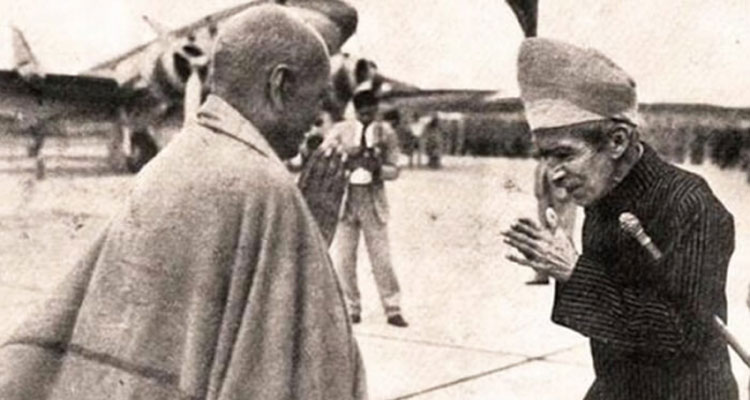
The Nizam of Hyderabad receiving Sardar Patel after Operation Polo

sunderlal
Extract from the Sunderlal Report

Operation Polo is the code name of Hyderabad “police action” in September 1948. On Day 5 of this operation, 17 September 1948, the Nizam announced a ceasefire which ended the armed action. The operation led to massive communal violence and violations by the police. This prompted Jawaharlal Nehru to appoint a commission, led by Pandit Sunderlal, to investigate the situation. The findings of the report remained buried until 2013 when it was finally released and was accessible from Nehru Memorial Museum and Library (New Delhi).

Subject File No. 2. Sunderlal Papers, NMML.

We were asked by the Government of India to proceed to Hyderabad state on a goodwill mission and beg to submit our report. The delegation consisting of Pandit Sunderlal, Qazi Abdul Ghaffar and Maulana Abdulla Misri arrived in Hyderabad on 19th November and left for Delhi on 21st December 1948. During this period, we toured through 9 out of the 16 districts of the state, visiting 7 district headquarters, 21 towns and 23 important villages. In addition, we met over 500 people from 109 villages which we had not visited. Further, 31 public meetings and 27 private gatherings…were addressed by the members of the Mission.

At all these meetings, the main problem discussed was that of the creation and maintenance of cordial relations between the communities. Appeals were made to the people to forget the past and to work unremittingly for the establishment of peace and harmony amongst themselves….special emphasis was laid on the objective which was the established of a secular government…Ours was not a commission of investigation or enquiry into events proceeding of following the police action…All the same we feel it our duty to bring to your notice what we saw and gathered in our two weeks.

Killing and Looting

Hyderabad State has 16 districts comprising nearly 22,000 villages. Out of them only three districts remained practically free of communal trouble which affected the state during first the activities the Razakars and then during the reprisals that followed the collapse of that organisation. In another four districts the trouble had been more serious but nothing like the havoc that overtook the remaining eight. Out of these again the worst sufferers have been the districts of Osmanabad, Gulbarga, Bidar, and Nanded, in which four the number of people killed during and after the police action was not less than 18,000. In the other four districts viz Aurangabad, Bir, Nalgonda and Medak, those who lost their lives numbered at least 5,000. We can say at a very conservative estimate that in the whole state at least 27,000 to 40,000 people lost their lives during and after the police action. It is a significant fact that the four worst affected districts had been the main strongholds of Razakars and the people of these districts had been the worst sufferers at the hands of the Razakars. In the town of Latur, the home of Qasim Razvi, which had been a big business centre, with rich Kuchchi Muslim merchants, the killing continued for over 20 days. Out of a population of about 10,000 Muslims there, we found barely 3,000 still in the town.

Other Crimes

Almost everywhere, communal frenzy did not exhaust itself in murder, in which at some places even women and children were not spared. Rape, abduction, loot, arson, desecration of mosques, forcible conversions, seizure of houses and land, followed or accompanied the killing. The sufferers were Muslims who formed a hopeless minority in rural areas. The perpetrators of these atrocities were not limited to those who had suffered at the hands of Razakars, not to the non-Muslims of Hyderabad State. These latter were aided and abetted by individuals and bands of people, with and without arms, from across the borders, who had infiltrated through in the wake of the Indian army. We found definite indications that a numbers armed and trained men belonging to a well-known Hindu communal organisation from Sholapur and other Indian towns as also some local and outside communists participated in these riots and in some areas actually led the rioters.

The Army and the Police

Duty also compels us to add that we had absolutely unimpeachable and independent evidence to the effect that there were instances in which men belonging to the Indian army and also the local police took part in looting and even other crimes. During our tour we gathered, at not a few places, that soldiers encouraged, persuaded and in a few cases even compelled the Hindu mob to loot Muslim shops and houses. At one district town, the present Hindu head of the administration told us that there was a general loot of Muslim shops by the military…Complaints of molestation and abduction of girls, against Sikh soldiers particularly, were by no means rare…unfortunately there was a certain element in the army that was not free from communal feelings probably because some of them could not forget the atrocities committed elsewhere on their kith and kin. Before concluding this summary of atrocities committed we would like to affirm that we have not made any of the above statements lightly or without realising to the full our responsibility in making them…we are prepared to place before you all the relevant material collected.

The Razakar organisation, had in the Muslim mind stood as an effective barrier against the establishment of a Hindu Raj, the latter being synonymous to the average Hyderabadi Muslim with the demand by state Congress of a responsible government as it would in effect be based on the will of the Hindu majority. Barring a microscopic minority, the Muslim masses generally were unable to realise that their sufferings were the inevitable reprisals of the Hindu masses to the atrocities committed on the latter only a few weeks before by the Razakars, who had the active sympathy if not the actual support of practically every single Muslim in Hyderabad from the Nizam downwards. There were some exception of course, but it is doubtful if they number more than a few dozen. Such of them as dared to publicly oppose the Razakars’ activities paid heavily for their temerity. Even those Muslims who traced their happenings to their original cause, the Razakars, considered the police action as their immediate cause for which they held the Indian government responsible. Like the Razakars, the perpetrators of these crimes against the Muslim actively encouraged and nurtured the belief that they had the backing of the administration of the day.

Colour was lent to this belief by some actions and omissions of such people in authority as had been unable to purge their minds of the communal virus. The doubts and suspicions as regards the good faith and the absolute impartiality of the Indian government as between the Hindus and the Muslims, however baseless, were thus not the unnatural outcome of the indiscriminate sufferings of hundreds of thousands of Muslims in which tens of thousands lost their lives…in this campaign of retaliation at least a hundred were made to suffer for the sins of each guilty individual. Unfortunately, the conduct of some of the congressmen added to the distrust of the Muslim population…it was reported to us during our tour that at some places, persons claiming to be congressmen took the law in their own hands and adopted various devices of extracting money from panicky Muslims…such persons were going about approaching Muslims who had not left their homes or those who had returned extracting money from them against promises of so-called protection…Congressmen had auctioned cultivatable land left behind by Muslims on condition that half the crops were to be handed over to the Congress.

Doubts and suspicions in the minds of the literate Muslims were aggravated by yet another factor, namely the complaints of those who had been in state service before the police action and had lost their jobs. We have received a long list of names of persons dismissed, degraded, suspended or otherwise penalised in various departments…we are quite prepared to believe that some of these were men who could not be allowed to continue in the best interest of the administration but we have reasons to believe that a large number have suffered and are suffering for no fault of theirs. There may be cases of mere suspicion or false accusation. In fact, we have incontrovertible evidence of the innocence of some of these men. We are sure these men can be depended upon for their loyalty to the new regime. The fact also remains that these readjustments have landed a large number of Muslims families in considerable difficulties…the fact is that bitter experience has brought home to the Hyderabadi Muslims the dire consequences of communalism. Naturally they now want to live and let live. We believe that they would be perfectly happy and contented if they can be taken out of the present atmosphere of distrust and frustration.

From the archives: 2 letters – Patel to Nehru

Nehru & Patel

62 (II), Patel to Nehru, 7 November 1950:

My Dear Jawaharlal, [in hand-writing]

I am most grateful to you for your affectionate greetings and good wishes on my birthday and for the very kind terms in which you have conveyed your message to the public meeting at Ahmedabad. It is my earnest and heartfelt prayer that I continue to serve my country up to the very end and that I live long enough to see it emerge happily out of the critical period through which it is passing. Whether God will answer my prayer is in the lap of future, but your affection and leadership sustain my faith in it and your appreciation gives me strength and support for which I am deeply obliged.

With love,

Yours Vallabhbhai Patel [in hand-writing]


63 (II), Patel to Nehru, 14 November 1950: 

[Entirely handwritten]

My Dear Jawaharlal,

My affectionate greetings on your birthday. Relations between us transcend formalities and I need hardly say anything more than this: it is my fervent and heartfelt prayer that you may live long and well to lead the country through all difficulties and establish in it an era of peace, happiness and prosperity. I so much wanted to come to your place since this morning but I have been feeling out of sorts since yesterday and I could not do so.

Yours Vallabhbhai