
(c) copyright 2017 Pippa Virdee

(c) copyright 2017 Pippa Virdee

(c) copyright 2017 Pippa Virdee

(c) copyright 2017 Pippa Virdee

(c) copyright 2017 Pippa Virdee

(c) copyright 2017 Pippa Virdee

(c) copyright 2017 Pippa Virdee
All photos from Banksy’s temporary “bemusement” park installation in Weston-Super-Mare, 2015.
It appears that the new political landscape across the globe is colliding with old ideas of liberty, freedom and basic human rights. This is particularly palpable in the movement of people; what is heart wrenching is the curtailment of that freedom to flee from persecution, have the chance to live your life without fear and to seek sanctuary. Those who are forced to flee do not do this out of choice; they are forced to do so for a reason. Basic humanity means under the circumstance most of us would readily help those in need. But in a “globalised” world, it seems that goods and trade have more freedom to travel the world than humans. We want the benefits of living in an integrated global community but actually in reality we cannot cope with the consequences, which also bring cultures and people together. It brings about change and impacts local communities and threatens the very notions of what make a nation-state.
A few snippets that appeared in the last 12 hours to highlight the uncertainty of moving towards hard borders.
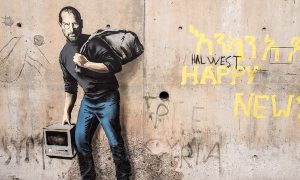
Banksy uses Steve Jobs to highlight the refugee crisis. Jobs was the son of a Syrian migrant who came to America after the Second World War and Apple is number one brand that has connected people across borders with the revolutionary smart phones.
https://www.theguardian.com/artanddesign/2015/dec/11/banksy-uses-steve-jobs-artwork-to-highlight-refugee-crisis
Precarious Trajectories: Understanding the human cost of the migrant crisis in the central Mediterranean. The film by Dr Simon Parker is set on location in Libya, Italy and Greece during 2015-2016, at the height of the Mediterranean migration crisis. It focuses on the perilous sea crossings that hundreds of thousands of refugees have undertaken in recent years in order to arrive at what they hope will be the safer shores of Europe through the eyes of Ruha from Syria and Ahmed from Somalia. See project website: https://precarioustrajectories.wordpress.com/
Equally compelling was the 3-part documentary by the BBC, Exodus. This is a compelling and powerful journey across the deadly Mediterranean Sea. Read a review of it in the Guardian: https://www.theguardian.com/tv-and-radio/2016/jul/12/exodus-our-journey-europe-review-bbc-documentary-bbc
Link to the programme: http://www.bbc.co.uk/programmes/b07ky6ft
Pakistan’s Stepchildren – an in-depth and powerful analysis of the plight of millions of Afghans who sought sanctuary in Pakistan, but they remain “refugees” despite the vast majority who were born in Pakistan.
Citizenship for Afghan refugees and migrants, or their descendants has long been a contentious issue. According to the Pakistan Citizenship Act 1951, anyone born in Pakistan is a national by birth, except those whose parents are ‘aliens’ — someone “who is not citizen of Pakistan”.
Furthermore, Pakistan is not a signatory to the 1951 Convention Relating to the Status of Refugees, nor to its 1967 additional protocol. As such, according to the Pakistani government, it is not obligated to “facilitate the assimilation and naturalisation of refugees.”
Read the full article: http://www.dawn.com/in-depth/afghan-refugees/
Prisoner of war
‘The Chinese man trapped in India for half a century’ is the tragic story of Wang Qi who was a Chinese army surveyor in 1963 following the Sino-Indian war; but he ended up on the wrong side of the border by accident. The story highlights the plight of Wang Qi, who is now settled in India and has a family but he does not have any legal rights in India. He is caught up in the quagmire of legalities surrounding his rights and citizenship. [Read full article: http://www.bbc.co.uk/news/world-asia-india-38715056%5D The story is reminiscent of the many people who have been trapped for months and years on the wrong side of the border between the futile politics of India and Pakistan. Though more worrying is the current trend, in not just Trump’s America but in Modi’s India. India is also making discrimination against Muslims a key ingredient of its refugee and immigration policy. The following is a small extract from the article, ‘Indians Angry at Trump’s Ban on Muslim Refugees should look at what Modi is doing,’ highlights the current mood of India’s current government:
The Citizenship (Amendment) Bill proposes a redefinition of “illegal immigrant”:
“Provided that persons belonging to minority communities, namely, Hindus, Sikhs, Buddhists, Jains, Parsis and Christians from Afghanistan, Bangladesh and Pakistan, who have been exempted by the Central Government by or under clause (c) of sub-section (2) of section 3 of the Passport (Entry into India) Act, 1920 or from the application of the provisions of the Foreigners Act, 1946 or any order made there under, shall not be treated as illegal migrants for the purposes of this Act.”
This effectively means that persons from minority religious communities from our neighbouring Muslim majority countries shall not be considered as illegal migrants and subjected to prosecution.
Trump’s executive order cleverly does not use the word ‘Muslim’ in the ban it imposes on those seeking to enter the US. India’s Citizenship (Amendment) Bill, on the other hand, by identifying explicitly and arbitrarily the intended beneficiaries of its refugee policy, directly excludes Muslim communities which may or do face persecution in India’s Muslim-majority neighbours (eg. Ahmadis, Hazaras, Shias) as well as Muslims who are in a minority elsewhere, like Myanmar or China.
Read the full article:https://thewire.in/104236/indians-angry-trumps-new-travel-ban-muslims-look-modi/







 BAGICHA