Tag Archives: memory

Dhurries: the Woven Threads of Memory


Earlier this year, I visited Ludhiana, Punjab, a place I try to make time for whenever I have an opportunity or a slight reason. As is often the case, no visit feels complete without visiting Mau Sahib, my father’s ancestral village near Phillaur. Although no immediate family members live there anymore, Mau Sahib holds a special place in our hearts, especially for my sister. She remembers it with warmth and nostalgia, as a place of her childhood.

Our visits have become something of a ritual—paying respects at the historic Gurudwara, partaking in the langar, and then visiting the nearby Sufi shrine. It’s a quiet pilgrimage that connects us with both our heritage and the memory of those who came before us.

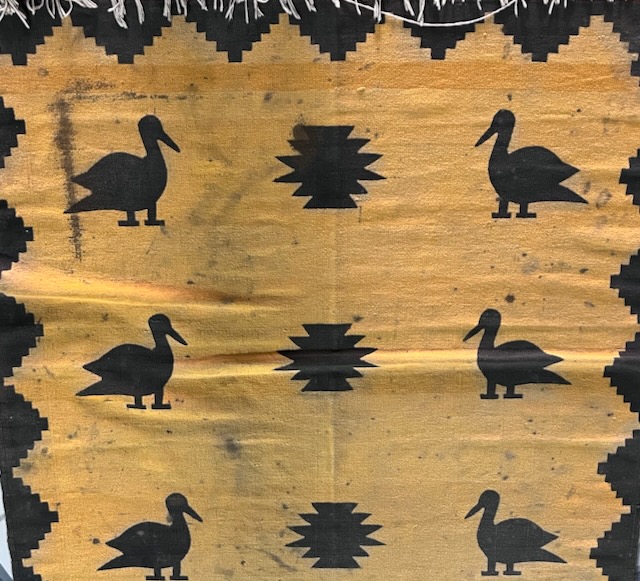
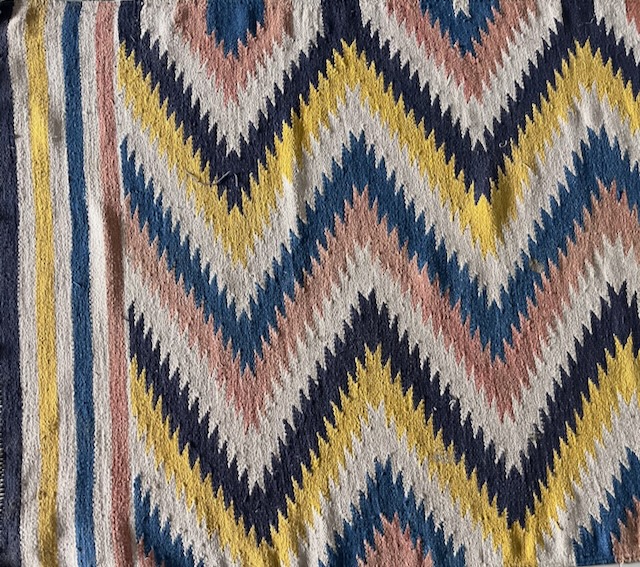
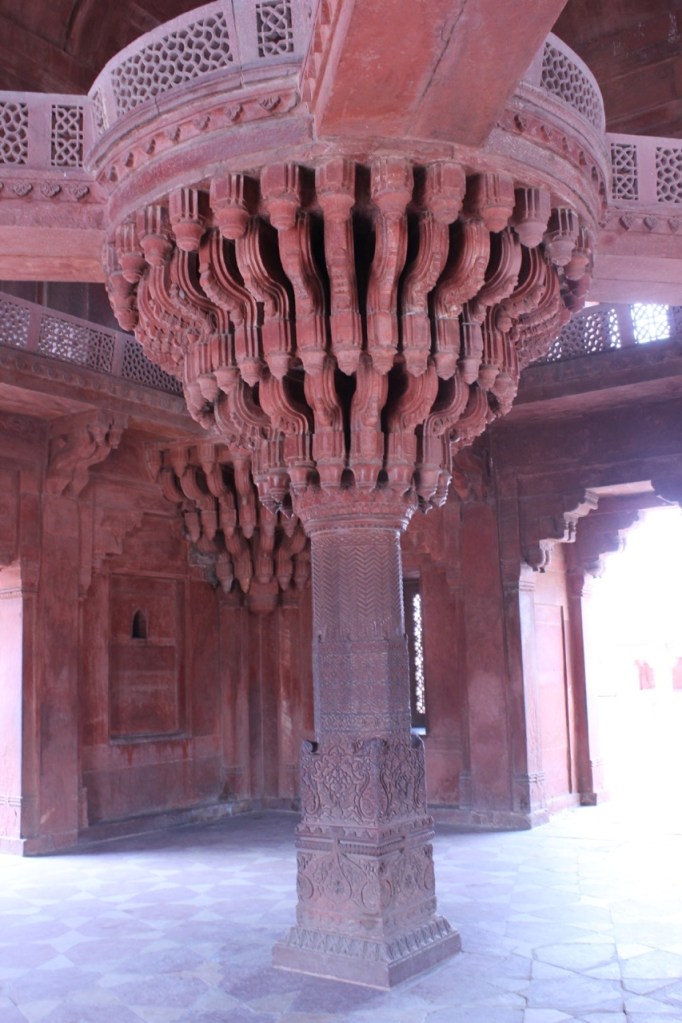
During this visit, the Gurdwara was undergoing renovations. Amid the scaffolding and signs of change, we made our way to the basement area; a large, echoing hall that was mostly empty and only partially completed. The Guru Granth Sahib rested there with solemn grace in the middle of the hall, surrounded by an assortment of vibrant dhurries scattered across the floor. The scene was simple yet striking. I couldn’t help but take photos of the colourful, handwoven patterns.

In that quiet moment, surrounded by these beautiful pieces of craft, I was instantly transported to my study back home. There, in the middle of my room, lies a black-and-white dhurrie—a treasured piece handmade by my mother. The rug, is now a relic and a reminder of her remarkable talent, one of many handcrafted creations she lovingly produced over the years.
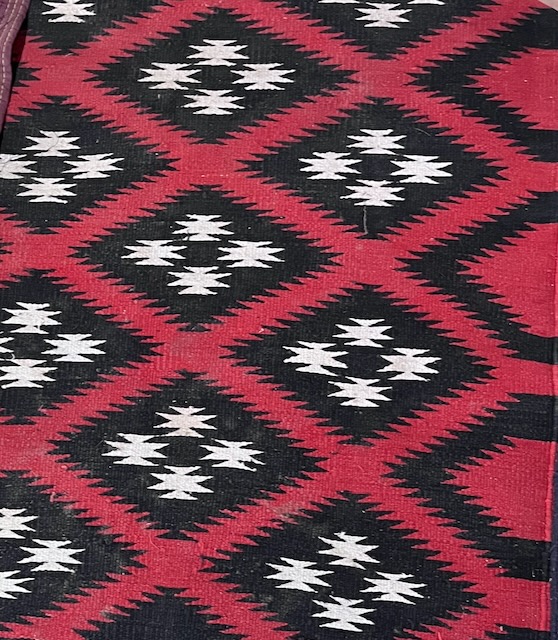
At the time, I must admit, I didn’t fully appreciate the time, effort, and skill that went into these works of art. But today, that dhurrie is a cherished heirloom. It reminds me not only of her hands at work but also of the deeper cultural traditions that she carried within her.

For those unfamiliar, a dhurrie is a handwoven rug or flat-weave carpet, traditionally made in India and Pakistan. They were mostly made from cotton or jute and thus accessible for all. Dhurries are often lighter, reversible, more versatile and useful for everyday use; they can be used as floor coverings, bedding, or even wall hangings. In rural Punjabi households, you often find these dhurries spread out for meals, prayers, weddings, and community gatherings, making them silent witnesses to the everyday rituals and rhythms of life.

What makes them so striking are the geometric patterns, vivid stripes, or sometimes floral designs, each inspired by the region and culture from which they originate. The bold designs are usually in bright colours such as red, blue, yellow, as well as using black and white.
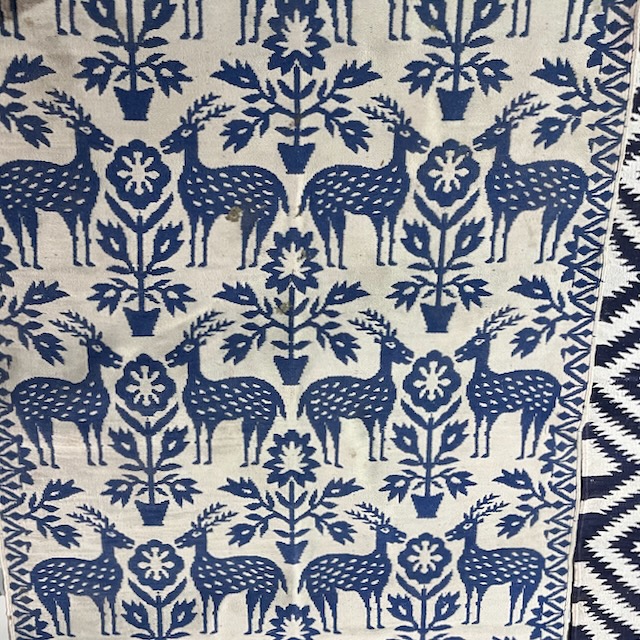
Historically, dhurrie weaving was a thriving cottage industry in rural India. But it was also something more intimate and symbolic, especially for women. Young brides-to-be were often taught the art from a young age. Many dhurries formed part of a woman’s dowry, and their patterns weren’t just decorative. They carried stories—symbols of personal, familial, and spiritual identity, passed down through generations, like a family recipe.

In many villages, it was common to see women sitting on charpoys under the shade, rhythmically working on pit looms while chatting about daily life. Though machine-made textiles are now more common, the tradition of handwoven dhurries survives in some artisan clusters, supported by cultural preservation efforts and a renewed appreciation for handmade goods.

As I stood in that hall, looking at the scattered dhurries beneath my feet, I realised how deeply woven this craft is into the fabric of our collective memory. These are not just utilitarian objects; they are vessels of heritage, art, and emotion. Each thread, each motif, tells a story.

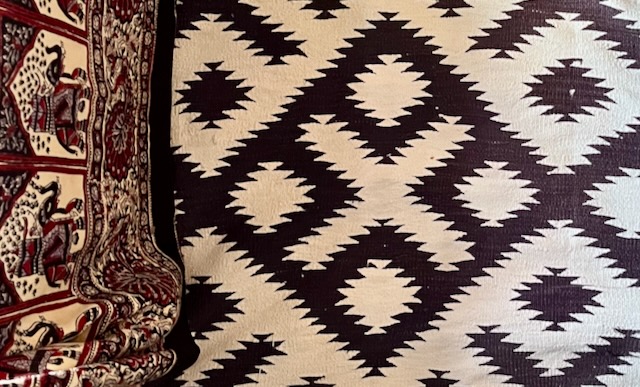
In many ways, my mother’s dhurrie now tells mine. And you may well be wondering about the one I have? This was prized away from my sister my years ago. She had a number of them, given to her when she got married, and I convinced her to part with one which then travelled with me to England!

Remembering Partition in the Punjab – podcast

Earlier in the summer I recorded a podcast with Realms of Memory. There are two episodes for those interested in understanding more about the history of Partition, especially how it impacted the Punjab. The talk was based on my book, ‘From the Ashes of 1947: Reimagining Partition’ published by Cambridge University Press (2018). In the podcast I also discuss some of the recent changes that have taken place in the study in Partition.

You can listen to the podcast via most streaming sites, or via Realms of Memory

Remembering Partition in the Punjab: Part 1

Remembering Partition in the Punjab: Part 2

Kitabe aur ta.aliim

“Of all the social sciences, it is history which rouses the greatest interest in the minds of the politicians. There are various reasons for this. It has always had an inventive and purposive use. The line between history and mythology is thought to be thin; the past can be used to lend legitimacy to any aspect of the present….”

R. Mahalakshmi, ‘Communalising history textbooks’

Resource list:

  • Extract published from ‘RSS and School Education’ from the book RSS, School Texts and the Murder of Mahatma Gandhi, written by Aditya Mukherjee, Mridula Mukherjee and Sucheta Mahajan, 2008. Published by Indian History Collective.
  • R. Mahalakshmi, ‘Communalising history textbooks’ Frontline, 2 August 2021
  • Sylvie Guichard. The Construction of History and Nationalism in India. Textbooks, Controversies and Politics. London / New York: Routledge, 2010.
  • Kusha Anand & Marie Lall (2022) The debate between secularism and Hindu nationalism – how India’s textbooks have become the government’s medium for political communication, India Review, 21:1, 77-107, DOI: 10.1080/14736489.2021.2018203
  • Neeladri Bhattacharya, ‘Teaching History in Schools: The Politics of Textbooks in India.’ History Workshop Journal, no. 67 (2009): 99–110. http://www.jstor.org/stable/40646212.
  • Romila Thapar, “The History Debate and School Textbooks in India: A Personal Memoir.” History Workshop Journal, no. 67 (2009): 87–98. http://www.jstor.org/stable/40646211.
  • Sanjay Joshi, Contesting histories and nationalist geographies: A comparison of school textbooks in India and Pakistan. South Asian History and Culture. 1. (2010) 357-377. 10.1080/19472498.2010.485379.
  • Yuji Kuronuma, ‘Hindu nationalism creeping into Indian textbooks’ Asia Nikkei, 25 June 2016.
  • Alex Traub, ‘India’s Dangerous New Curriculum’ The New York Review, 6 December 2018
  • S. S. Dikshit, Nationalism and Indian Education, Sterling Publishers, 1966.
  • Raksha Kumar, ‘Hindu right rewriting Indian textbooks’ Al Jazeera, 4 Nov 2014.
  • Eviane Leidig ‘Rewriting history: The ongoing controversy over textbooks in India’ LSE Blogs 1 June 2016.
  • Aminah Mohammad-Arif, “Textbooks, nationalism and history writing in India and Pakistan.” In Veronique Benei (ed) Manufacturing Citizenship, pp. 143-169. Routledge, 2007.
  • Murali Krishnan, ‘Is the BJP altering textbooks to promote Hindu nationalism?’ DW 25 May 2022.
  • Seema Chishti, ‘Rewriting India’s History Through School Textbooks’ New Lines Magazine, 9 March 2023.
  • Kamala Visweswaran; Michael Witzel; Nandini Manjrekar; Dipta Bhog; Uma Chakravarti, “The Hindutva View of History: Rewriting Textbooks in India and the United States,” Georgetown Journal of International Affairs 10, no. 1 (Winter/Spring 2009): 101-112.
  • Naseem, Mohamed Ayaz, Ratna Ghosh, James McGill, and William C. Mcdonald. “Construction of the ‘other’in history textbooks in India and Pakistan.” In Interculturalism, society and education, pp. 37-44. Brill, 2010. DOI: https://doi.org/10.1163/9789460912498_004
  • Sridhar, M., and Sunita Mishra, eds. Language Policy and Education in India: Documents, contexts and debates. Routledge, 2016.
  • Krishan Kumar, Political agenda of education: A study of colonialist and nationalist ideas. SAGE Publications India, 2005.
  • Sanjay Seth. “Rewriting histories of nationalism: The politics of “moderate nationalism” in India, 1870–1905.” The American Historical Review 104, no. 1 (1999): 95-116. https://doi.org/10.2307/2650182
  • Carey A Watt. “Education for National Efficiency: Constructive Nationalism in North India, 1909–1916.” Modern Asian Studies 31, no. 2 (1997): 339-374. DOI: https://doi.org/10.1017/S0026749X00014335
  • Lars Tore Flåten, Hindu nationalism, history and identity in India: Narrating a Hindu past under the BJP. Taylor & Francis, 2016.
  • Marie Lall, “Educate to hate: The use of education in the creation of antagonistic national identities in India and Pakistan.” Compare: A Journal of Comparative and International Education 38.1 (2008): 103-119. https://doi.org/10.1080/03057920701467834
  • Janaki Nair, “Textbook Controversies and the Demand for a Past: Public Lives of Indian History.” History Workshop Journal. Vol. 82. No. 1, 2016. https://doi.org/10.1093/hwj/dbw023
  • Romila Thapar, “Politics and the rewriting of history in India.” Critical Quarterly 47.1‐2 (2005): 195-203.

History, memory and knowledge production

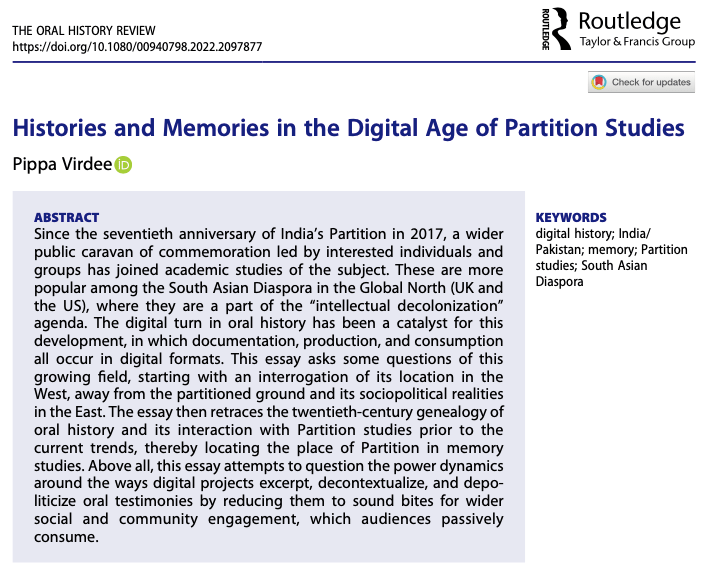
Open The Oral History Review journal and article.

August is the time when anyone who has any interest in the history, politics, and society of South Asia will be talking, tweeting, and sharing about the time of Partition/Independence. Here in the UK, I have noticed how much discussion about Partition has entered the public discourse, whether it is TV, radio, newspapers etc. In this essay, recently published in The Oral History Review, I have attempted to show how the historiography of Partition has developed, especially over the past twenty-five years. It is an attempt to contextualise and understand how this field of Partition Studies has evolved and what role technology, new forms of social media and the South Asian diaspora, have played in taking this field into new directions. I was keen to highlight the disparities, and structural inequalities that have been produced and strengthened in this process, despite appearances to the contrary.

As a side-note and not completely unrelated to the article, access to information/knowledge must not be taken for granted as there are institutional and economic barriers, which prevent a level-playing field. This article is NOT open access because 1) my post-92 university in the UK does not subscribe to the costly Gold Open Access scheme, and 2) the article was not written with the support of any UKRI research grant. It means that my article will remain behind a paywall, unless an institution subscribes to the journal. Again, many institutions are now cutting back to save money (esp. post-92 universities) and so subscriptions to costly academic journals are often subject to scrutiny of disciplinary demands and budgetary considerations. It is likely that this article will only reach a limited number of people compared with any open access article, thus the readership, citations and engagement will remain confined.

If you have institutional access that’s great, if you don’t and you are interested in reading the full article, please feel free to contact me.

Across Three Continents with a Sewing Machine in Tow


© Pippa Virdee

A fragment of my personal history in celebration of International Women’s Day and in memory of my own mother, who played such an important part in shaping my ideas. Visit the Indian Memory Project to read the full piece which I wrote in 2013.