Tag Archives: life

Omar Khayyam’s Rubaiyat

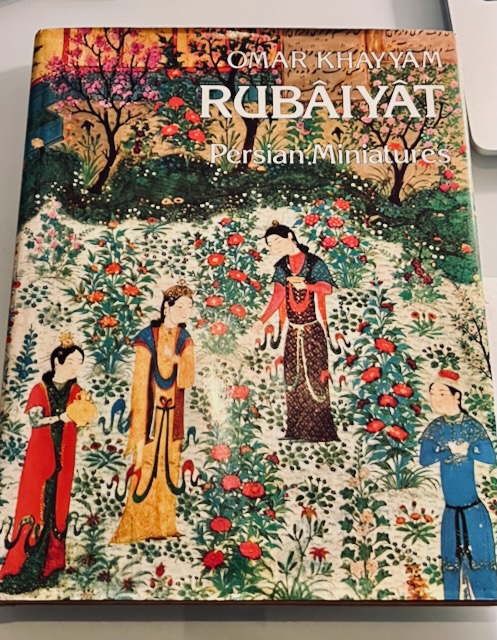
Omar Khayyam Rubaiyat Persian Miniatures

Some time back, while browsing a second-hand bookshop — the name and place now lost to memory — I stumbled upon a copy of Omar Khayyam’s Rubaiyat, translated from Persian by Edward FitzGerald. Published in 1981, it is a beautifully illustrated edition, adorned with miniature paintings. Time-worn as it is, the book carries a warm and inviting feel, and I always thought I would one day find the right words to write about it. It usually sits on the bookshelf directly in front of my desk, front cover on full display — a small splash of colour and beauty against what can otherwise be rather dry academic reading. The richness of the text and the miniature paintings breathe both life and warmth into the room and, on occasion, inspire me to write.

Omar Khayyam (1048–1131) was a Persian poet and polymath of remarkable range — a mathematician, astronomer, and philosopher as much as a literary figure. Born in Nishapur in present-day Iran, he flourished during the Seljuk era, a world away in time and place from the Crusades unfolding to the west. Though celebrated in his own time for his scientific and philosophical work, it is his poetry that secured his enduring fame in the modern world — largely thanks to Edward FitzGerald’s celebrated English translation, first published in 1859. FitzGerald’s Rubaiyat of Omar Khayyam is a loose but inspired rendering of quatrains drawn from the Bodleian manuscript, and its success was extraordinary: a bibliography compiled in 1929 listed over 300 separate editions, with many more appearing in the century since.

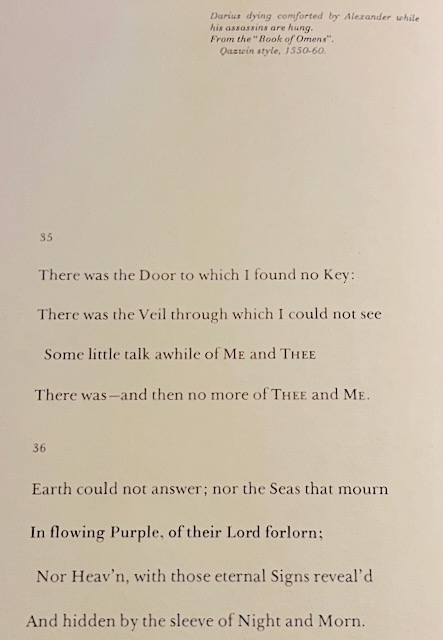
There is, of course, much to be said about FitzGerald and the liberties — and brilliance — of his translation, but that is a conversation for another time. For now, it was the events of the past few days that compelled me to lift the book from the shelf and turn its pages. Two quatrains, in particular, stopped me in my tracks.

35

There was the Door to which I found no Key;
There was the Veil through which I could not see
Some little talk awhile of ME and THEE
There was—and then no more of THEE and ME.

36

Earth could not answer; nor the Seas that mourn
In flowing Purple, of their Lord forlorn;
Nor Heav'n, with those eternal Signs reveal'd
And hidden by the sleeve of Night and Morn
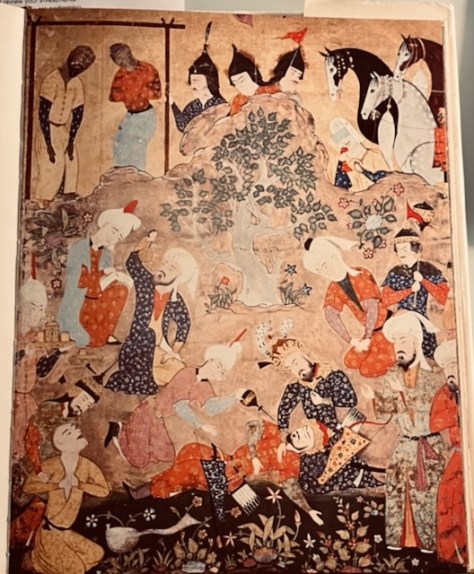
Darius dying comforted by Alexander while his assassins are hung. From the “Book of Omens.” Qazwin style, 1550-60

Crossing Bridges

Bridge

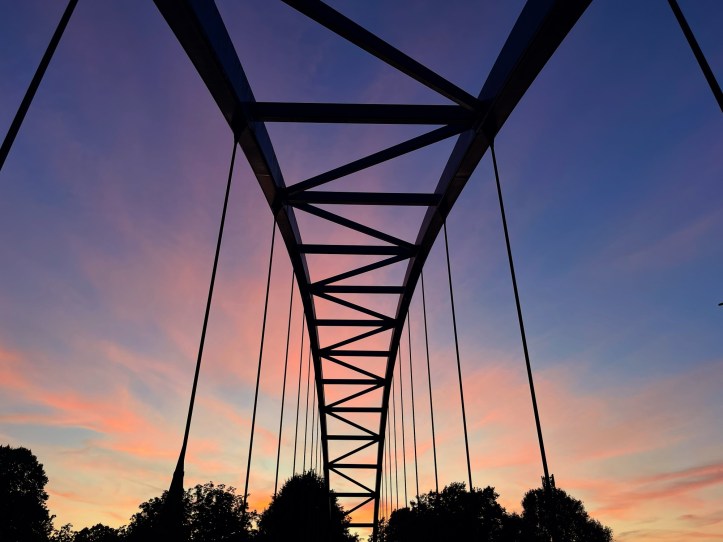
As we experience yet another heatwave, I found myself lacking the energy for any activity beyond a brief evening walk. Yet, the need to move—both physically and emotionally—compelled me to step outside, hoping to release the tensions accumulated over the day. On my return, I was met with a striking view: the sun had dipped firmly below the horizon, casting a serene glow across the bridge in front of me. This image prompted a moment of contemplation—particularly on the symbolic significance of bridges.

Bridges, in their physical form, connect distant places and facilitate movement between separate points. Metaphorically, however, they represent much more. They embody transition, decision-making, and the effort required to reconcile division—whether internal or external. Though intended to unite, bridges can also signal challenge, especially when we are compelled to “bridge the gap” in our own lives.

At present, I find myself standing on such a metaphorical bridge. The path ahead exists, but it is shrouded in uncertainty. I cannot clearly see what lies beneath or what awaits on the far side. What is certain, however, is that bridges inherently require a departure from the familiar. They demand forward motion and ask us to focus not on what lies behind, but on what we must face ahead.

The magnitude of the bridge often correlates with the magnitude of the challenge. Its instability—its rattling and trembling—can mirror our own internal doubts. Nevertheless, retreat is frequently not an option. Thus, we commit to the crossing. We proceed with trust in our steps and with faith in our own convictions, accepting that uncertainty is an intrinsic part of all meaningful transition.

Leap of faith

It has been a while since I’ve had a chance to post something substantial on my Blog, for the pressures of term-time mean that there are few opportunities to sit down and ponder. However, today was 29th February and I wanted to post something, even if something small. I got my inspiration this morning, when I opened my email to find an editorial on the various Lit.Fests taking place in Pakistan recently, but hidden within this was a lament about women’s position in Pakistan and their battle against “suffocating patriarchy”. On the other hand, here in the UK, I was always told that on the 29th February, women can propose marriage! 

While there are hardly any bars on women proposing marriage on any other day of the year, traditionally this was considered here the “man’s” job/role. To be honest, I had never looked into where this myth came from, until today, when to my surprise, I discovered that this comes from a 5th century Irish tradition, also known as Ladies’ Privilege or Bachelor’s Day. The legend is that Saint Brigid of Kildare complained to Saint Patrick that women sometimes had to wait too long to marry because the men were too slow! In response, Saint Patrick decreed that on the extra day of a leap year, women could propose to men.

As we bid farewell to February, and welcome March, we will also celebrate international women’s day. The lived reality is that wherever you are, there is discrimination, oppression, intolerance, and worse. Take a leap of faith and believe in yourself, be the change you want to see. 

Leap Year Poem
BY MOTHER GOOSE
Thirty days hath September,
April, June and November.
All the rest have thirty-one,
Excepting February alone,
And that has twenty-eight days clear
And twenty-nine in each leap year.