Tag Archives: Lahore

The first session of the National Assembly, Dacca, 1956

national-assembly-pakistan

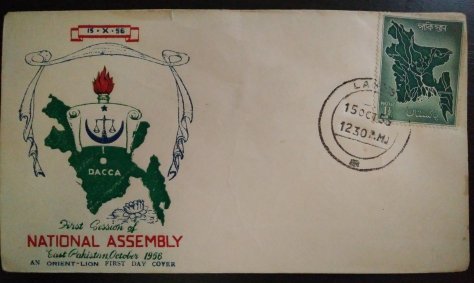
To commemorate the first session at Dacca, East Pakistan, of the National Assembly of Pakistan, three postage stamps were issued on and from the 15th October 1956:—

  • 1½-anna, bottle green
  • 2-anna, dark brown
  • 12-anna, deep red

The picture above is the first day cover with a 1 ½ anna stamp. I just came across it during a stroll at the book fair on The Mall, Lahore which is held on Sundays. The commemorative stamp was issued on the eve of Pakistan becoming the first Islamic Republic in the world. At the time Pakistan was made up of two wings, East Pakistan (now Bangladesh) and West Pakistan. The National Assembly of Pakistan is the lower house of parliament and initially met in the capital Karachi. However, this was the first session of the National Assembly in Dacca and in fact the last time as well because two years later Ayub Khan became the first military dictator in Pakistan and eventually by the 1971, the country was on the brink of splitting up.

The stamp encapsulates the period when Pakistan ended its status as a dominion and was declared an Islamic Republic of Pakistan on 23 March. Hence this is day is celebrated as Republic Day in Pakistan. This of course is also the same day that Mohammad Ali Jinnah adopted the Pakistan Resolution (Lahore Resolution) outlining the two-nation theory. The full text of the 1940 Resolution is available via: http://www.columbia.edu/itc/mealac/pritchett/00islamlinks/txt_jinnah_lahore_1940.html.

The Constituent Assembly became the interim National Assembly with Governor General Iskander Mirza as the first President of Pakistan. The Assembly had 80 members, half each from East Pakistan and West Pakistan. A turning point in Pakistan’s history, the Constitution required the president to be a Muslim and he (typically it was a he), had the power appoint the Prime Minister and he was also empowered with the ability to remove the Prime Minister, if there was a lack of confidence in his abilities. The Constitution of 1956 was written almost ten years after Pakistan was created, but crucially it set in motion a dangerous precedent; the President had the power to suspend fundamental rights in case of an emergency. Crucially though the Constitution of 1956 was short-lived because by 7 October, 1958, General Mirza dissolved the constitution and declared Martial law in Pakistan.


Borders and Boundaries

As an academic my main pre-occupation has been centred around the partition of India and creation of Pakistan in 1947. I have been fortunate enough to have been able to spend time on both sides of the border, comparing the impact of this division on the people of Punjab; the area that has been severely affected by the decision taken in 1947. From being the bread basket of British India and the major recruiting ground for the colonial Indian army, East Punjab becomes the hostile border with Pakistan and West Punjab, while politically dominate, recedes culturally. The culturally, linguistically and economically rich land of Punjab is Balkanised after 1947 and now exists as a mere skeleton of its former self. The land has been reconfigured along religious identities which evaporate the pluralistic history; it tries to re-imagine itself for the new global order but lacks the former strength it had.

For the past 14 years I have crossed the official border crossing at Wagha/Attari between India and Pakistan numerous times; I’m lucky because I don’t have a green or blue passport, both of which immediately open you up tedious amounts of scrutiny. By virtue of being “foreign” and at the same time a “desi”, you get to experience this place in a different manner. Although I have Indian heritage, the Indians are on the whole sterner, matter of fact during the immigration and customs. Sometimes I will strike a conversation and there is rare chance to get their views. For example, during my last trip, the Indian official wanted me to recommend some history books to read, especially those that were impartial. On the Pakistan side, there are of course always questions, inquisitions about what, why, who…but there appears to be more “conversation”. There is always intrigue and sometimes joy that a “foreigner” would want to spend time in Pakistan. I have also been unlucky enough to be stuck on both sides of the border just as it is about to close for crossing. And both sides have blamed the other, “madam ji, we will let you go through but the Indians/Pakistanis will not accept you”. Both behave in this rather childish and tit for tat manner. It is a shame then that politics is also conducted in this manner. While Delhi and Islamabad exchange words of war, the ordinary people suffer, as they have suffered in the past 69 years.

The new global trend for hyper nationalism, as seen in the impact Trump is having in America, the growing influence, both emotionally and politically, of right wing politics can also be seen in the UK, France, Denmark, Sweden, and so socially progressive countries which are now retracting and adopting more defensive policies. While in India, the impact of Modi and his cosy relationship with RSS has unleashed and legitimatised a form of nationalism and patriotism which makes it difficult to question governments and their policies. In the name of showing loyalty to the state, Indianess/Hinduness and the armed forces, it has become unpatriotic to say anything which may offend. Have we become so insecure that we cannot even tolerate any scrutiny? Surely we need reflect on our past and how we face the challenges of an increasingly globalised society. We cannot live in isolation, putting up barriers, preventing the movement of people and creating homogenous spaces. India and Pakistan did this in 1947 and we live with the legacies of that today. Homogenous (religiously or ethnically) societies does not equate with security, peace and harmony. Look at the challenges Pakistan has faced since it was founded as a country for the Muslims of India. Working together for a solution is the only option. But amongst this raft of change has also been the enormous disconnect between the politicians and the people and this is a global challenge.

It is therefore staggering to think that as we approach 70 years of independence, little has been gained and little has been achieved in our relationship with our closest neighbour. We cannot deny that we were once attached together and there are many cultural, ethnic, linguistic commonalities that unite us, yet we are determined to focus on the differences and maintain the status quo of a sibling rivalry. Unfortunately, there is no parent who can step in try to patch up things, we have to be mature enough to do that ourselves. Otherwise, this rivalry will remain for the next 70 years. People away from border states like Punjab and especially Kashmir cannot comprehend the negative impact this rivalry has had on the mind-set and livelihoods of the people. They live in the shadows of this rivalry, even though there is much more which unites them than divides them. They also have a right to live in peace and aspire for prosperity, we should not be so selfish to deny them this.
Eating vegetables in Lahore

Being a vegetarian in Lahore is not easy. It is a city dominated by the carnivorous types. Meat is everywhere; from street vendors to top-end restaurants. The more the meat the merrier. But it’s not just the simple question of the quantity, it is also the status afforded to gosht-meat. Meat consumption is also dominated with the wealthy rather than the poor, who still consume a more balanced diet. Thus there is evidently a distinction between the class of people who eat meat. Having said that during my first visit to HyperStar (one of the largest malls in Pakistan), I noticed how expensive some vegetables were. Especially those which are not locally in demand. Mushrooms were nowhere to be seen and peppers/capsicums were priced exorbitantly. Price will most likely follow demand but why is that some vegetables and lentils are even more expensive than meat, surely this is not right.

This gradual shift of people’s eating habits has hardly been noticed. In countries with high levels of poverty, it is often a question about getting enough to eat rather thinking about over-consumption. But undoubtedly Lahore before 1947 was not so dominated by meat, the diet would have been varied to reflect the multi-cultural nature of the city. Many of the elder inhabitants attest to different eating habits as recently as the 1970s and even the 1980s. The change in what people eat is not just to do with the political and demographic changes brought about by 1947, they are also to do with modern eating habits. Yet interestingly meat consumption in Pakistan has gone up particularly when we compare it to Bangladesh. The main difference between the two is most likely explained by the fact that the Bengali diet has a lot more fish than real “meat”.

The Real Meat http://www.dawn.com/news/1207254

I’m not a vegetarian for any religious reasons, the habit started more out of change in circumstances and then for ideological and pro-animal reasons. These early encounters in my teens have subsequently remained with me. Over recent years I have become more flexible but a few things stand, no red meat and certainly a preference for veggie food whenever possible. Without preaching, I have encouraged my friends to reduce meat consumption, starting with maybe abstaining from meat once a week. There are of course some sound environmental and health benefits to a vegetarian diet.

Eat less meat to avoid dangerous global warming, scientists say https://www.theguardian.com/environment/2016/mar/21/eat-less-meat-vegetarianism-dangerous-global-warming

Can eating less meat help reduce climate change? http://www.bbc.com/news/science-environment-34899066

As I’m living and working in Lahore, food is an important part of my “experience”. So it’s sad to say that while Lahore has embraced gosht-eating so wholeheartedly, it has also forgotten how to cook and handle vegetables. Some households still produce some good basic veggie food, others experiment with more fashionable veggie food, perhaps for health reasons. Overwhelmingly though they are gosht lovers. The kebabs and tandoori chicken might be unparalleled but it has be said that across the border in India, there is much more choice and acceptance of veg food. India perhaps is the only place where the term veg/non-veg is used; it highlights the importance and priority on veggie foods as opposed to it being a side order. India also has one of the lowest rates of meat consumption in the world, though this varies from state to state. The choice and creativity in veg food in India is unparalleled I think.

Mapped: The countries that eat the most meat http://www.telegraph.co.uk/travel/maps-and-graphics/world-according-to-meat-consumption/

Top Meat Consuming Countries In The World http://www.worldatlas.com/articles/top-meat-consuming-countries-in-the-world.html

My solution is let’s make vegetarianism fashionable and cool! The same way that perhaps having meat became so pervasive and a marker of upward mobility, perhaps we can do the same with opting for the healthier veggie option. By making it fashionable perhaps the elite in Lahore can embrace this trend and start spreading some health conscious habits.


Guru ka langar

Langar at Gurdwara Pehli Patshahi and small motif from Gurdwara Janam Asthan Sri Guru Ram Das. Both located in Lahore, Pakistan.

Gurdwara Pehli Patshahi is located inside Delhi Darwaza The gurdwara where Guru Ram Das was born is the location of his ancestral house. Both these gurdwaras are relatively good condition compared to others.

Poetry Corner: Lahore

Daal dus khaan shehar lahore e ander
(Tell me, in the city of Lahore)
Bai kinnein boohey tay kinnian barian nein
(How many doors and windows are there?)
Naley Das Khaan aothon dian ittaan
(Tell me also about its bricks.)
Kinnian tuttian tay kinnian saaran nein
(How many are still firm, and how many lie broken?)
Daal dus khaan shehr Lahore e Andar
(Tell me, inside the city of Lahore)
Khooian kinnian mithian tey kinnian khaarian nein
(How many wells have fresh water and how many are ruined with salt?)
Zara soch key dewien jawaab meinoon
(Think carefully before you answer.)
Aothey kinnian viyaeyan tay kinnian kunvarian nein
(How many are married and how many single?)
Daal Dassaan mein shehr lahore e ander
(I will tell you what lies in the city of Lahore.)
Bai lakhaan boohey tay lakhaan e baarian nein
(There are millions of doors and millions of windows.)
Jinnaan Ittaan tay tahar gaey paer aashiq
(The bricks burn in the memory of lovers’ footsteps.)
O heoon Tuttian tay baqi saarian nein
(Only those lie broken.)
Jinnaan Khooian toun paher gaey mashooq paarrien
(Only wells that quench a lover’s thirst)
Jerian behendian apnein naal sajraan dey
(Only those who sit with their lovers)
O heon viyaiyan teh baaqi kunvarian nein

Haji lok makkey nun jandey
(Pilgrims go to Mecca)
Mera ranjha mahi makkah
(My beloved Ranjha is my Mecca.)
Nein main kamli aan
(O! I am crazy)
Nein main kamli aan
(O! I am crazy)

Haji lok makkey nun jandey
(Pilgrims go to Mecca)
Mera ranjha mahi makkah
(My beloved Ranjha is my Mecca.)
Nein main kamli aan
(O! I am crazy)
Nein main kamli aan….
(O! I am crazy)

Ho Kajjal da ki pawana
(What is the use of wearing kohl)
Keh jeda athro wagan rurh jawey
(Which is washed away with streaming tears?)
Kach da key pehnana
(Why wear glass)
Jera Thece Lagey Tutt Jawey
(Which can shatters with a nudge?)
Rung da key Lawaran
(Why bother putting on color)
Keh Jera Boond Pawey Khurr Jawey
(That would melt away with every drop?)
Aashiq Noun Key Maarran
(Why bother killing the lover)
Keh Jera Cheherk Dawey Mur Jawey
(When he would die with the thought of your anger?)
Nein Mein Kamli Aan O!
(I am crazy indeed)
Nein Mein Kamli Aan O!
(I am crazy)

Ho Mein Tan Mung Ranjhan Di Hoean To Ranjha
(I am betrothed)
Mera Babul Dainda e Thaka
(My father pushes me)
Nein Main Kamli Aan
(O! I am crazy)
Nein main Kamli Aan
(O! I am crazy)
Nein Main Kamli
(O! I am crazy)

Jey Rab milda nahatian tohotian
(If God was to be found by bathing)
They milda daddoan machian
(Then fish and frogs would have found Him.)
Jey Rab milda jungle bailey
(If God was to be found by roaming jungles)
Tan milda gaoan wachian
(Then cows and calves would have found Him.)
Jey Rab milda wich maseetee
(If God was to be found in Mosques)
Tan Milda Chaam Charikian
(Then bats would have found Him.)
Bullia Rab aonan nu milda bullia!
(He is only found by those)
Bhai neetaan jinhan dian sachian
(Who are pure at heart.)
Nein Mein Kamli Aan
(O! I am crazy)

Parh Parh main hazaar kitabaan
(Yes, you have read a thousand books)
Kitabaan…
(Books…)
Parh Parh im hazaar kitabaan
(Yes, you have read a thousand books)
Kadee Aprain Aap Noun Perhia Nahein
(But you have never read your own self)
Jaan Jaan Warrdey Mandar Maseetee
(You rush to temples and mosques)
Kadee Mun Aprrain wich Warian Nahein
(But you never tried to enter your own heart)
Aewein Larrnaein Shaitaan Dey Naal Bundia
(All your battles with Satan are lost)
Kadee Nafs Aprrain Naal Larria Nahein
(For you have never tried to fight your own desires)
Aakhay Peer Bulleh Shah
(Saint Bulleh Shah says)
Aakhay Peer Bulleh Shah Aasmaani Pharr naen
(Saint Bulleh Shah says you try to touch the one in the sky)
Aakhay Peer Bulleh Shah Aasmaani Pharr naen
(Saint Bulleh Shah says you try to touch the one in the sky)
Allah…
Nein mein Kamli Aan
(O! I am crazy)
Nein mein Kamli Aan
(O! I am crazy)

Source: http://lyricsdna.com/songs/lyrics/kamlee-hadiqa-kiani-coke-studio-5

Lyrics: Bulleh Shah Singer: Hadiqa Kiani: Coke Studio, 2008