
During a recent trip to Doha, I found myself intrigued by the history of pearl diving. I must admit I knew little about this and it turned out to be one of the oldest professions in Qatar, dating back to around 4,600 BCE. Before the discovery of oil and gas, the inhabitants of the Gulf’s Arab coast relied on diving for natural pearls as their economic livelihood. Pearls from the Gulf were traded to India, Persia, and the Ottoman Empire. In the mid-19th century, the pearl industry rapidly expanded to meet the global demand as pearls became a precious and much sought-after luxury item.
It was typically the male member of the family who would go out during the pearling season, which was usually during the four summer months. The women stayed back, managing the household and all the associated work. The boats departed from ports like Manama, Doha, Dubai, and Abu Dhabi. Divers, sailors, and “pullers” (who brought divers up from the seabed) participated. Advances were often given to crews by boat captains (nakhudas), who financed the season. Pearl merchants (tawawish) paid nakhudas upon pearl delivery.
The work itself was perilous and dangerous; it was technical and incredibly hard work, where some of the divers never made it back home. The pearl divers endured many obstacles, from the burning sun to the treacherous waters. Many men would stay in one ship cramped together for months to sustain their families. During their dives, they would hold their breaths with the help of a nose peg for up to two minutes at a depth of up to 18 metres. This is no mean feat!
Interestingly the museums made some comparison of this work with the discovery of oil. Both relied heavily on labour who were separated from their families for long periods. It was hard and arduous, gruelling in the summer heat, but necessary to sustain livelihoods and family life in the desert where there few other alternatives. The beneficiaries typically were a handful of people, whether this was from the pearl industry or “black gold.” From the 1920s, with the discovery of oil, pearl diving itself began to decline and led many divers to leave the profession.
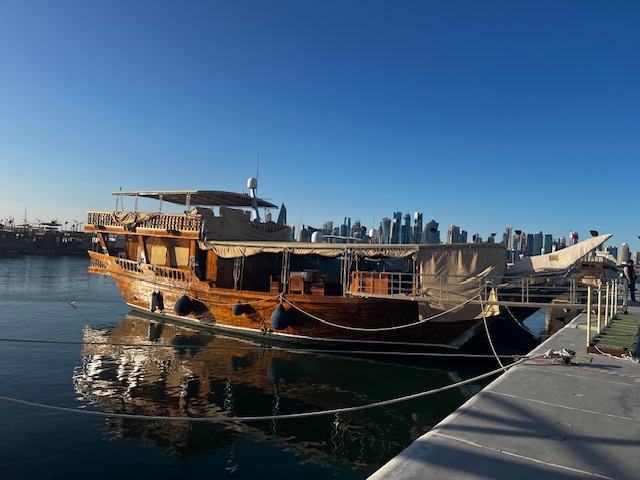
At the same time, countries such as Japan, began cultivating pearls, leading to a decline in the Arabian trade. These cultured pearls became more abundant and affordable than the Gulf-harvested pearls. The pearl fishing fleets shrank, and towns’ populations dwindled. But despite this, it remains an integral part of Qatar’s national heritage. If you ever visit Doha, you will you’ll find nods to Qatar’s pearl diving past throughout the capital city, including the dhow boats at the harbour, traditionally used for collecting pearls; the pearl sculpture at Corniche which is an open oyster shell statue with a pearl inside; or then the artificially built Pearl Island which exudes modernity, technological advancement, while paying homage to the past.
The preservation of this heritage can also be gleaned from the traditional pearl diving songs. The songs blend elements from Bedouin, East African, Persian and Indian styles, creating a rich and diverse musical heritage. They evoke the spirit of the sea, resilience, and the camaraderie of pearl divers. It is often through this orality that one can still get a sense and appreciate the past.
Read more: The Tradition of Pearl DivingPhotos: Pearl diving tradition being kept alive in Qatar
 BAGICHA