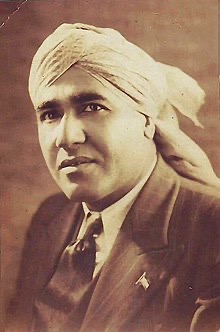
Frank Brazil pays tribute to Indian revolutionary Udham Singh who was executed at London’s Pentonville Prison on 31 July 1940. It follows the 21 years of Udham Singh’s life following the Jallianwallah Bagh massacre in 1919, leading up to the assassination of Michael O’Dwyer and his execution in Pentonville Prison shortly after.
Music and lyrics by The Ska Vengers
India travel to Africa
Africa …travel to America
America link the Gaddar Party
Try and do things far away form home

One day
Travel down to Germany
Italy France and ina Switzerland
1934 I reach England
and get ready for assassination

Judge won’t you hear my plea
Before you open up the court
I don’t care If I spend 99 years in jail
Or you send me to the electric chair

Travel the planet and endure some hardship
Walk the path to meifumado ready to endure hardship
Pan patroll stroll intro my target
One question before we get started
You know what a one way ticket to the morgue is

Body bags stacked up ina cold storage
Crush my culture and said it was garbage
Rule by the cruel rule of the free market
Ask some cracker grandpa what a cat o nine tail scar is

Judge won’t you hear my plea
Before you open up the court
I don’t care If I spend 99 years in jail
Or you send me to the 'lectric chair

Now we combust
Bredrin stay focused and conscious
Company rule is so unjust
Feel the tension of my ancestors in my muscle fiber and now I'm ready to crush

Shot him with my 6 chamber
Zetland by his side
Stood there looking at him
While he wallowed down and died
Now I'm on my journey to a Brixton prison cell
Tell the judge and jury that I did my time well

Judge, judge, lordy judge
Send me to the 'lectric chair

Burn burn
Read further:
Anita Anand, The Patient Assassin: A True Tale of Massacre, Revenge and the Raj (Simon & Schuster, 2020).
David Clark. “Recollections of resistance: Udham Singh and the I WA.” Race & Class 17, no. 1 (1975): 75-77.
Louis Fenech, “Contested Nationalisms; Negotiated Terrains: The Way Sikhs Remember Udham Singh ‘Shahid’ (1899–1940)”. Modern Asian Studies. (2002) 36 (4): 827–870. doi:10.1017/s0026749x02004031
Navtej Singh. “Reinterpreting Shaheed Udham Singh.” Economic and Political Weekly (2007): 21-23.









 BAGICHA