Tag Archives: Islam

Looking for Kabir

Kabirdas was a 15th century Indian mystic poet and is revered as a saint by many, across regions, communities, castes, and, now, nations. A disciple of Ramananda (in Banaras), his writings fed the syncretic Bhakti movement, which in turn influenced the development of Nanak and his teachings, to the extent that Kabir’s immortal verses are included in Adi Granth. Kabir was critical of all organised, institutionalised, hierarchical faiths, and their rites and rituals, sanctioned by sanctimonious and exploitative clergy. For Kabir, the Truth was not in these trappings, nor in their egoistic traders.

chadariya jheeni re jhini (Kabir)

Read this wonderful explanation and translation: https://www.petervis.com/gallery/web/bollywood-translations/chadariya-jhini-re-jhini-english-translation.html

Kabir and The Kabir Panth by Rev. G.H. Westcott, Fellow of Allahabad University (Cawnpore, 1907) https://archive.org/details/KabirAndTheKabirPanth_466/mode/2up Page 1-5

It is generally allowed that of all the great Reformers, Kabir (1440-1518) and Tulsi Dass (1544-1624) have had the greatest influence for good among…Northern and Central India. Kabir has been described…as the Indian Luther (1483-1546)…

Among those who acknowledge their indebtedness to Kabir as a spiritual guide are Nanak Shah (1469-1538) of the Panjab, the founder of the Sikh community; Dadu of Ahmedabad (1544) founder of the Panth that bears his name, and Jag Jiwan Dass of Oudh (1760) the founder of the Sat Nami sect. Among religious teachers whose doctrine is said to be largely based upon the teaching of Kabir are Bribhan, founder of the Sadh community (1658), Baba Lal of Malwa and Shiva Narain of Ghazipur.

In modern days the number of those who have in one way or another come under the influence of Kabir is very great. In the Census Report of 1901, the number of Kabir Panthis alone is returned as 843,171 and the actual number is probably considerably larger, as in the United Provinces many Kabir Panthis seem to have been returned as Ramanandis and the figures for the Panjab are not included.

The hymns of Kabir are still sung by many a wandering minstrel, while his pithy sayings are frequently employed to win the attention of a dreamy audience or to clench a lengthy argument.

Unfortunately, the material for a life of Kabir is miserably scanty. It is admitted by all Kabir Panthis that Kabir was brought up as a child in the house of Niru, a weaver. In the Adi Granth occur these lines: By caste a weaver and patient of mind: utters Kabir with natural ease the excellences of Ram.

One Hundred Poems of Kabir, translated by Rabindranath Tagore, assisted by Evelyn Underhill (Macmillan, 1915) https://archive.org/details/OneHundredPoems/mode/2up?q=kaaba Page XV

It does not need much experience of ascetic literature to recognise that boldness and originality of this attitude in such a time and place. From the point of view of orthodox sanctity, whether Hindu or Mohammedan, Kabir was plainly a heretic; and his frank dislike of all institutional religion, all external observance – which was a thorough and as intense as that of the Quaker themselves – completed, as far as ecclesiastical opinion was concerned, his reputation as a dangerous man. The God whom he proclaimed was “neither in Kaaba nor in Kailash.”

 Mo ko kahan dhunro bande
 O servant, where dost thou see Me?
 Lo! I am beside thee
 I am neither in temple nor in mosque:
 I am neither in Kaaba nor in Kailash:
 Neither am I in rites and ceremonies, nor in Yooga and renunciation.
 If thou art a true seeker, thou shalt at once see Me: thou shalt meet Me in a moment of time.
 Kabir say, “O Sadhu! God is the breath of all breath.” 

 Santan jat na pucho nirguniyan
 It is needless to ask of a saint the caste to which he belongs;
 For the priest, the warrior, the tradesman, and all the thirty-six castes, alike are seeking for God.
 It is but folly to ask what the caste of a saint may be;
 The barber has sought God, the washerwoman, and the carpenter –
 Even Raidas was a seek after God.
 The Rishi Swapacha was a tanner by caste.
 Hindus and Moselms alike have achieved that End, where remains no mark of distinction.  

HAD ANHAD (Bounded Boundless): Journeys with Ram & Kabir (103 min, English Subtitles) A film by Shabnam Virmani – Kabir was a 15th century mystic poet of north India who defied the boundaries between Hindu and Muslim. He had a Muslim name and upbringing, but his poetry repeatedly invokes the widely revered Hindu name for God – Ram. Who is Kabir’s Ram? This film journeys through song and poem into the politics of religion, and finds myriad answers on both sides of the hostile border between India and Pakistan.

Further Reading see Purushottam Agrawal: Kashi ka Kabir and Akath Kahani Prem Ki: Kabir Ki Kavita Aur Unka Samay (An Ineffable Tale of Love: Kabir’s Poetry and his Times) (Rajkamal Prakshan, 2009).
Nation, State and Education

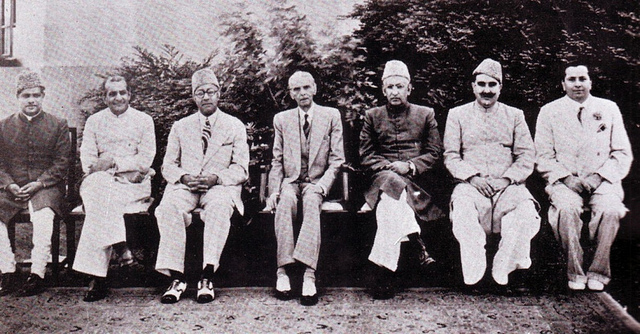
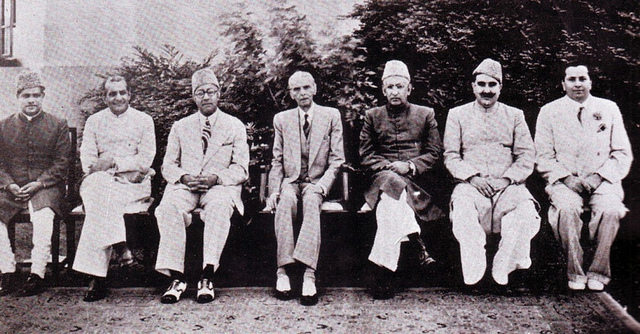
Fazlur Rehman, Ghulam Muhammad, Liaquat Ali Khan, M A Jinnah, Ibrahim Ismail Chundrigar, Abdul Rab Nishtar and Abdul Sattar Pirzada.
Picture credit, Dr. Ghulam Nabi Kazi

In this year of 2020, as debates are generated around Government of Pakistan’s new single national curriculum and its comparison with Government of India’s new national education policy, mind goes back to the first attempts made by a different Government of Pakistan, ‘to evolve a comprehensive national plan in accord with the Objectives Resolution’ of March 1949 (File No. 3 (4)-PMS/50, GoP, PMS).

Fazlur Rahman, then-Minister for Commerce & Education, was born in then-Dacca and was a lawyer-politician of the Bengal Provincial Muslim League, who had served as Revenue Minister of the pre-partitioned province. On 14 September 1949, he sent a 14-page letter (F. No. 14-313/49-Est) to Prime Minister Liaquat Ali Khan, in which he set out his trenchant comments and an accompanying template for the ‘two-fold task’ confronting them namely (1) ‘to lay the foundations of an educational system based on “Islam”’ and (2) to imbue children ‘with an international outlook’.

Recalling the first Pakistan Educational Conference of November 1947 and its resultant educational ideology and institutions – ‘the Advisory Board of Education, the Council of Technical Education and the Inter-University Board’ – he felt that the time had come to overcome ‘the existing system of education, with its alien background, Hindu and Christian ideas, foreign to our ideology’, for as long as it continued, it could not be expected ‘to produce men and women who would realise the value of the Islamic way of life and would make loyal and zealous citizens of Pakistan’.

For the successful achievement of this task, two things were essential: (i) text-books and (ii) teachers. As far as text-books were concerned, the need for Rahman was ‘to draw up the syllabus for every subject on the basis of Islamic ideology (as distinct from instruction in Islamic theology) and get text-books written by competent authors’. He wanted ‘Urdu readers – fundamentally the same all over Pakistan’, necessitating ‘a change in the existing system of publication – whose sole motive is profit-making’. Thus, ‘the Central Government should have them written under supervision’.

There was also the matter of ‘compiling a national history as a kind of reference book’ comprising researched topics like (a) ‘Islamic history and civilisation, (b) the rise and fall of Muslim states all over the world and (c) the contribution made by Muslims to the Indo-Pakistan sub-continent’. For the adoption of Islamic ideology, it was ‘essential to establish a Research Institute in Islamiyat’. As regards teachers and their training, ‘a number of Central Training Institutions’ were needed. These two were ‘fundamental problems which exclusively concerned the Central Government’.

While education was constitutionally the responsibility of the provinces – like in India – their ‘limited resources’ and its ‘all-Pakistan character’ made it ‘incumbent on the Central Government’ to take the lead – ‘from adult to university education’. For ‘democracy and illiteracy go ill together. The illiteracy percentage for India [before 1947] was nearly 90, but with the establishment of Pakistan and the exodus of non-Muslims (educationally more advanced) and the influx of Muslim refugees (to a large extent illiterate)’, there was an increased mass illiteracy in Pakistan. 

Adult education, however, was not ‘mere imparting of literacy’ but included ‘spiritual, civic and vocational motives’ for the creation of a patriotic and productive citizenry. This involved infrastructure, implements, literature, teachers and audio-visual aids, for the provision of which, ‘the Central Government must assume certain powers’. Equally important was ‘the provision of free, universal, compulsory primary education’, involving a vast expenditure. ‘Free, compulsory secondary education’ was ‘unfeasible and must be left to future’.

Anyhow, the Central Government had the ‘clear responsibility’ to produce ‘patriotic citizens not warped by narrow provincialism or alien cultural elements as the Hindu influence in East Bengal’. National solidarity therefore required ‘the speedy revision of curricula and syllabi and re-writing of textbooks’. Another problem was the ‘place of Urdu in national life’. As Jinnah had made it ‘abundantly clear’ that Urdu was to be ‘the national language’ and as, by adopting Hindi in Devanagari script, India had ‘dealt a blow’ to Urdu – ‘the cultural heritage of Indian Muslims’.

For Rahman, language was a ‘potent means’ to maintain ‘cultural ascendancy and a separate political consciousness’. Urdu with its Persian and Arabic words was ‘alien in spirit to Hindu culture’, essentialising its ‘elimination from Indian national life’.  Conversely, in Pakistan it was ‘a matter of vital necessity to have Urdu in Arabic declared forthwith as state language, a compulsory subject in schools’ overcoming the ‘narrow provincialism’ and ‘parochial mentality’ of East Bengal and Sind and resistance of West Punjab and NWFP ‘to assimilate the vocabulary and culture of these two’.

It was a no-brainer for ‘all employees of the Central Government be required to know Urdu’ and a Bureau of Translation be set up for all technical-scientific terms. In this connection, it is important to remember that in 1949, the Hindu community in East Bengal constituted one third of its population, among whom were ‘the caste Hindus – wedded to the Bengali language – the hard-core of resistance’. Rahman was concerned about their potential for ‘an anti-national mentality’ without ‘a pro-Islamic outlook’; ‘dependable citizens of Pakistan with due regard to their religious rights’.

His suggestion was to ‘reconstruct the Bengali language’ with ‘the Arabic script’ thereby ‘putting an end to the disruptive activity being carried in the name of the common culture of the two Bengals’. Moreover, the ‘present Bengali language with its Sanskrit script’ was ‘steeped in Hindu influence, full of Sanskrit words, Hindu mythology and [thus] anti-Islamic’. The Arabic script would ‘eliminate Hindu influence, facilitate adult education, link up East and West Pakistan [and] ensure East Bengal’s willing acceptance of Urdu as a national language’.

In technical education, Pakistan then had only 3 ‘engineering colleges’, like its 3 universities, for a population of 80 million, ‘impaired by the exodus of non-Muslim teachers’. A ‘Grants Committee’ for both was needed. Here, the ‘main obstacle’ was ‘the attitude of the Ministry of Finance’, to which education was a ‘provincial responsibility’. Rahman had forged the establishment of a History Board, Adult Education Centres in East Bengal, a Central Syllabus Committee with its Bengali sub-committee, a Committee of adopting Arabic script and a Committee on Technical Education.

His future proposals were less piece-meal and included the Central Government assuming ‘direct responsibility for the general planning and coordination of education’, a central-provincial sharing of adult education expenditure, central financial assistance for free, compulsory primary education in provinces, Urdu as state language, Arabic script for regional languages and centres for translation, Islamiyat, teachers’ training and a University Grants Committee. 


First Cabinet of Pakistan – Ministers of Liaquat Ali Khan & Muhammad Ali Jinnah in 1947

Special report: The founding fathers 1947-1951. The season of light… By Dr Syed Jaffar Ahmed, Dawn.