Tag Archives: Indian Workers Association

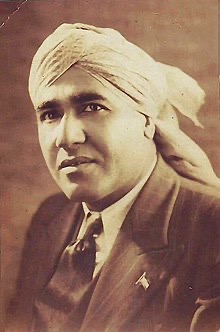
Frank Brazil aka Udham Singh (26 December 1899 — 31 July 1940).

https://www.youtube.com/watch?v=VuYgICoMer8

Frank Brazil pays tribute to Indian revolutionary Udham Singh who was executed at London’s Pentonville Prison on 31 July 1940. It follows the 21 years of Udham Singh’s life following the Jallianwallah Bagh massacre in 1919, leading up to the assassination of Michael O’Dwyer and his execution in Pentonville Prison shortly after.

Music and lyrics by The Ska Vengers

India travel to Africa
Africa …travel to America
America link the Gaddar Party 
Try and do things far away form home

One day
Travel down to Germany
Italy France and ina Switzerland
1934 I reach England
and get ready for assassination

Judge won’t you hear my plea
Before you open up the court
I don’t care If I spend 99 years in jail
Or you send me to the electric chair

Travel the planet and endure some hardship 
Walk the path to meifumado ready to endure hardship
Pan patroll stroll intro my target
One question before we get started
You know what a one way ticket to the morgue is

Body bags stacked up ina cold storage
Crush my culture and said it was garbage
Rule by the cruel rule of the free market
Ask some cracker grandpa what a cat o nine tail scar is

Judge won’t you hear my plea
Before you open up the court
I don’t care If I spend 99 years in jail
Or you send me to the 'lectric chair

Now we combust
Bredrin stay focused and conscious
Company rule is so unjust
Feel the tension of my ancestors in my muscle fiber and now I'm ready to crush

Shot him with my 6 chamber
Zetland by his side
Stood there looking at him 
While he wallowed down and died
Now I'm on my journey to a Brixton prison cell
Tell the judge and jury that I did my time well

Judge, judge, lordy judge
Send me to the 'lectric chair

Burn burn

Read further:

Anita Anand, The Patient Assassin: A True Tale of Massacre, Revenge and the Raj (Simon & Schuster, 2020).

David Clark. “Recollections of resistance: Udham Singh and the I WA.” Race & Class 17, no. 1 (1975): 75-77.

Louis Fenech, “Contested Nationalisms; Negotiated Terrains: The Way Sikhs Remember Udham Singh ‘Shahid’ (1899–1940)”. Modern Asian Studies. (2002) 36 (4): 827–870. doi:10.1017/s0026749x02004031

Navtej Singh. “Reinterpreting Shaheed Udham Singh.” Economic and Political Weekly (2007): 21-23.

Padosi (1941) – Neighbour

Many times browsing through archives, especially the digital kind, leads you from one place to another. I was scanning the British Newspaper Archive for material related to the North-West Frontier of British India and ended up finding a small snippet in the Public Notices section of The Coventry Evening Telegraph on an Indian film, Padosi, hosted by the IWA at the Opera House in 1945.

The Coventry Evening Telegraph, Thursday, April 26, 1945

The Indian Workers Association (IWA) was founded in 1938 in Coventry to mobilise for Indian independence amongst the small working-class Indian community living in the UK. Many of its early members were from Sikh and Muslim Punjabi backgrounds. Some of these members were sympathetic to and inspired by the Ghadr Party (est. 1913 in California). The British government naturally kept an eye on their activities; not only for their nationalist motivations but also for their leftist leanings. The extract below is taken from a document on the IWA, dated 14 April 1942.

The Hindi (or Hindustani) Mazdur Sabha, now more usually referred to as the Indian Workers’ Association (or union), has come gradually into being as a result of war conditions. In the two years preceding the outbreak of war a number of disaffected Sikhs – some of them with Ghadr Party contacts – who had come to the United Kingdom to work as pedlars decided to start, if possible, an organisation of Indians which should give all possible aid to the movement for Indian independence. At first the only practical step towards carrying out this decision were the secret collections and remittances to India of sums of money for payment to the dependents of political prisoners. The fund in India which received these sums of money was created by the Ghadr Party in California and there can be little doubt that the Indians in the UK who were chiefly interested in these collections were actuated by motives and by a long-range policy which were identical with these of the Ghadr Party. Some of them were in receipt of the “Hindustan Ghadr” until the close watch of the postal censorship succeeded in imposing an effective check on the entry of the paper into the UK. From the very beginning Coventry was the headquarters of the movement, for it so happened that the Indians chiefly interested were pedlars who sold their goods in the Coventry area. (File no. L/PJ/12/645)

Read further about the IWA:

Gill, Talvinder. “The Indian Workers’ Association Coventry 1938–1990: Political and Social Action.” South Asian History and Culture 4, no. 4 (2013): 554-573. DOI: 10.1080/19472498.2013.824683

Virdee, Pippa. Coming to Coventry: Stories from the South Asian Pioneers. The Herbert, 2006.

Communities in Action: the Indian Workers’ Association – Our Migration Story

Indian Workers’ Association – Making Britain

The film listed in the Public Notices snippet is “Parosi” (sic). This was a social drama directed by V. Shantaram and was set in the back drop of Hindu-Muslim unity. The Indian national movement was remarkably communalised in its last years, leading to unprecedented violence accompanying the end of British India. In 1941, it was unclear when and how this end would come. Alongside this rising tide of deteriorating inter-communal relations, there were progressive voices in the diversifying public sphere, now including cinema. One of these was the film’s legendary director, Shantaram, who pointedly got a Muslim actor to play a Hindu character and vice versa, to promote harmony between the communities. It is the type of film I imagine the IWA would want to show, as the organisation wished to emphasise class unity over communal politics in the battle against colonialism.

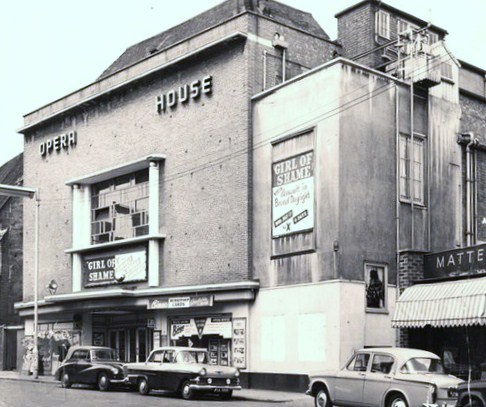
The Opera House, Hales Street, Coventry. Picture Source: http://cinematreasures.org/theaters/37902

The Opera House in Coventry was opened in 1889. During World War II, the building was damaged by bombing but it was quickly repaired and transformed into a cinema when it re-opened in 1941. The Opera House closed in 1961 and, while there were plans to restore it to a live theatre venue, this never happened.

Read more about the former cinemas in Coventry.