Report of a joint inquiry into the causes and impact of the riots in Delhi from 31 October to 10 November 1984. Published jointly by Gobinda Mukhoty, President, PUDR, 213, Jor Bagh, New Delhi- 110003 AND Rajni Kothari, President, PUCL, 1, Court Road, Delhi – 110054. November 1984
Following the assassination of Prime Minister Indira Gandhi by her Sikh Bodyguards on 31 October 1984, parts of Delhi, North India and other areas with Sikh populations became engulfed in an anti-Sikh pogrom. From 31 October to 3 November 1984 in the national capital, organised violence against the Sikh community was unleashed, unlike anything it had witnessed previously since the anti-Muslim carnage of September 1947. The ‘official’ claim later was that 2,800 Sikhs were killed in Delhi and 3,350 elsewhere in the country. However, independent sources suggest a much high figure. Among these, one of the first to come out was this fact-finding report by political scientist Rajni Kothari of the People’s Union For Civil Liberties and Gobinda Mukhoty of the People’s Union for Democratic Rights, which investigated the murders, looting and rioting that took place during those 10 days and published it later the same month. It starkly concluded that:
…the attacks on members of the Sikh Community in Delhi and its suburbs during the period, far from being a spontaneous expression of “madness” and of popular “grief and anger” at Mrs. Gandhi’s assassination, as made out to be by the authorities, were the outcome of a well organised plan marked by acts of both deliberate commissions and omissions by important politicians of the Congress (I) at the top and by authorities in the administration. Although there was indeed popular shock, grief and anger, the violence that followed was the handiwork of a determined group which was inspired by different sentiments altogether.
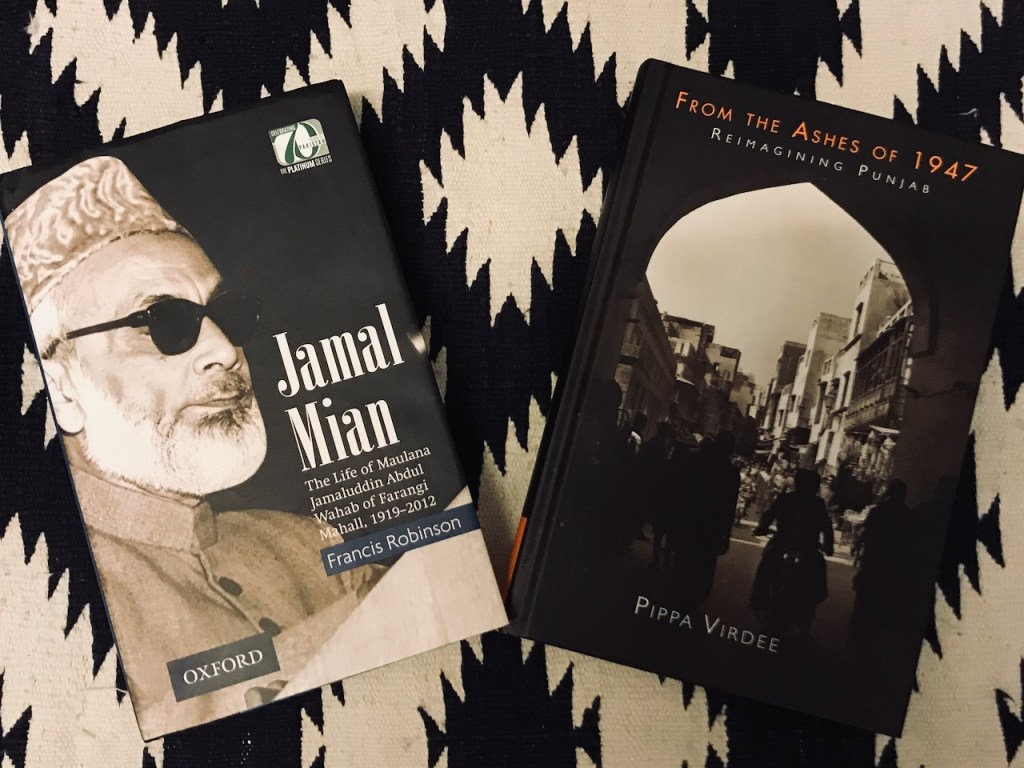
The two books are placed on a traditional handmade dhurrie/dari by my mother.
ONE is the biography of Jamal Mian (1919-2012), a life across British India, independent India, East Pakistan and Pakistan. The kind of life, which would be unimaginable to most people of the subcontinent today. At the core, this is a detailed history of the changing political landscape of North India told through the life and times of an extraordinary life. The story unfolds with authority and simplicity, the kind of old-fashioned narrative history writing that barely exists. Stories and history writing are barely written like like because they do not command the short-term impact and they take years, generations to unfold through the relationship of the historian and his subject. But importantly it brings together the life and times of an individual and his milieu – showcasing the kind of “Hindustan” that no longer exists, other than in history books.
Pippa Virdee, FRANCIS ROBINSON. Jamal Mian: The Life of Maulana Jamaluddin Abdul Wahab of Farangi Mahall, 1919–2012, The English Historical Review, ceaa186, https://doi.org/10.1093/ehr/ceaa186
TWO is an account of the province(s) of Punjab; rising From the Ashesof 1947 but simultaneously being reimagined. This too is about a political landscape that has been transformed and only exists in the history books, kinder memories and sepia imaginations of some of its people. It is about the shorter, shocking and longer, hardening consequences of dividing the land of five rivers. It too has been written over a long period and reveals the changing nature of my understanding of Partition, from the beginning of my doctoral work in 2000, to the point of this publication in 2017. It has changed further still because history is about engaging with the past through the unfolding present and “reveals how far nostalgia combined with the lingering aftershocks of trauma and displacement have shaped memories and identities in the decades since 1947.”
Sarah Ansari, PIPPA VIRDEE. From the Ashes of 1947: Reimagining Punjab, The American Historical Review, Volume 125, Issue 2, April 2020, Pages 635–636, https://doi.org/10.1093/ahr/rhz695
When we visualise India’s Partition of 1947, we almost always do so through the images of Margaret Bourke-White. For the past seven decades, her images have saturated the cover of numerous books, newspaper articles, magazine features, documentaries et al related to Partition. She was, of course, one of the most iconic photographers of the last century. Born in 1904 (d. 1971) in New York City and raised in rural New Jersey, she was the daughter of Joseph White (who was of Jewish descent from Poland) and Minnie Bourke, an Irish Orthodox Catholic. Joseph was an inventor and engineer and perhaps thus an early influence on his daughter’s eventual interest.
This interest matched the tenor of those times, as Henry R Luce, the publisher tycoon realising the potential of photography, felt that America was ready for a magazine that documented events the through photographs. In 1936, Luce bought Life magazine and relaunched it, with Bourke-White becoming one of the first photojournalist to be offered a berth there (Kapoor: 13). America then was in the midst of the Great Depression and Bourke-White ‘took to documentary photography in order to disseminate the idea of inconvenient truth’ for a readership of 2.86 million people (Bhullar: 301).
In India, she is primarily known for her photographs that captured the Partition-related violence and migration, as it ushered in the new dawn of independence. Her photographic essay, The Great Migration: Five Million Indians Flee for Their Lives, was published in Life magazine on 3 November 1947. It had commissioned her to cover the exchange of populations that was taking place across the plains of the divided Punjab and she writes thus what she saw: “All roads between India and Pakistan were choked with streams of refugees. In scenes reminiscent of the Biblical times, hordes of displaced people trudged across the newly created borders to an uncertain future” (Kapoor: 14).
Recently, in 2010, Pramod Kapoor published Witness to life and freedom:Margaret Bourke-White in India & Pakistan with a reprint of over 100 of her photographs. Kapoor wrote about them thus: “They offer a kind of stately, classical view of misery, of humanity at its most wretched, yet somehow noble, somehow beautiful”. His book gives us into a glimpse beyond the frames. Bourke-White had arrived in India in March 1946 and travel around documenting low life and high people: “She was there to photograph Gandhi at his spinning wheel. She was there to photograph Jinnah with his fez. And soon after, both men were to meet their Maker” (Kapoor: 14). Her frames on them served to reinforce their pervading stereotypes of the saint and shrewd. Kapoor details:
“Margaret photographed Gandhi many times afterward. He called her, fondly, she thought, ‘the torturer’. His inconsistencies puzzled her rational mind; it was not until she saw his self-sacrificing bravely in the face of India’s convulsive violence that she began to think him akin to the saint she made him out to be with her camera. She also photographed Mohammed Ali Jinnah; whose features were as sharp as the creases in his western business suits. Jinnah would almost single-handedly bring about the partition of India and the creation of Pakistan”.
Bourke-White documented the aftermath of the so-called Direct-Action Day in August 1946, which was announced by Jinnah following the failure of the Cabinet Mission Plan. Her photographs of the riots in Calcutta then are sometimes confused with the images she took following the Partition, a year later. The article ‘The Vultures of Calcutta’ featured in the 9 September 1946 issue of Life, showing vultures waiting to prey on the bodies of dead victims was later, intermittently and inaccurately, used for depicting the carnage in August 1947.
Vicki Goldberg, the biographer of Bourke-White, writes that when she heard about the Calcutta Riots, Bourke-White immediately flew to Calcutta, and “badgered photographer Max Desfor (1913-2018), the first foreigner to photograph the aftermath of the riots, to tell her where to find the most carnage. While others were sickened by the sight of the bodies, Bourke-White kept working and wrote the scene reminded her of concentration camps in Germany: “the ultimate result of racial and religious prejudice” (Forbes: 7). Desfor’s images were not published by the Associated Press because they were “too revolting for its readers”. Bourke-White’s comrade was Lee Eitingon, a Life reporter based in India, in whose words, “Both of us were whatever the female equivalent of macho is. The smells were so terrible, the officers accompanying us would have handkerchiefs over their faces. We would not…that was part of the time and the period. Being women, we had to be tougher” (Kapoor: 27).
Much of Bourke-White’s archive are housed in Syracuse University’s Bird Library Special Collections section. Here “one can find some of the original photos that include the British soldiers who accompanied Bourke-White and Lee Eitingon” but, as Forbes notes, “the soldiers were cropped from the published pictures”, which dramatically changes the visual narrative (12). It now appears that Bourke-White staged photographs: “Eitingon wrote about her directing a group of starving Sikh refugees…to go back again and again”. She adds, “they were too frightened to say no. They were dying”. When Eitingon protested, Bourke-White told her “to give them money!” (Forbes: 11-12). Even Patrick French writes about how some of these images were staged. When the contact sheets were discovered, they provided an insight into the wider context in which these photographs were being taken. Some of this approach of a pushy, zealous and ambitious American, has been noted in the writing of Claude Cookman. In his examination of how Bourke-White and her French counterpart Henry Cartier-Bresson (1908-2004) approached the coverage of Gandhi’s funeral he notes:
“Flash had become a contentious issue in Bourke-White’s coverage of Gandhi. She had used a flash bulb to make her famous portrait of Gandhi by his spinning wheel. Gandhi…tolerated the technique, but his inner circle never did. They thought flash was disrespectful, and they feared the bright light would harm his sensitive eyes. Flash became a serious liability for Bourke-White in her coverage of Gandhi’s funeral. With her camera concealed, she slipped into the room, where his body lay surrounded by grieving relatives, supporters and government officials. It was about 6:30 p.m.…When she ignited a flash bulb to make her exposure, his followers became enraged by her violation of their privacy and grief. They seized her camera and threatened to destroy it. Hannah Sen intervened, calming the group. After Bourke-White’s film was removed and exposed to the light, Mrs. Sen escorted her from the room. She returned the camera with the understanding that Bourke-White would leave Birla House and not return. Not one to give up after one rebuff, she reloaded her camera and tried to re-enter the room to get another picture. Eventually, Bourke-White yielded to Mrs. Sen’s pleas to honour her promise and left empty-handed. The stereotype of the rude, aggressive American news photographer, who would trample on anybody’s toes or sensitivities to get the picture was a commonplace during the 1940s…Cartier-Bresson deplored this rough-and-tumble approach to photo-journalism: ‘We are bound to arrive as intruders’, he wrote, ‘it is essential, therefore, to approach the subject on tiptoe. It’s no good jostling or elbowing’. As part of his approach, he rejected artificial lighting: ‘And no photographs taken with the aid of flashlight either, if only out of respect…Unless a photographer observes such conditions as these, he may become an intolerably aggressive character’. When Cartier-Bresson wrote this rejection of flash in 1952, he may well have been recalling Bourke-White’s experience at Gandhi’s wake four years earlier” (Cookman: 200).
Geraldine Forbes also notes the differences between Cartier-Bresson and Bourke-White. The former is less known but his images exude a sensitivity, absent in the work of Bourke-White. Upon receiving a photography award, Bourke-White claimed, “The photographer must know. It is his sacred duty to look on two sides of a question and find the truth”. And she cited her work to reference this point (Kapoor: 26). However, when we look at her work, we rarely observe that her work, almost entirely based on the Punjab migration, has yet been made to stand for Independence/Partition exclusively, without acknowledging the vast and diverse range of experiences. The visual record which is taken as “the truth” is rarely explored critically or contextually, while less said so of the racial-ethnic cultural capital of a white American female to travel freely to photograph this momentous carnage at the end of empire. These were foreign journalists writing for a predominately American and western audience, yet these photographs have come to represent Partition.
References:
Dilpreet Bhullar, ‘The Partition of the Indian Subcontinent Seen through Margaret Bourke-White’s Photographic Essay: ‘The Great Migration: Five Million Indians Flee for their Lives’, Indian Journal of Human Development, (2012) 6 (2): 299-307.
Claude Cookman, ‘Margaret Bourke-White and Henri Cartier-Bresson: Gandhi’s funeral’, History of Photography 22, no. 2 (1998): 199-209.
Geraldine Forbes, ‘Margaret Bourke-White: Partition for Western Consumption’, In Reappraising the Partition of India edited by K. Mitra and S. Gangopadhyay (Readers Service, 2019), pp. 3-16.
Patrick French, ‘A New Way of Seeing Indian Independence and the Brutal ‘Great Migration’, Time, 14 August 2016.
Vicki Goldberg, A Biography. New York: Harper & Row. 1986.
Pramod Kapoor, Witness to Life and Freedom: Margaret Bourke-White in India & Pakistan. New Delhi: Roli & Janssen. 2010.
Asma Naeem, ‘Partition and the Mobilities of Margaret Bourke-White and Zarina’, American Art 31, no. 2 (2017): 81-88.
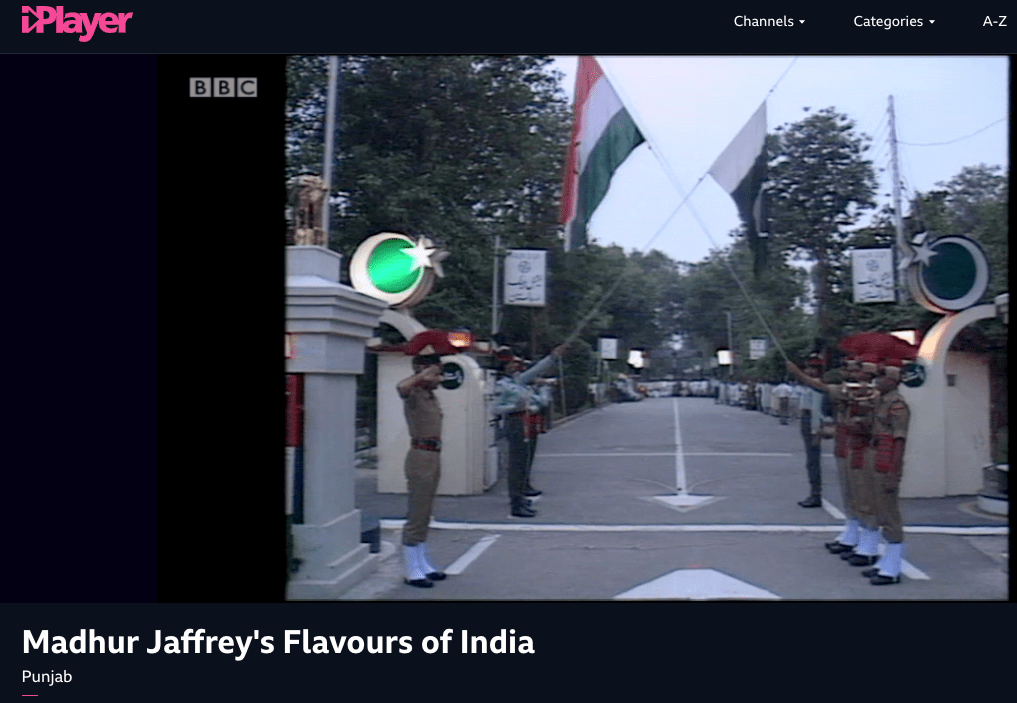
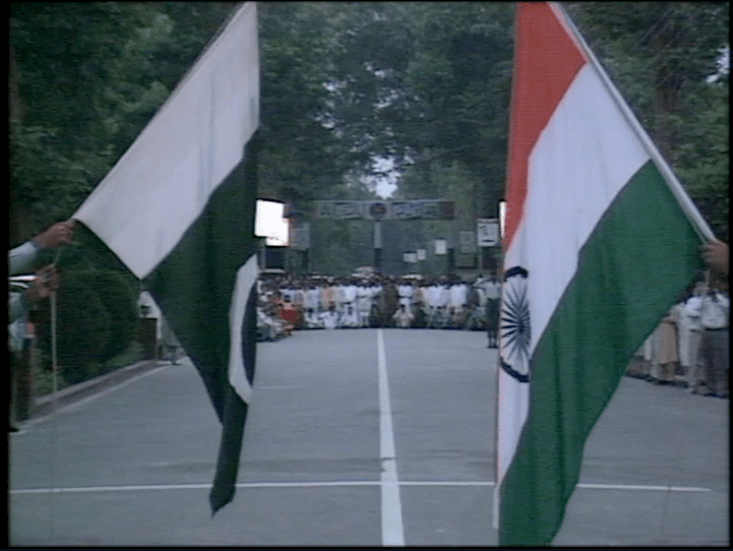
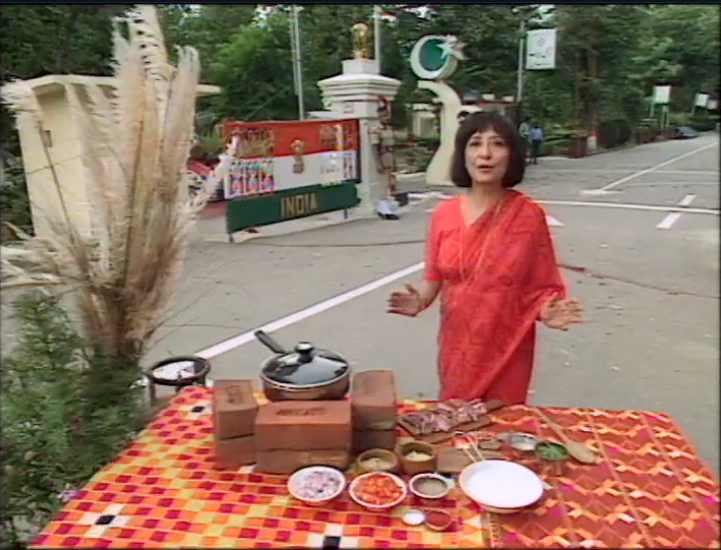
I accidentally stumbled across Madhur Jaffrey’s Flavour of India, which is being repeated on BBC iPlayer. I remember watching this when there were hardly any Indian chefs or Indian cooking on mainstream TV, so I decided to watch some of these again…it is a Sunday morning! As I sat through the episode on Punjab, near the end of the programme I was amazed to see her making lamb chops on the Wagah-Attari border. I have crossed this border numerous of times and I have also seen now much it has changed from a leafy road with colonial bungalows acting as the immigration/custom points to a harsh border with a daily dose of jingoism and national pride on full display. These few minutes have just reminded me how much India (and Pakistan) has changed since 1995. I wonder where the BSF walla tasting the lamb chop is today…
The Muslim League’s Resolution on Pakistan has called forth different reactions. There are some who look upon it as a case of political measles to which a people in the infancy of their conscious unity and power are very liable. Others have taken it as a permanent frame of the Muslim mind and not merely a passing phase and have in consequence been greatly perturbed.The question is undoubtedly controversial. The issue is vital and there is no argument which has not been used in the controversy by one side to silence the other. Some argue that this demand for partitioning India into two political entities under separate national states staggers their imagination; others are so choked with a sense of righteous indignation at this wanton attempt to break the unity of a country, which, it is claimed, has stood as one for centuries, that their rage prevents them from giving expression to their thoughts. Others think that it need not be taken seriously. They treat it as a trifle and try to destroy it by shooting into it similes and metaphors. “You don’t cut your head to cure your headache,” “you don’t cut a baby into two because two women are engaged in fighting out a claim as to who its mother is,” are some of the analogies which are used to prove the absurdity of Pakistan. In a controversy carried on the plane of pure sentiment, there is nothing surprising if a dispassionate student finds more stupefaction and less understanding, more heat and less light, more ridicule and less seriousness. My position in this behalf is definite, if not singular. I do not think the demand for Pakistan is the result of mere political distemper, which will pass away with the efflux of time. As I read the situation, it seems to me that it is a characteristic in the biological sense of the term, which the Muslim body politic has developed in the same manner as an organism develops a characteristic. Whether it will survive or not, in the process of natural selection, must depend upon the forces that may become operative in the struggle for existence between Hindus and Musalmans. I am not staggered by Pakistan; I am not indignant about it; nor do I believe that it can be smashed by shooting into it similes and metaphors. Those who believe in shooting it by similes should remember that nonsense does not cease to be nonsense because it is put in rhyme, and that a metaphor is no argument though it be sometimes the gunpowder to drive one home and imbed it in memory. I believe that it would be neither wise nor possible to reject summarily a scheme if it has behind it the sentiment, if not the passionate support, of 90 p.c. Muslims of India. I have no doubt that the only proper attitude to Pakistan is to study it in all its aspects, to understand its implications and to form an intelligent judgement about it.
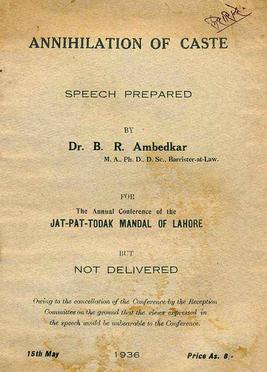
The Annihilation of Caste was an undelivered speech written in 1936 and to be delivered at the Jat-Pat Todak Mandal (Society for the Abolition of Caste system). However, the organiser found elements within the speech objectionable and Ambedkar refused to censor his words.
Other contemporary abominations like apartheid, racism, sexism, economic imperialism and religious fundamentalism have been politically and intellectually challenged at international forums. How is it that the practice of caste in India – one of the most brutal modes of hierarchical social organisation that human society has known – has managed to escape similar scrutiny and censure? Perhaps because it has come to be so fused with Hinduism, and by extension with so much that is seen to be kind and good – mysticism, spiritualism, non-violence, tolerance, vegetarianism, Gandhi, yoga, backpackers, the Beatles – that, at least to outsider, it seems impossible to pry it loose and try to understand it.
Listen to The Doctor and The Saint: The Ambedkar—Gandhi debate: Race, Caste and Colonialism with Arundhati Roy (2014)
O’Boyle, Jane “The New York Times and the Times of London on India Independence Leaders Gandhi and Ambedkar, 1920–1948” American Journalism, Volume 35, 2018 – Issue 2, 214-235.
During the years before India’s independence, the Times of London published news stories that were derisive and skeptical of Mahatma Gandhi, reflecting a national policy to diminish his power in the process to “quit India.” The Times was respectful of the untouchables’ leader Bhimrao Ambedkar and his civil rights movement for untouchables, perhaps to further distract from Gandhi’s popularity. The New York Times lavished positive attention on Gandhi and largely ignored Ambedkar altogether. The American newspaper framed a hero of colonial independence and never his oppression of untouchables, adhering to news policy during the Jim Crow era of racial persecution.
While the caste system has been formally abolished under the Indian Constitution, according to official statistics, every eighteen minutes a crime is committed in India on a Dalit-untouchable. The Persistence of Caste uses the shocking case of Khairlanji, the brutal murder of four members of a Dalit family in 2006, to explode the myth that caste no longer matters. In this exposé, Anand Teltumbde locates the crime within the political economy of post-Independence India and across the global Indian diaspora. This book demonstrates how caste has shown amazing resilience – surviving feudalism, capitalist industrialization and a republican constitution – to still be alive and well today, despite all denial, under neoliberal globalization.
Teltumbde, Anand. “Deconstructing Ambedkar,” Economic and Political Weekly (May 2, 2015).
Electoral politics became competitive bringing to the fore vote blocks in the form of castes and communities, both skilfully preserved in the Constitution in the name of social justice and religious reforms, respectively. The competing Ambedkar icons offered by various political manufacturers in India’s electoral market have completely overshadowed the real Ambedkar and decimated the potential weaponry of Dalit emancipation. The rhetoric of aggressive development, modernity, open competition, free market, etc, necessitated the projection of a new icon which would assure people, particularly those of the lower strata whom it would hit most, of the possibility of a transition from rags to riches with the adoption of the free-market paradigm.
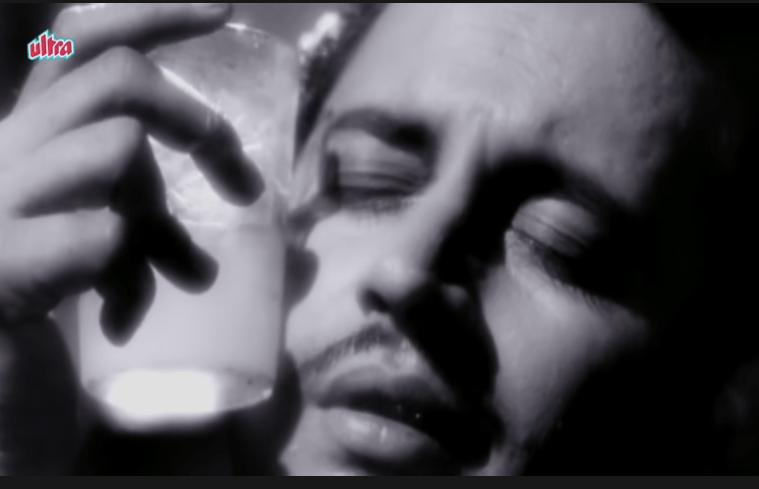
This song/poem written by Sahir Ludhianvi for the film Pyaasa, starring Guru Dutt, has as much relevance today as it did in 1957 at the height of the Nehruvian age. The lyrics and translation below are courtesy of Proud Indians, Are We? – Jinhe Naaz Hai Hind Par – Pyaasa By Deepa.
It is also worth reading the broader article, which is on Guru Dutt, “a man clearly ahead of his time.” Follow link for the song via YouTube. Make sure if you listen to any other versions that it has the last Antara of the song, which has been cut in some versions.
Ye kooche ye nilaam ghar dilkashi ke Ye lutate huye caravan zindagi ke Kahaan hain kahan hain muhafiz khudi ke Jinhe naaz hai hind par wo kahaan hain Kahaan hain kahaan hain kahaan hain
Look at these lanes, alluring houses which are up for sale/auction everyday. Look at these robbed caravans of life. Where are those protectors of self respect and pride? Where are those who say we are proud Indians? What are you exactly proud of?
Ye purpech galiyaan ye badnaam bazaar Ye gumnaam raahi ye sikkon ki jhankaar Ye ismat ke saude ye saudon pe taqraar Jinhe naaz hai hind par wo kahaan hain Kahaan hain kahaan hain kahaan hain
These complicated streets, these defamed, scandalized markets. The unknown pedestrians who walk in anytime with bagful of money. This trade of honour and chastity followed by the bargains of the same. Are we Indians proud for this? Where are those who say this?
Ye sadiyon se bekhauf sehmi si galiyaan Ye masli huyi adhkhili zard kaliyaan Ye bikti huyi khokhli rangraliyaan Jinhe naaz hai hind par wo kahaan hain Kahaan hain kahaan hain kahaan hain
These lanes which for years have been under pressure of fear, distress, angst. This place where the pale half blossomed buds are crushed (referring to young girls who fall prey to the flesh trade). The hollow festivities which are sold in this market. Show all this to those who say, they are proud of this country. Where are those people?
Wo ujle darichon mein paayal ki chhan chhan Thaki haari saanson pe table ki dhandhan Ye berooh kamron mein khaansi ki thanthan Jinhe naaz hai hind par wo kahaan hain Kahaan hain kahaan hain kahaan hain
The sound of the trinkets, anklets which come from the shimmering windows. Those tired, ill heartbeats which try to keep pace with the pace. This soul less room which filled with the unpleasant sound of coughing. For those who say they are proud Indians, please come and see this.
Ye phoolon ke gajre ye pikon ke chhinte Ye bebaak nazrein ye gustaakh fiqrein Ye dhalke badan aur ye bimar chehre Jinhe naaz hai hind par wo kahaan hain Kahaan hain kahaan hain kahaan hain
The flowers, the garlands, the stains of betel juice. The bold stares, the blunt, audacious comments. The deteriorating, decaying bodies and weak faces. Look at them, those who say, they are proud of their country.
Yahan piir bhi aa chuke hain jawaan bhi Tanaumand bete bhi abba miyaan bhi Ye biwi bhi hai aur behan bhi hai maa bhi Jinhe naaz hai hind par wo kahaan hain Kahaan hain kahaan hain kahaan hain
The ambassadors of religion, the young and the old, the sons and the fathers, all are regular visitors to this place. Here you will find someone’s wife, someone’s sister or mother too. Come and have a look at this place. Will this place make you proud?
Madad chaahti hai ye hawwa ki beti Yashoda ki hamjins Radha ki beti Payambar ki ummat Zulaykha ki beti Jinhe naaz hai hind par wo kahaan hain Kahaan hain kahaan hain kahaan hain
The girls, women here need help. They are no different from Eve, Yashoda, Radha, Zulaykha who are seen with regard and respect. Come and help them, they need you.
Zara mulk ke rahbaron ko bulaao Ye kooche ye galiyaan ye manzar dikhaao Jinhe naaz hai hind par unko laao Jinhe naaz hai hind par wo kahaan hain Kahaan hain kahaan hain kahaan hain
Someone please call the so called guides, leaders of the country. Show them these lanes, show them this miserable scene. Call them those who say they are proud of their country. Where are they?
A fragment of my personal history in celebration of International Women’s Day and in memory of my own mother, who played such an important part in shaping my ideas. Visit the Indian Memory Project to read the full piece which I wrote in 2013.
Sharing a screen grab from the last page of my book From the Ashes of 1947. Balraj Sahni captured the human tragedy of Partition in this poem, the spectre of which still continues to haunt us everyday. We seem to be unable to be human first.






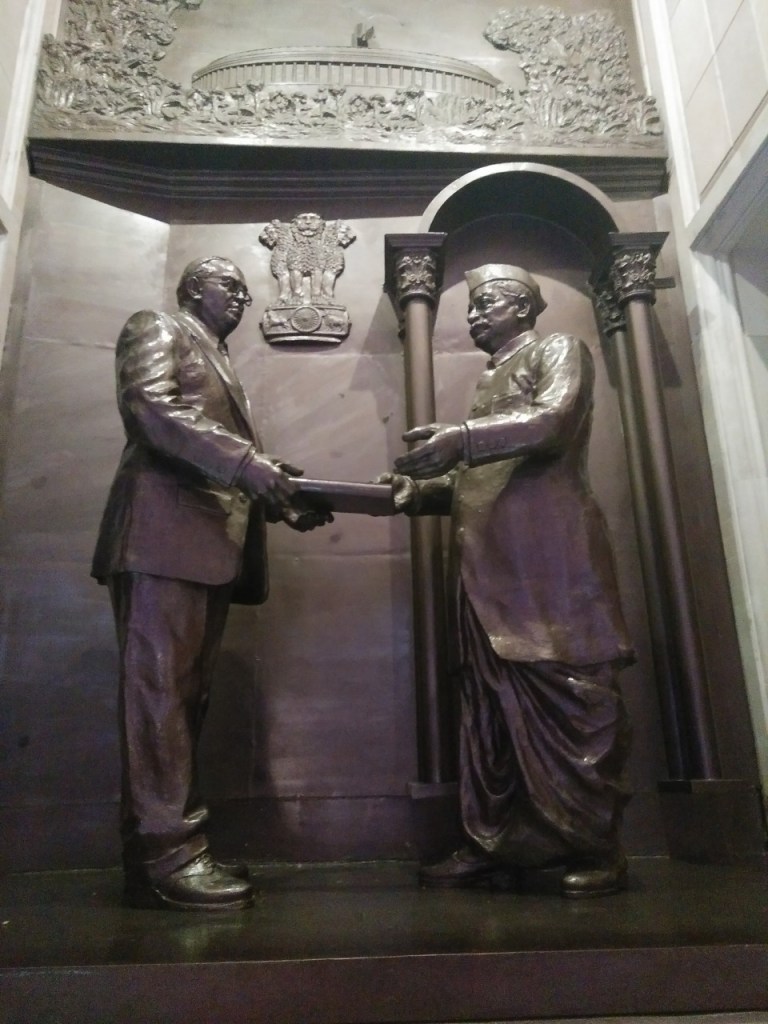
 Ambedkar, Bhimrao Ramji.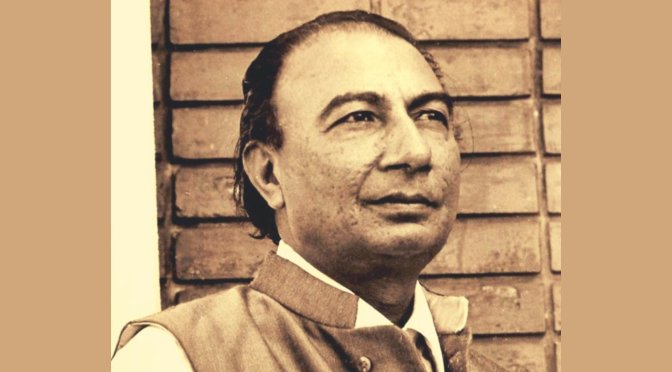


 BAGICHA