Tag Archives: India

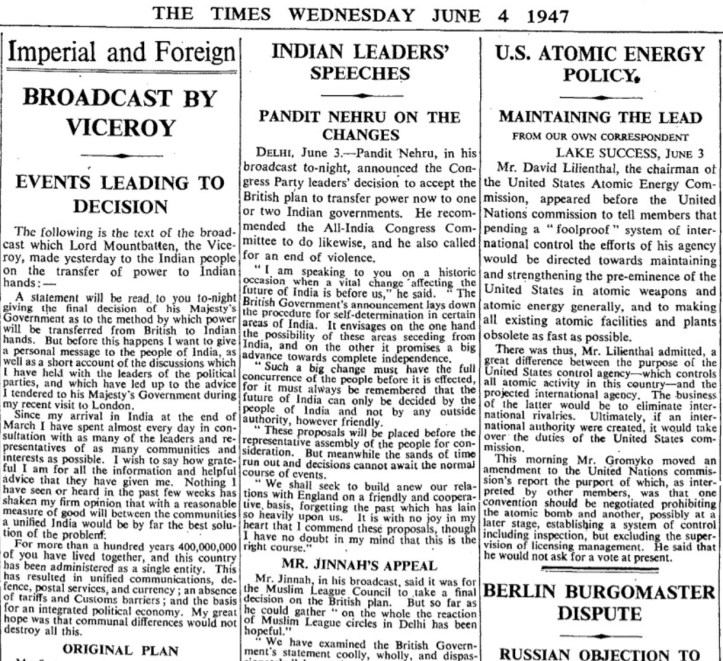
4 June 1947 – Broadcast by Viceroy Mountbatten

© The Times Wednesday June 4 1947

Below is the full transcript of the speech, which was delivered by Lord Mountbatten, the last Viceroy of India. It is followed by statements by Attlee, Nehru, Jinnah and Baldev Singh. The latter’s parting words make for interesting, wishful reading considering that it was the Sikh community that was impacted the most by this Partition Plan. This is also fully acknowledged by Mountbatten in his speech.

BROADCAST BY VICEROY
EVENTS LEADING TO DECISION

The following is the text of the broadcast which Lord Mountbatten, the Viceroy, made yesterday to the Indian people on the transfer of power to Indian hands:-

A statement will be read to you tonight giving the final decision of his Majesty’s Government as to the method by which power will be transferred from British to Indian hands. But before this happens I want to give a personal message to the people of India, as well as a short account of the discussions which I have held with the leaders of the political parties, and which have led up to the advice I tendered to His Majesty’s Government during my recent visit to London.

Since my arrival in India at the end of March I have spent almost every day in consultation with as many of the leaders and representatives of as many communities and interests as possible. I wish to say how grateful I am for all the information and helpful advice that they have given me. Nothing I have seen or heard in the past few weeks has shaken my firm opinion that with a reasonable measure of good will between the communities a unified India would be far the best solution of the problem.

For more than a hundred years, 400,000,000 of you have lived together, and this country has been administered as a single entity. This has resulted in unified communications, defence, postal services and currency; an absence of tariffs and Customs Barriers; and the basis for an integrated political economy. My great hope was that communal differences would not destroy this.

ORIGINAL PLAN

My first course, in all my discussions, was therefore to urge the political leaders to accept unreservedly the Cabinet mission plan of May 16, 1946. In my opinion that plan provides the best arrangement that can be devised to meet the interests of all the communities of India. To my great regret it has been impossible to obtain agreement either on the Cabinet mission plan or on any other plan that would preserve the unity of India. But there can be no question of coercing any large areas in which one community has a majority to live against their will under a Government in which another community has a majority—and the only alternative to coercion is partition.

But when the Muslim League demanded the partition of India, Congress used the same arguments for demanding in that event the partition of certain provinces. To my mind this argument is unassailable. In fact neither side proved willing to leave a substantial area in which their community have a majority under the government of the other. I am, of course, just as much opposed to the partition of provinces as I am to the partition of India herself, and for the same basic reasons. For just as I feel there is an Indian consciousness which should transcend communal differences, so I feel there is a Punjabi and Bengali consciousness which has evoked a loyalty to their province. And so I felt it was essential that the people of India themselves should decide this question of partition.

The procedure for enabling them to decide for themselves whether they want the British to hand over power to one or two governments is set out in the statement which will be read to you. But there are one or two points on which 1 should like to add a note of explanation.
It was necessary, in order to ascertain the will of the people of the Punjab. Bengal, and part of Assam, to lay down boundaries between the Muslim majority areas and the remaining areas, but I want to make it clear that the ultimate boundaries will be settled by a boundary commission and will almost certainly not be identical with those which have been provisionally adopted.

POSITION OF SIKHS

We have given careful consideration to the position of the Sikhs. This valiant community forms about an eighth of the population of the Punjab, but they are so distributed that any partition of this province would inevitably divide them. All of us who have the good of the Sikh community at heart are very sorry to think that the partition of the Punjab which they themselves desire, cannot avoid splitting them to a greater or lesser extent. The exact degree of the split will be left to the boundary commission on which they will, of course, be represented.

The whole plan may not be perfect: but like all plans its success will depend on the spirit of good will with which it is carried out. I have always-felt that once it was decided in what way to transfer power, the transfer should take place at the earliest possible moment, but the dilemma was that if we waited until a constitutional set-up for all India was agreed, we should have to wait a long time, particularly if partition were decided on, whereas if we handed over power before the Constituent Assemblies had finished their work we should leave the country without a constitution.

The solution to this dilemma, which I put forward, is that his Majesty’s Government should transfer power now to one or two governments of British India each having Dominion status as soon as the necessary arrangements can be made. This I hope will be within the next few months. I am glad to announce that his Majesty’s Government have accepted this proposal and are already having legislation prepared for introduction in Parliament this session. As a result of these decisions the special function of the India Office will no longer have to be carried out, and some other machinery will be set up to conduct future relations between his Majesty’s Government and India.

I wish to emphasize that this legislation will not impose any restriction on the power of India as a whole or of the two new States if there is partition, to decide in the future their relationship to each other and to other member states of the British Commonwealth.

Thus the way is now open to an arrangement by which power can be transferred many months earlier than the most optimistic of us thought possible, and at the same time leave it to the people of British India to decide for themselves on their future, which is the declared policy of his Majesty’s Government.

INDIAN STATES

I have made no mention of the Indian States, since the new decisions of his Majesty’s Government are concerned with the transfer of power in British India.

If the transfer of power is to be effected in a peaceful and orderly manner, every single one of us must bend all his efforts to the task. This is no time for bickering, much less for the continuation in any shape or form of the disorders and lawlessness of the past few months. Do not forget what a narrow margin of food we are all working on. We cannot afford any toleration of violence. All of us are agreed on that.

Whichever way the decision of the Indian people may go, I feel sure any British officials or officers who may be asked to remain for a while will do everything in their power to help implement that decision. His Majesty as well as his Government have asked me to convey to all of you in India their sincere good wishes for your future and the assurance of their continued good will.

I have faith in the future of India and am proud to be with you all at this momentous time. May your decisions be wisely guided and may they be carried out in the peaceful and friendly spirit of the Gandhi-Jinnah appeal.

MR. ATTLEE’S MESSAGE

A recording of the Viceroy’s message to the Indian people was broadcast in this country last night. It was introduced by the Prime Minister who said that the twofold purpose of the plan now put forward was to make possible the maximum degree of harmony and cooperation between the Indian political parties in order that the partition of India, if decided upon, might involve as little loss and suffering as possible, and secondly to enable the British Government to hand over its responsibilities in an orderly and constitutional manner at the earliest opportunity.

“I would make an earnest appeal to everyone to give calm and dispassionate consideration to these proposals,” Mr. Attlee went on. “It is, of course, easy to criticize them, but weeks of devoted work by the Viceroy have failed to find any alternative that is practicable. They have emerged from the hard facts of the situation in India”.

INDIAN LEADERS’ SPEECHES

PANDIT NEHRU ON THE CHANGES

DELHI, June 3.-Pandit Nehru, in his broadcast to-night, announced the Congress Party leaders’ decision to accept the British plan to transfer power now to one or two Indian governments. He recommended the All-India Congress Committee to do likewise, and he also called for an end of violence.

“I am speaking to you on a historic occasion when a vital change ‘affecting the future of India is before us,” he said. The British Government’s announcement lays down the procedure for self-determination in certain areas of India. It envisages on the one hand the possibility of these areas seceding from India, and on the other it promises a big advance towards complete independence.

“Such a big change must have the full concurrence of the people before it is effected, for it must always be remembered that the future of India can only be decided by the people of India and not by any outside authority, however friendly.

“These proposals will be placed before the representative assembly of the people for consideration. But meanwhile the sands of time run out and decisions cannot await the normal course of events.

“We shall seek to build anew our relations with England on a friendly and cooperative, basis, forgetting the past which has lain so heavily upon us. It is with no joy in my heart that I commend these proposals, though I have no doubt in my mind that this is the right course.”

MR. JINNAH’S APPEAL

Mr. Jinnah, in his broadcast, said it was for the Muslim League Council to take a final decision on the British plan. But so far as he could gather “on the whole the reaction of Muslim League circles in Delhi has been hopeful.”

“We have examined the British Government’s statement coolly, wholly, and dispassionately,” he went on. “We have to take momentous decisions, and have very big issues facing us in the solution of this complex political problem. Therefore we must galvanize and concentrate all our energies to see that the transfer of power is effected in a peaceful and orderly manner.

“It is clear that the plan does not meet in some important respects our point of view, and we cannot say or feel that we are satisfied or that we agree with some of the matters dealt with by the plan. It is for us now to consider whether the plan as presented to us by the British Government should be accepted by us as a compromise or a settlement. On this point I do not wish to prejudge the decision of the council of the All-India Muslim League, which has been summoned to meet on Monday. I appeal to every community in India, and especially to the Muslims, to maintain peace and harmony.”

Sardar Baldev Singh, the Sikh leader, said: We have closed a dreary chapter. It would be untrue if I were to say that we are altogether happy. Our common quest for freedom need never have divided and torn us asunder one from the other. This has actually taken place. The shadow of our differences has thrown its gloom over us. We have let ourselves be rent apart.”

The British plan did not please everybody, “not the Sikh community, anyway, but it is certainly something worthwhile. Let us take it at that.

“I believe with all my heart that the divisions that tend to keep us apart now will not last long. The very blueprint of our plans, so soon as we view it with care, will bind us together.”

-Reuter.

City Library – Jawaharlal Nehru’s Book Collection, Teen Murti House

Statesman’s books. Hundreds of books have been written on India’s first prime minister. One day The Delhi Walla checked out the books that …

City Library – Jawaharlal Nehru’s Book Collection, Teen Murti House

“Lockdowns” and Electoral Autocracies

Democracy Report 2021, V-Dem Institute, page 21

Extracts taken from the Democracy Report 2021:

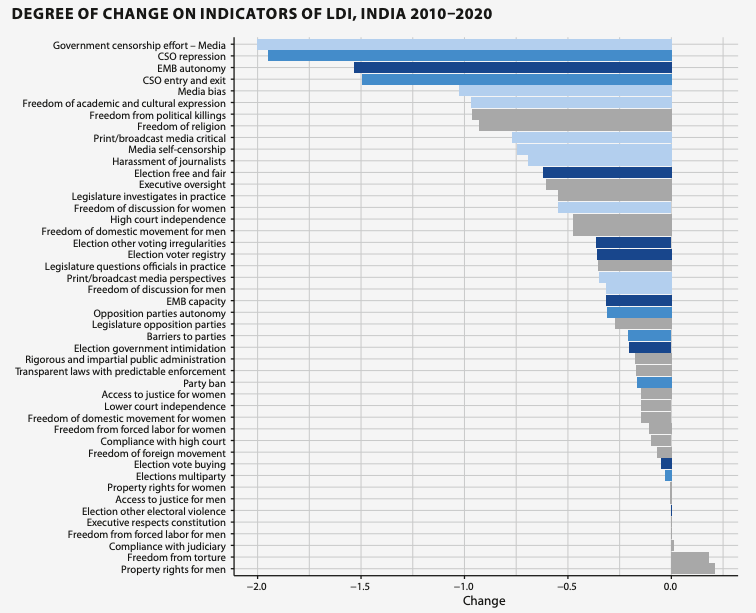
Electoral autocracies continue to be the most common regime type. A major change is that India – formerly the world’s largest democracy with 1.37 billion inhabitants – turned into an electoral autocracy. With this, electoral and closed autocracies are home to 68% of the world’s population. Liberal democracies diminished from 41 countries in 2010 to 32 in 2020, with a population share of only 14%. Electoral democracies account for 60 nations and the remaining 19% of the population. (p13)

Yet, the diminishing of freedom of expression, the media, and civil society have gone the furthest. The Indian government rarely, if ever, used to exercise censorship as evidenced by its score of 3.5 out of 4 before Modi became Prime Minister. By 2020, this score is close to 1.5 meaning that censorship efforts are becoming routine and no longer even restricted to sensitive (to the government) issues. India is, in this aspect, now as autocratic as is Pakistan, and worse than both its neighbors Bangladesh and Nepal. In general, the Modi-led government in India has used laws on sedition, defamation, and counterterrorism to silence critics.1 For example, over 7,000 people have been charged with sedition after the BJP assumed power and most of the accused are critics of the ruling party. (p20)

Recently, the Unlawful Activities (Prevention) Act (UAPA) from 1967 and amended in August 2019 is being used to harass, intimidate, and imprison political opponents, as well as people mobilizing to protest government policies.6 The UAPA has been used also to silence dissent in academia. Universities and authorities have also punished students and activists in universities engaging in protests against the Citizenship Amendment Act (CAA). (p20)

Democracy Report 2021 by V-Dem Institute

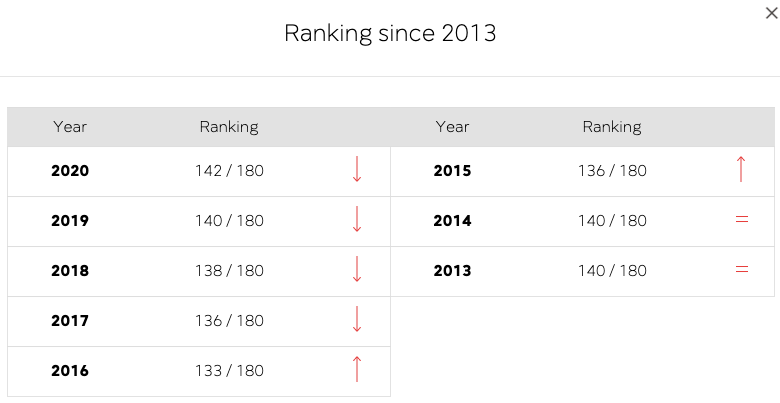
India has consistently been ranked amongst the lowest countries in the annual reports by Reporters without Borders in Press Freedom Index:

Read Rohan Venkataramakrishnan, ‘India complains about low press freedom rank – even as ministers talk of ‘neutralising’ journalists’ Scroll, 28 Mar 2021

Read the piece by Atikh Rashid on “What are democracy and autocracy waves? What’s behind the surge of autocratisation across the world?” Man Bites Dog, 18 Mar 2021

In my own piece written to coincide with 70 years of independence for India and Pakistan, I wrote the following:

Protests at Jawaharlal Nehru University in 2016 and Ramjas College at Delhi University in 2017, with chants of Azaadi (freedom), clearly showed that the idea of freedom is not merely an act of political freedom and is certainly not a freedom from thought in the increasingly mind-numbing and stealth homogenization of the millennial generation. It entails actual and real freedoms, freedoms which allow citizens to exist without fear of persecution, fear of raising critical voices, fear of consumption and cultural practices, fear from oppression and, above all, freedom from having a question mark at their very existence just for being.

The role of any democratic country, with a well-defined rule of law, is to protect all its citizens, ensuring that their rights and freedoms are safeguarded. This is especially true of countries where, as in the case of Pakistan, there is a significant minority; and in the case of India, though a majority Hindu state, secularism is enshrined in its constitution. It is in fact difficult to imagine these lands without the heterogeneity that forms the essence of being South Asian. It is this vibrancy and diversity that gives it character and strength. To move toward a homogenous culture is not only problematic but also dangerous because it is based on exclusivity.

Freedom and Fear: India and Pakistan at 70

1881: the first full census in British India

As we completed the Census 2021 in the UK today, it made me think back to the first Census that was undertaken in British India in 1881. Actually, the first full census was supposed to take place in 1861 but due to the rebellion of 1857-9 and “due to the sensitivity which the British had developed to what, at least in North India, might be constructed as undue interference in the life of the people, the census was postponed until 1871-2” (Cohn, 324). In 1987, Bernard Cohn was perhaps one of the first to put forward the argument that the colonial census played an important role in constructing identities, thinking about their own numerical strength and the possibilities that this presented in a competitive imperial state.

“The actual taking of the census was a two-step affair. Enumerators were appointed by circle supervisors, who were usually government officials. Supervisors were patwaris, zamindars, schoolteachers, or anyone who was literate. They were given a form with columns on which was to be entered information about every member of a household. The information to be collected was name, religion (e.g., Hindu, Muslim), sect, caste, subdivision of caste, sex, age, marital status, language, birthplace, means of subsistence, education, language in which literate, and infirmities. There was a one-month period before the actual date of the census in which the enumerator was to fill in the forms, and then on the day of the census he was to check the information with the head of the household. As an aid to achieving standardization in the recording of information on caste and subcaste, lists were prepared as early as the 1881 census which gave standard names with variations for the castes. The supervisors were supposed to instruct the enumerators in how to classify responses. The lists of castes were alphabetically arranged giving information on where they were to be found and containing very brief notes” (Cohn, 329).

Cohn notes that the most “complex” and problematic question for the census takers was on the issue of caste. He references the work of Srinivas and Ghurye who raised important questions about the relationship between the census and caste, putting forward the question, why did the British officials record the caste of individuals? Was it perhaps curiosity or part of a design by the British? That is, as some nationalist Indians believed, “to keep alive, if not to exacerbate, the numerous divisions already present in Indian society” (Cohn, 327). The second question is to what extent did the census effect people’s notion of who they were? There arguments and connection have subsequently been advanced by many others about the importance of the census in creating and essentialising identities at a time when communalism was taking root. This period of enormous socio-economic change, and politicisation of identities is further entrenched with the enumeration of people and which religion they belong to. Kenneth Jones, in his work on the socio-religious reform movements in British India, highlights that fact that

“Traditionally, Hinduism lacked a conversion ritual. After the introduction of a decennial census in 1871, religious leaders began to focus their attention on the issue of numerical strength. For Hindus the census reports pictured their community as one in decline, its numbers falling in proportion to those of other religions. Christian success in converting the lower and untouchable castes furthered Hindu fears and led the militant Aryas to develop their own ritual of conversion, shuddhi. Initially shuddhi was employed to purify and readmit Hindus who had converted to Islam or Christianity” (Jones, 100).

Indeed, Gopal Krishan, in his study on the demography of the Punjab, highlights that

“The most fascinating demographic feature of the colonial Punjab was the religious composition of its population. While it represented an evolution of a cultural diversity in history, it became a new and divisive force in polity over time. It was on the basis of religion that the British India was partitioned; and more pertinently the partition was specific to only two provinces, Punjab and Bengal. These two provinces were marked by not only a sensitive composition of the Muslims and non-Muslims (essentially Hindus and Sikhs in the case of Punjab) but also by regional segregation of the two religious’ groups, by and large. In Bengal, the Muslims were in overwhelming majority in the eastern segment and the non-Muslims in its western counterpart; in Punjab, the picture was in reverse, with the Muslims in a large majority in the western wing and the non-Muslims in the eastern” (Krishna, 83).

When it finally came to the Partition in 1947, Sir Cyril Radcliffe was using what are considered to be out-dated figures from the Census conducted during World War Two in 1941. However, the lines between two countries were drawn based on this information.

Bhagat Ram B. ‘Census enumeration, religious identity and communal polarization in India.’ Asian Ethnicity, 2013, 14:4, 434-448, DOI: 10.1080/14631369.2012.710079

Bhagat, Ram B. ‘Census and the Construction of Communalism in India.’ Economic and Political Weekly (2001): 4352-4356.

Bhagat, Ram B. ‘Caste Census: Looking Back, Looking Forward.’ Economic and Political Weekly 42, no. 21 (2007): 1902-905. Accessed March 21, 2021. http://www.jstor.org/stable/4419628.

Cohn, Bernard. ‘The Census, Social Structure and Objectification in South Asia’, in Sarkar, Sumit, and Tanika Sarkar. Caste in Modern India (Orient Blackswan, 2018).

Jones, Kenneth W. Socio-religious reform movements in British India. Vol. 1. Cambridge University Press, 1989.

Krishan, Gopal. ‘Demography of the Punjab (1849-1947).’ Journal of Punjab Studies, 11, no. 1 (2004): 77-89

Singh, Joginder. ‘The Sikhs in the British Census Reports, Punjab.’ Proceedings of the Indian History Congress 46 (1985): 502-06. Accessed March 21, 2021. http://www.jstor.org/stable/44141395.

Yengde, Suraj. ‘Adivasis are not Hindus. Lazy colonial census gave them the label.’ The Print, 9 March 2021.

The 1881 Census is digitized and available via: The Government of India or Digital South Asia Library.

The Incredible Story of Nek Chand Rock Gardens, India

This account has rekindled memories of visiting the Rock Gardens in Chandigarh. I have pre-digital age photographs and will share those on my blog but this is a wonderful piece on the unique history of Nek Chand.

The Nek Chand Rock Gardens had been on our radar for a long time before we finally made it there. Located in the city of Chandigarh, at the foot of …

The Incredible Story of Nek Chand Rock Gardens, India

Revolution in their blood

Harinder Bindu and Sonia Mann have become prominent faces at the ongoing farmers’ movement. Both Bindu and Mann’s fathers were gunned down by Khalistanis during the militancy in Punjab, in the early 1990s. “What does this society think of women? This society’s Manusmriti, its religious institutions, and its other institutions, they think that ‘Women have no wisdom. They should be kept under our shoes,’” Bindu said. “But we say ‘No.’ Women are equal to men and they too have the right to struggle. For a life of equality, for a good life, they should fight.” “They [the government] are the ones operating like terrorists,” Mann said. “They are the ones shooting cold water [from water canons] at us and our elders, throwing tear gas at them, and hurting them [elders].” Shahid Tantray reports. Camera by CK Vijayakumar and Tantray. #FarmersProtest

The Making of the Indian Middle-Class

Nothing has captured contemporary adjectives around India more than its seemingly inevitable and irresistible MIDDLE-CLASS; a cursory survey yields an expansive collection of studies on the subject. The key question in them often is how to define this broad category.

According to Abhijit Roy and based on data by “the World Bank and the Organization for the Economic Cooperation and Development (OECD), for those in the middle classes, the earnings typically lie in the range of US $10 to $100 per day, as expressed in the 2015 purchasing power parities”. Using the India Human Development Survey II (2011–12), Maryam Aslany reveals significant findings about the Indian middle class:

“(1) It calculates the size of the middle class to be 28.05% of the urban and rural population. (2) It demonstrates that despite the occupational diversity that exists, a large proportion of the middle class are salaried employees. (3) It demonstrates that contrary to common assumptions, a considerable segment of the Indian middle class resides in rural areas. (4) The fastest growth is in the lower middle classes, who spend between US $4 and $6 per day. This group includes carpenters, street vendors, decorators and drivers”.

Statistical evidence aside, one of the key elements of a middle class is how this class shifts from need to want – a key component of the capitalist model, which creates the desire to consume something, even when it is not required. This is an aspirational desire and in India, the strong connection to society/samaaj ensures that this “want and desire” has a strong market, from whose epicentre – Bombay/Mumbai – economists have defined the middle class as “consumers spending from US $2 to $10 per capita per day. By this definition, approximately half of India’s population of 1.3 billion is in the middle class” (Roy).

Employable education is often seen as one of the key routes to this upward mobility. But once successful, there is also potentially a “tussle between individuality and community: seeking novel self-expression in new jobs and leisure or taking risks with autonomy (the divorce rate is growing, from a low base), but also attempting to keep a sense of community, with dutiful support of parents (a high number of IT professionals buy cars for their parents) and strenuous attempts at maintaining a social circle (oriented around alcohol, movies, resorts and restaurants)” (Ram-Prasad).

One of the challenges with understanding how class works in India is the overlaps with caste. It is often difficult to disaggregate the two. “Upper-caste elites have, in recent decades, become used to those below them in the hierarchy accruing economic power, especially since liberalisation in the early 1990s. The new middle class argues that since it had no help from older elites, its success is self-made and ought to be the model for the poor. But the poor are still usually from castes traditionally lower than those of the new middle class—and this acts as an obstacle to their advancement” (Ram-Prasad).

One of the key things that I have observed over my three decades of travelling to India is the shift in people’s attitude after the liberalisation of the economy. Over a period of time, an airy sense of arrogance, importance and arrival at the global stage has replaced the grounded humility, self-reflection and non-aggression that had wider traction. In part, these attitudes can be traced back to the freedom movement and it is interesting to reflect back to when India had only recently gained independence.

The following extracts from G. L. Mehta, a long-serving Indian Ambassador to America in the mid-1950s, highlight the then- “numerical insignificance” of this ubiquitous group of the middle classes:

“In India, government officials, professional men like lawyers and doctors, technicians and teachers, shop-keepers and clerks are all part of the inchoate group, which goes by the name of “middle classes”. Although merchant classes and officials in medieval India were a group, the middle classes are of a comparatively recent origin. In a society, where caste and status determined the social structure, the middle-income group did not wield any political power nor did they enjoy any social prestige…

…the rise of the middle classes has been due as much to the advent of foreign rule as to the impact of economic forces…There is no gainsaying the fact that our national movement has had its origin and impulse from the middle class. Indeed, the leaders of the labour movement have also been drawn mostly from the middle classes. These classes have largely helped to make India what it is, both in its strength and in its weaknesses…

…the striking fact, however, is their numerical insignificance. An examination of the income-tax statistics shows that in the Indian Union, the numbers of those earning between Rs. 300/- and Rs. 2000/- per month add up to only a little over 3 lakhs. Allowing for 5 dependents to every income earner, it would appear from this that the core of the middle classes in India consists of less than 2 million out of 350 million people…

…in 1938-39, their share of the national income was roughly 5%; today their share is more 3 ½-4%. While the rising prices of the last decade have created higher incomes and pushed up people, it is only a few in the upper income groups, who have stood to gain. Those earning between Rs. 500/- and Rs. 1000/- per month had an annual income of Rs. 80 crores in 1948-49 compared to Rs. 50 crores in 1938-39 but those in Rs. 1000/- and Rs. 2000/- group had Rs. 100 crores in 1948-49 compared to Rs. 30 crores in 1938-39 and those with incomes of Rs. 2000/- per month shared nearly Rs. 160 crores in 1948-49 compared to Rs. 30 crores in 1938-39…

…these distributional changes, together with the general stagnation in the economy, have created a situation of great stress and strain. The middle classes have, on the whole, stopped recruiting from below. Unless the middle classes can improve their economic condition in pace with the growth in their numbers, they are bound to suffer frustration and disillusionment, in proportion with unemployment and inflation. As the London Economist said recently commenting on the situation in India, “when the shop-keeper flourishes and the clerk starves, revolution is round the corner, for the educated middle class will tolerate only so much” (!)…

…but the future of a class, which is not allied to any special interest in uncertain. Equally, if the middle classes are to maintain their leadership, they should avoid freezing into a static group. They will have, therefore, to absorb continuously waves of people ascending from the ranks of peasants, artisans and labourers. At the other end they would have also to discard those whose stakes in the system are so great that they become an impediment to change…because the middle class, and its professional core in particular, can check the acquisitive instincts of the Economic Man. Perhaps it may be the role of the middle-class, to show us the middle way between freedom and order, enterprise and social security”.   

References:

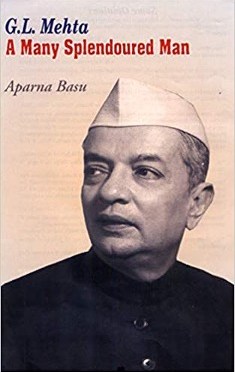
Above extracts from an All-India Radio talk, 14 January 1951 by G.L. Mehta (A Many Splendoured Man, Aparna Basu, 2001)

Maryam Aslany, ‘The Indian middle class, its size, and urban-rural variations’, Contemporary South Asia, 2019, 27:2, 196-213, DOI: 10.1080/09584935.2019.1581727

Abhijit Roy, ‘The Middle Class in India: From 1947 to the Present and Beyond’, Spring 2018. https://www.asianstudies.org/publications/eaa/archives/the-middle-class-in-india-from-1947-to-the-present-and-beyond/

Ram-Prasad Chakravarthi, ‘India’s middle-class failure’, 30 September 2007. https://www.prospectmagazine.co.uk/magazine/indias-middle-class-failure

Brant Moscovitch, ‘A Liberal Ghost? The Left, Liberal Democracy and the Legacy of Harold Laski’s Teaching,’ The Journal of Imperial and Commonwealth History, 2018, 46:5, 935-957, DOI: 10.1080/03086534.2018.1519245

Mottled Dawn – Subh-e Azadi

© 2020 Pippa Virdee

This post is inspired by the sky outside, which immediately reminded me of Manto’s Mottled Dawn. Saadat Hasan Manto, born in Samrala, Ludhiana, is considered one of the most iconic Urdu writers of the twentieth century. He lived in Bombay until 1948 and worked as a successful screenplay writer for the film industry, but even he finally relented and left India for Pakistan. Khalid Hasan writes, “Manto left Bombay, a city that he loved and a city that he yearned for until his dying day, soon after Partition. He felt deeply disturbed by the intolerance and distrust that he found sprouting like poison weed everywhere, even in the world of cinema. He could not accept the fact that suddenly some people saw him not as Saadat Hasan but as a Muslim.” Mottled Dawn: Fifty Sketches and Stories of Partition (Intro. Daniyal Mueenuddin and trans. Khalid Hasan, Penguin Modern classics), brings together stories of dark humour and horror, powerfully capturing the tragedy of Partition. The book begins with the opening lines of Faiz Ahmed Faiz’s Subh-e Azadi – Mottled Dawn.

Below is the full poem by Faiz, courtesy of Penguin.

Subh‐e Azadi
Yeh daagh daagh ujaalaa, yeh shab gazidaa seher
Woh intezaar tha jiska, yeh woh seher to nahin
Yeh woh seher to nahin, jis ki aarzoo lekar
Chale the yaar ki mil jaayegi kahin na kahin
Falak ke dasht mein taaron ki aakhri manzil
Kahin to hogaa shab-e-sust mauj ka saahil
Kahin to jaa ke rukegaa safinaa-e-gham-e-dil
 
Jawaan lahu ki pur-asraar shahraahon se
Chale jo yaar to daaman pe kitne haath pade
Dayaar-e-husn ki besabr kwaabgaahon se
Pukaarti rahi baahein, badan bulaate rahe
Bahut aziz thi lekin rukh-e-seher ki lagan
Bahut qareen tha haseenaa-e-noor ka daaman
Subuk subuk thi tamanna, dabi dabi thi thakan

Suna hai, ho bhi chukaa hai firaaq-e-zulmat-o-noor
Suna hai, ho bhi chukaa hai wisaal-e-manzil-o-gaam
Badal chukaa hai bahut ehl-e-dard ka dastoor
Nishaat-e-wasl halaal, o azaab-e-hijr haraam

Jigar ki aag, nazar ki umang, dil ki jalan
Kisi pe chaaraa-e-hijraan ka kuch asar hi nahin
Kahaan se aayi nigaar-e-sabaa, kidhar ko gayi
Abhi charaag-e-sar-e-raah ko kuch khabar hi nahin
Abhi garaani-e-shab mein kami nahin aayi
Najaat-e-deedaa-o-dil ki ghadi nahin aayi
Chale chalo ki woh manzil abhi nahin aayi
 —Faiz Ahmed Faiz

The Dawn of Freedom, August 1947
This light, smeared and spotted, this night‐bitten dawn
This isn’t surely the dawn we waited for so eagerly
This isn’t surely the dawn with whose desire cradled in our hearts
 
We had set out, friends all, hoping
We should somewhere find the final destination
Of the stars in the forests of heaven
The slow‐rolling night must have a shore somewhere
The boat of the afflicted heart’s grieving will drop anchor somewhere
When, from the mysterious paths of youth’s hot blood
The young fellows moved out
Numerous were the hands that rose to clutch
the hems of their garments,
Open arms called, bodies entreated
From the impatient bedchambers of beauty—
 
But the yearning for the dawn’s face was too dear
The hem of the radiant beauty’s garment was very close
The load of desire wasn’t too heavy
Exhaustion lay somewhere on the margin
 
It’s said the darkness has been cleft from light already
It’s said the journeying feet have found union
with the destination
The protocols of those who held the pain in their
hearts have changed now
Joy of union—yes; agony of separation—forbidden!
 
The burning of the liver, the eyes’ eagerness, the heart’s grief
Remain unaffected by this cure for disunion’s pain;
From where did the beloved, the morning breeze come?
Where did it go?
 
The street‐lamp at the edge of the road has no notion yet
The weight of the night hasn’t lifted yet
The moment for the emancipation of the eyes
and the heart hasn’t come yet
Let’s go on, we haven’t reached the destination yet
—Translated by Baran Farooqui