Tag Archives: India

From the archives: 2 letters – Patel to Nehru

Nehru & Patel

62 (II), Patel to Nehru, 7 November 1950:

My Dear Jawaharlal, [in hand-writing]

I am most grateful to you for your affectionate greetings and good wishes on my birthday and for the very kind terms in which you have conveyed your message to the public meeting at Ahmedabad. It is my earnest and heartfelt prayer that I continue to serve my country up to the very end and that I live long enough to see it emerge happily out of the critical period through which it is passing. Whether God will answer my prayer is in the lap of future, but your affection and leadership sustain my faith in it and your appreciation gives me strength and support for which I am deeply obliged.

With love,

Yours Vallabhbhai Patel [in hand-writing]


63 (II), Patel to Nehru, 14 November 1950: 

[Entirely handwritten]

My Dear Jawaharlal,

My affectionate greetings on your birthday. Relations between us transcend formalities and I need hardly say anything more than this: it is my fervent and heartfelt prayer that you may live long and well to lead the country through all difficulties and establish in it an era of peace, happiness and prosperity. I so much wanted to come to your place since this morning but I have been feeling out of sorts since yesterday and I could not do so.

Yours Vallabhbhai

From Ambedkar to Mayawati

This slideshow requires JavaScript.

Patangbaazi greets one at the magnificent Parivartan Sthal (Ambedkar Memorial Park) complex constructed by the orders of Chief Minister Mayawati and completed by 2009-10. It is a park today and has from khomche to ice-cream, from couples to families, from beggars to bourgeoisie and all castes in the midst. Stretching along the river-front, a tourist-spot complete with statues and footpaths, in marbles and sandstones, it has a marvellous sense of space. An extraordinary, larger-than-life and gargantuan assertion of identity, dignity and deities – Ambedkar and wife, Kanshiram and Mayawati on opposite sides – this is not merely a reclaiming, recovery of history. It is not even an attempt to re-write history. This set-up, so reminiscent of the Lincoln and Luther King Memorials in Washington, is a grabbing of past and present by its throat and laying down a marker for future. 

The geometrically precise, expansive space – rational and theistic with its human-Gods – has a jarring note struck by the VIP Lounge on one side of the entrance with the other side being for reserved for others. One long path takes tourist-pilgrims to a stupa-hill, rock-cut alignment with huge mural depictions of Ambedkarite Buddhism from deeksha to nirvana. Hues of blue lighting enhanced the sandstone, soil-coloured backdrop amidst which stood exceptionally well-done, real-life-likeness statues. Ambedkar is sitting majestically in the Lincoln pose in the sanctum-sanctorum. On the circular walls, on one side, Ambedkar is ‘giving’ the gift of Constitution to Babu Rajendra Prasad, the upper-caste Chairman of the Indian Constituent Assembly and on the other, Ambedkar is shown receiving the gift of deeksha from a Baudh-Bhikshu. 

Guest Post.

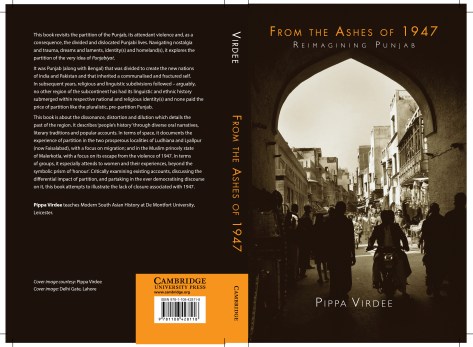
From the Ashes of 1947: Reimagining Punjab

From the Ashes_Full Cover

Full details: From the Ashes of 1947

Watch the panel discussion with Pippa Virdee (De Montfort University, UK), Afzal Saahir (Poet and Radio Host) and Sajid Awan (Quaid-e-Azam University) of my book From the Ashes of 1947 at the Afkar-e-taza, January 2018 Panel Discussion

Living in Coventry: from Thatcher to May

Screen Shot 2017-12-11 at 15.18.21This week Coventry successfully won the bid to be the city of culture in 2021. Subsequently, there have been numerous articles about Coventry in the media, reflecting both the history and lived experiences of the city. The response has also been mixed in the sense that some people have continued to dwell on the lack of culture and “beauty” in the city, and in part this is true. The more optimistic see this as an opportunity to revive the glorious past with renewed energy.

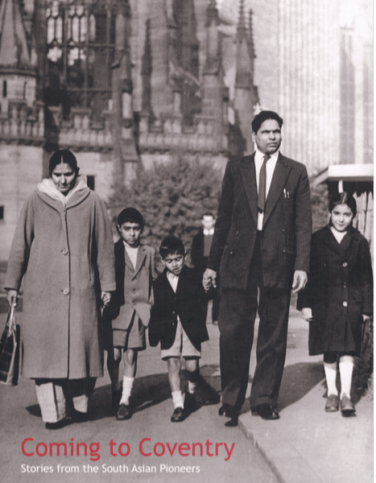
As I reflect on the city’s bid to become the city of culture, I remember an oral history project, which I did in 2005-6, Coming to Coventry. It was funded by the HLF and supported by The Herbert and documented the migration of South Asians to Coventry from the 1940-60s. We collected over fifty oral accounts of people, who migrated here and, through these testimonies and the beautiful pictures that people shared with us, we documented their journeys to Coventry in search of a better life. Many of the early migrants had intended to go back home but gradually, some of them made Coventry their home. They contributed to the growth and development of the city in the heyday of the post-war years. The 1970s were, of course, to bring about change and the consequent downturn was not kind to Coventry.
The time through the duration of the project gave me an insight into the city, which I did not fully comprehend before. It made me reflect on my own experiences of migrating to it. Coventry is a city that I came to, not out of choice but as a child accompanying my mother. At the time, I had no preconceptions of the city and my response was only that of a child, who could not quite understand the upheaval of migration and dislocation to a “foreign” land. It could have been anywhere and I suspect the response would have been the same. Nonetheless, Coventry became my home while growing up in 1980s Britain: a challenge in itself. In the backdrop were Thatcher’s Britain, the Falkland’s war, the vibrant music of the 80s, racism and the declining car industry in Coventry. Gradually the former car plants gave way for housing and retail parks. The city changed and adapted, as did I. But the years of the Thatcher administration left its mark on me, especially when I was beginning to see and understand the society around me, even though the Prime Minister would have us believe that there was no such thing as society. Studying politics, sociology and art seemed to me a perfect combination in response to the excesses of Thatcherism.
The pursuit of knowledge led me to University and I had two choices, University of Warwick or the newly created Coventry University. Despite having a place at the former, due to personal circumstances, I chose the latter. I had felt out of place at a visit to the former and besides, something caught my eye on the courses offered at Coventry University, namely, the opportunity to study the history of India and Pakistan – from where I and my parents originally came from. As that has become my life’s calling, I have stayed in Coventry, despite subsequent other opportunities. There is something quite strong and resilient in the city, which has kept me here, in my adopted home of over three decades. It is, as many have pointed out not the most attractive city and lacks many amenities, yet, there is a subaltern robustness and romance to Coventry. The city, for all its drawbacks, is standing, attempting to reinvent and reimagine itself. For me, it provides my base, which is provincial, on-the-margins and of the under-dog; these feed the spirit and space to keep hoping and doing.

Lucknow: the Awadhi ‘heartland’.

This slideshow requires JavaScript.

Lucknow is the capital of the Indian subcontinent’s Awadhi ‘heartland’, in historian Gyanesh Kudaisya’s evocative words. Less evocatively, it is the capital of the Indian State of Uttar Pradesh (UP) and its largest city with a population of three million people, of which 26 per cent are Muslim. It is the centre of Shia Islam in India, historically the capital of Awadh, it was one of the major centres during the rebellion in 1857, the cultural capital of north India and home to the famous Chikankari embroidery work, thought to be popularised by Nur Jahan. The Nawabs of Lucknow were known for their refined tastes as much as their extravagant lifestyles, and the city has most beautifully been captured and bought to life in the 1977 film, Shatranj ke Khiladi that was based on the Hindi short-story of the same name by Munshi Premchand  and the 1981 film, Umrao Jaan that was based on the Urdu novel Umrao Jaan Ada by Mirza Hadi Ruswa. Set in mid-nineteenth century Lucknow, they show the decadence of the Lucknavi high society through the life of Nawabs and courtesans, the moral decay/hypocrisy around their lives in the backdrop of political intrigue and rebellion. Shift to the present-day Lucknow/UP and the state is better known for returning a thumping win in the state election of 2017 for an ascending Hindu ‘nation’ led by Narendra Modi and, in return, finding itself being ruled by a Yogi. A milieu previously famous for its adab-tehzeeb is now the habitus of Adityanath and his terrific to many, terrifying to some, presence.

A recent visit their began at the annexe of the Charbagh station, past the pillars of the fly-overs of the-then on-going metro constructions and a rather tasteful red-and-white façade of the Charbagh metro-station with its Jali décor; apropos which my auto-wallah remarked, ‘Akhilesh ne kaam to bahut kiya par chacha ne harwa diya’. In no time, we were in old Lucknow; the narrow, congested streets of Aminabad, where the first thing noticeable was that while many shops had named the lane we were on as Latouche Road, others had it as G.B. Road, for, Gautam Buddha. The incongruity of being in a space that marked its time from both the British Lt-Governor Sir James Latouche (AD 1901-06) and the Shakyamuni Siddhartha (563-483 BC) did not end there. It was also reflected in much of the arms, air guns et al, and ammunitions market on one side being stared at by hundreds of chickens from their kens in many of the poultry-khanas on the other. While the arms stores dated back to 1933, 1940s-50s, prominent among these being Gupta Brothers, Hashim Manzil, with their colonial, hanging, dilapidated balconies, small windows, tapering and peeling pillars, darkening, decaying visage, plants growing out of lime plastered walls, the poultry-khanas seemed without pedigree. Amidst this sea of noisy chatter around the selling of guns and the stoically silent birds, there was also a serene and strikingly yellow-coloured masjid/madrasa and its school of calligraphy. It plainly stood apart and alone in its intent and purpose.


“The real meaning of life”: the tomb of Khwaja Khizr

The city of Sonepat, in present day Haryana State, hardly has anything of note for the wandering and curious tourist but surprisingly there are a few gems hidden away. Tucked away in the semi-urban landscape is the tomb of Khwaja Khizr, surrounded by a lush green garden, buffaloes and residential housing. Standing tall and elevated on a mound is the tomb, overlooking the city of Sonepat. Local residents and the accidental tourists looking for scenic open spaces come here and congregate around the garden. Relaxing in the open air, families surround the tomb, passing time or having picnics; children play games and make merry. And the occasional visitor ventures inside the tomb to pay their respects or simply out of curiosity.

This stunning tomb was built over the remains of Khwaja Khizr. According to a Persian inscription on the site, Khwaja Khizr was the son of Darya Khan Sarwani. Darya Khan himself was an influential noble in the court of Sikandar Lodhi. Work commenced on the tomb in 1522 and was completed by 1524 by Ibrahim Lodhi.

Latif writing in 1889 notes:

Sikandar Lodi died in 1517 in Agra, his son Ibrahim Lodi ascended the throne. Dissatisfied with the court of Delhi, Doulat Khan Lodi (Sikandar’s uncle and viceroy of the Panjab) sent his agents to Kabul to urge Baber, the Moghal prince, a son of a great-grandson of Tymur, to attempt the subjugation of the empire of Hindostan, in imitation of his ancestor’s conquests. Baber, accordingly invaded India in 1526, and a battle was fought between the Moghals and Indians on the plains of Panipat, a battle-field on which the fate of India has so often been decided. This memorable battle, which was fought on the April 21, 1526, resulted in the victory of Baber. Ibrahim Lodi, the last of the dynasty, was slain on the field, and by his death a new dynasty under the Moghals was established. The reign of Ibrahim Lodi had lasted twenty years and the dynasty to which he belonged seventy-six in three successions, from 1450 to 1526. (Syed Muhammad Latif, History of the Panjab, 1889)

Locally Khwaja Khizr was revered as saint; he apparently renounced his courtly lifestyle in favour of pursuing a simple life inspired by the Sufi tradition. Like many before him, he was in search of the real meaning of life. Carefully leaving their shoes/slippers outside, the occasional devotees go inside the tomb to pay homage, lighting an incense stick, leaving offerings and tying treads for manants. The syncretic tradition associated with this historic land still finds places to hide-away and co-exist. For the curious visitor, the tomb itself is a rare example of being built with kankar (variety of limestone) blocks and red sandstone. The wide staircase leads to the two-arched gateway. The Indo-Islamic style of architecture sympathetically reflects the fusion and syncretic tradition. While reading around to find out more about the shrine, there was an article which suggests that ‘the tomb was once decorated with blue tiles – now missing – and that it was repaired in 1921-22 at a cost of Rs 130 although the sanctioned amount was Rs 167!’ (http://portofcall1.blogspot.in/2010/12/sonepat-beyond-toughs.html) Although the tomb could certainly do with some more care and attention, it is still worth a visit for the accidental or the intentional tourist who happens to pass by Sonepat. Neglect, whether this is willfully done or not, means that places like these fall into disrepair and with them they erase centuries old histories.

Tomb of Khwaja Khizr (Khijar Makbara and Park) – Sonepat, India https://www.youtube.com/watch?v=sZLZNr9bFdo

Durga Mandir/Juma Masjid

This slideshow requires JavaScript.

In an unassuming side street of an old residential area in Sonipat is a hidden gem and remnant of the past. Durga Mandir of Mohalla Kalan in Sonipat is still popularly known as Badi Masjid (big/greater Mosque). The latter should give an insight into the former life of this Mandir, which once was a Masjid. Even today looking at the exterior of this mandir it could quite easily be confused for a masjid. It stands tall and looks grand in the red stone façade with a courtyard for Friday prayers which probably attracted many of the local Muslims in pre-partitioned Punjab. Apart from the obvious changes of installing flags and idols, the three main domes and minarets are easily identifiable with that of a small Juma masjid.

Like many other places of East Punjab, the Muslims of Sonipat migrated to Pakistan, leaving behind their homes and places of worship. These were quickly claimed by the incoming Hindus and Sikhs. Muslims were often the second largest group in these areas. For example, Muslims were significantly present in cities like Hissar (28%), Gurgaon (34%), Karnal (32%) and Ambala (32%) Rohtak (17%); all of these are part of present-day Haryana State. Most of the Muslims abandoned their homes in the ensuing violence of August 1947 and fled to Pakistan. Similarly, in Pakistan, many of the old abandoned religious (Gurdwaras and mandirs) buildings were converted/neglected by the incoming populations to be utilised for their own purposes. See link below for more about this.

In this case, the masjid has been converted into a Durga Mandir, a temple for worshiping Goddess Durga. It is now known as ‘Sri Sanatan Dharm Sabha Panji Durga Mandir.’ The Goddess Durga assumes the central position in the mandir and is surrounded by other deities; outside in the courtyard is an encased idol of Baba Sai. The dome interior has recently been filled to mask the obvious Islamic style architecture but the exterior remains as before. The link below provides further information on the Badi Masjid but more interesting are the photos. The short article was posted in October 2015, and the pictures shared are quite different from when I went to visit the site recently. The interior now has been changed to hide all signs of its former existence as a masjid. The pictures from 2015 show the perfect domes and remnants of frescoes and tiling from before. The fact that much of the interior has been transformed in the past two years is telling of the Hindutva agenda prevailing in the region.

Sonipat in August 1947 was a small city in united Punjab, then it became a city in East Punjab and eventually a part of Haryana after the reorganisation of East Punjab in 1966. There is little in the history books about the intervening years before it became part of Haryana, yet a lot has changed in this area. Looking at Sonipat today, it is difficult to tell that this historic city was once communally diverse with Punjabi Hindus, Sikhs, Muslims and Christians. Today it feels very much like a Hindu city. Perhaps the latter is more of a reflection of the current climate in India. But hidden away are these old structures that remind us of a different time and a different history.

Read further about Sonepat’s Badi Masjid and see pictures from 2013. http://www.gounesco.com/badi-masjid-sonipat/

Pakistan’s long forgotten Hindu temples and gurdwaras. http://blogs.tribune.com.pk/story/15785/pakistans-long-forgotten-hindu-temples-and-gurdwaras/

The Politics of Partition and its Memory


Now that the euphoria over independence day “celebrations” and remembering partition are over, it is worthwhile remembering that it was in fact today, 70 years ago, that the Radcliffe Line was made public. Millions of people woke up on 15 August not knowing which side of border they would be on, today their fate was sealed. Sitting in Delhi on this day, having seen the way both Pakistan and India remember 14/15 August 1947, it is a stark reminder of how chaotic this process must have been.

The month of August in the sub-continent is when the monsoon rains gush down intermittently. The heavy rains leave places incapacitated due to the deluge that falls. Even today, where there is improved drainage, the monsoon rains have the capacity to bring towns and cities to a standstill. So, thinking about this back in August 1947, it is staggering to think that the last Viceroy, Louis Mountbatten, decided that 15 August would be the date for independence. The date was chosen because it coincided with the date when Japan surrendered after it was devastated by the nuclear bombs in Hiroshima and Nagasaki. Mountbatten was clearly sentimental about the date because he was Supreme Allied Commander of South-East Asia when Japan surrendered. But he also failed to show any foresight when it came to the sub-continent. All the leaders failed to anticipate that millions of people would be engulfed by violence and thus forced to flee and that too in the difficult month of August. This only added further to their misery and fuelled diseases in refugee camps. It must be kept in mind that the violence that was unleashed in August 1947 was not an isolated incident, it was a culmination and continuation of previous episodes of horrific communal/political violence in which many lost their lives and were displaced. It was thus not entirely unexpected, nor was it just spontaneous.

The British media (TV, Radio and Print) has decided to cover partition/independence extensively and interestingly for this decennial anniversary they have been giving full coverage to the voices of ordinary people. The BBC has had a full season of programmes (one of which I contributed to) devoted to India and Pakistan at 70. I have personally spent the last sixteen years working on partition and its wider impact on the Punjab region, so the ordinary voices are not new to me. In fact, this trend in scholarship has been evolving and growing for the past twenty years. What is sobering is how the coverage has differed in India, Pakistan and the UK. I can only speak about these three because I know them well and they were of course at the epicentre of this.

While there is still a huge gap in our understanding of empire and its consequences, these programmes are important in reaching out to ordinary citizens, to educate, to inform, to illuminate the travesty of empire and its end. They also serve as important markers of remembering, but that alone is not enough. Which is why being in India/Pakistan during the days of August has been important. It highlights the disparity between the diaspora and those who live here. Capturing and sharing the narratives of survivors is important but from an academic perspective, what do these voices mean, what do they tell us, why are they still relevant? The memorialisation of this memory and how it tells this story is also significant. There is little worth in collecting hundreds and thousands of accounts by survivors if this is not contextualised or critically framed in the existing historiography. A simple account of someone’s life and their experiences is important but what about beyond that? What lessons can we take from this?

And our politicians are still in the business of selling a myth of a glorious past and a dream for the future. It is that future which needs to be critically examined in relation to the previous seventy years. Pakistan today seems fragile as ever but (and more importantly its people) it is a resilient country. For the best part of the last seventy years Pakistan has been swinging between military dictatorship and democratic rule, while India, largely a democracy, has been busy playing and expanding upon the Hindutva card. A future in which we see a further entrenchment of Islamic Pakistan and Hindu India is entirely possible and while not a recent development, it does need to be contextualised firstly in colonial history and secondly in the how the developments of the past seventy years led to this. Of concern for everyone should be that in this vision to be exclusively majoritarian, both India and Pakistan would lose an asset: its significant minorities. The diversity in all its richness is what makes these countries vibrant and valuable, they should be celebrated rather than suppressed and targeted. And so, seventy years on, while we remember the people who suffered in the great partition, let us not forget that there a battle going on today for the hearts and minds of people. Which is why it is seemingly more poignant being here in the sub-continent at this moment because it is a reminder of the unfinished business of azaadi beyond empire.