Tag Archives: Hindus

Remembering Partition in the Punjab – podcast

Earlier in the summer I recorded a podcast with Realms of Memory. There are two episodes for those interested in understanding more about the history of Partition, especially how it impacted the Punjab. The talk was based on my book, ‘From the Ashes of 1947: Reimagining Partition’ published by Cambridge University Press (2018). In the podcast I also discuss some of the recent changes that have taken place in the study in Partition.

You can listen to the podcast via most streaming sites, or via Realms of Memory

Remembering Partition in the Punjab: Part 1

Remembering Partition in the Punjab: Part 2

Dr. B.R. Ambedkar: Castes in India: Their Mechanism, Genesis, & Development

© 2017 Pippa Virdee

Dr. B.R. Ambedkar (born April 14, 1891, Mhow, India—died December 6, 1956, New Delhi), leader of the Dalits (Scheduled Castes; formerly untouchables), chairman of the drafting committee of the Constituent Assembly of India (1946-49) and law minister of the government of India (1947-51).

On his 131st birth anniversary, I share below an excerpt from a paper read by a 25-year-old Ambedkar titled Castes in India: Their Mechanism, Genesis, and Development, at Columbia University, New York, U.S.A. on 9 May 1916:

Subtler minds and abler pens than mine have been brought to the task of unravelling the mysteries of Caste ; but unfortunately it still remains in the domain of the “unexplained”, not to say of the “un-understood” I am quite alive to the complex intricacies of a hoary institution like Caste, but I am not so pessimistic as to relegate it to the region of the unknowable, for I believe it can be known. The caste problem is a vast one, both theoretically and practically. Practically, it is an institution that portends tremendous consequences. It is a local problem, but one capable of much wider mischief, for “as long as caste in India does exist, Hindus will hardly intermarry or have any social intercourse with outsiders; and if Hindus migrate to other regions on earth, Indian castes would become a world problem.”

Dr Babasaheb Ambedkar: Writings and Speeches, Vol. 1, pp. 5-6

And pasted below are a slice of the meagre UK newspaper reportage across the first three decades after Ambedkar’s death, when he was not the indispensable icon that he has become in the India since 1990-91:

“Dr Ambedkar”, ‘…had once thought of asking to be received as a Sikh’ – political rather than theological conversion to Buddhism, therefore – opinion is equally divided on whether Untouchability is dying out or whether the caste system is still rigid, though it may take rather new forms’ – ‘the Untouchables would be happier if, without exaggerating their separateness from the main body of Hindus, they can produce more leaders to carry on Ambedkar’s work’.

7 December 1956, The Manchester Guardian, p. 10

“India’s former Untouchables seek arrest” – ‘Harijans all over India have launched an agitation to press their demands…yesterday 500 demonstrators courted arrest…but the Harijans lack the political organisation or the strength within society to raise anything more than a matter of discontent, easily ignored…the Harijan agitation is being directed by the RPI, the descendent of the old SCF, which the late Dr Ambedkar made a political force in the years before independence but which has shrunk in influence [since]…the agitation was launched on Dr Ambedkar’s birthday yesterday in support of a charter of 10 demands placed before the PM two months ago (land, houses, fair distribution of food grains, enforcement of the laws against untouchability and “immediate cessation of harassment” of Harijans)…the Harijans are stirring…stiffening through desperation or anger [as evidenced] by clashes between caste Hindus and “neo-Buddhists” (Harijans who have converted to Buddhism) in Maharashtra’.

8 December 1964, The Times, p. 9

“The timeless untouchable Indian problem” – ‘not a small minority: 20% in UP, WB, Haryana, Punjab; 10% in Gujarat, Maharashtra, Kerala, and Assam… ‘what has happened to [them] in these past 30 years? Very little, according to Mr. Dilip Hiro, The Untouchables of India. [On] the Untouchability (Offences) Act, 1955, ‘if we took this law seriously, said one state police chief, half the population in the state would have to be arrested’. [Reservation] ‘has tended to break up or drain off any kind of movement fighting for untouchable rights…Dr Ambedkar, the first Untouchable leader, believed that their status would be ameliorated only when the caste system itself was ended in India and there are no signs at all of that. Among western anthropologists, this…may be seen as an effective and defensible ordering of society. Nor does it seem likely that Mrs. Gandhi’s new order, powered by the authority of Kashmiri Brahmins, is going to start at the bottom of the Indian social heap’.

23 February 1976, The Times, p. 6

“14 killed as caste violence strikes at Bihar village” – ‘the third serious outbreak of caste violence [against Harijans by middle-ranking caste Hindus] in northern India in just over one month’ – ‘during the Janata rule in Bihar, the middle-ranking so-called “backward” castes seized the advantage over the former upper castes’ – ‘atrocities had increased recently against Harijans and other economically weaker groups…because other communities had become jealous of their advance, according to Mrs. Savita Ambedkar, widow of Mr. B.R. Ambedkar, the prominent Harijan leader who helped to draft the Indian constitution’.

27 February 1980, The Times, p. 9

Postscript:

On 7 August 1990, Vishwanath Pratap Singh, the prime minister at the time, announced that Other Backward Classes (OBCs) would get 27 per cent reservation in jobs in central government services and public sector units. The announcement was made before both Houses of Parliament. The decision was based on a report submitted on 31 December 1980 that recommended reservations for OBCs not just in government jobs but also central education institutions. The recommendation was made by the Mandal Commission, which was set up in 1979 under the Morarji Desai government and chaired by B.P. Mandal (former chief minister of Bihar). 30 years since Mandal Commission recommendations  — how it began and its impact today by Revathi Krishnan 7 August 2020, The Print.

Read more:

Educate, Agitate, Organise – a short biography of Dr B R Ambedkar by Sonali Campion, 26 April 2016.

Mr. Gandhi and the Emancipation of the Untouchables by Dr. B. R. Ambedkar.

The Annihilation of Caste by Dr. B. R. Ambedkar.

1881: the first full census in British India

As we completed the Census 2021 in the UK today, it made me think back to the first Census that was undertaken in British India in 1881. Actually, the first full census was supposed to take place in 1861 but due to the rebellion of 1857-9 and “due to the sensitivity which the British had developed to what, at least in North India, might be constructed as undue interference in the life of the people, the census was postponed until 1871-2” (Cohn, 324). In 1987, Bernard Cohn was perhaps one of the first to put forward the argument that the colonial census played an important role in constructing identities, thinking about their own numerical strength and the possibilities that this presented in a competitive imperial state.

“The actual taking of the census was a two-step affair. Enumerators were appointed by circle supervisors, who were usually government officials. Supervisors were patwaris, zamindars, schoolteachers, or anyone who was literate. They were given a form with columns on which was to be entered information about every member of a household. The information to be collected was name, religion (e.g., Hindu, Muslim), sect, caste, subdivision of caste, sex, age, marital status, language, birthplace, means of subsistence, education, language in which literate, and infirmities. There was a one-month period before the actual date of the census in which the enumerator was to fill in the forms, and then on the day of the census he was to check the information with the head of the household. As an aid to achieving standardization in the recording of information on caste and subcaste, lists were prepared as early as the 1881 census which gave standard names with variations for the castes. The supervisors were supposed to instruct the enumerators in how to classify responses. The lists of castes were alphabetically arranged giving information on where they were to be found and containing very brief notes” (Cohn, 329).

Cohn notes that the most “complex” and problematic question for the census takers was on the issue of caste. He references the work of Srinivas and Ghurye who raised important questions about the relationship between the census and caste, putting forward the question, why did the British officials record the caste of individuals? Was it perhaps curiosity or part of a design by the British? That is, as some nationalist Indians believed, “to keep alive, if not to exacerbate, the numerous divisions already present in Indian society” (Cohn, 327). The second question is to what extent did the census effect people’s notion of who they were? There arguments and connection have subsequently been advanced by many others about the importance of the census in creating and essentialising identities at a time when communalism was taking root. This period of enormous socio-economic change, and politicisation of identities is further entrenched with the enumeration of people and which religion they belong to. Kenneth Jones, in his work on the socio-religious reform movements in British India, highlights that fact that

“Traditionally, Hinduism lacked a conversion ritual. After the introduction of a decennial census in 1871, religious leaders began to focus their attention on the issue of numerical strength. For Hindus the census reports pictured their community as one in decline, its numbers falling in proportion to those of other religions. Christian success in converting the lower and untouchable castes furthered Hindu fears and led the militant Aryas to develop their own ritual of conversion, shuddhi. Initially shuddhi was employed to purify and readmit Hindus who had converted to Islam or Christianity” (Jones, 100).

Indeed, Gopal Krishan, in his study on the demography of the Punjab, highlights that

“The most fascinating demographic feature of the colonial Punjab was the religious composition of its population. While it represented an evolution of a cultural diversity in history, it became a new and divisive force in polity over time. It was on the basis of religion that the British India was partitioned; and more pertinently the partition was specific to only two provinces, Punjab and Bengal. These two provinces were marked by not only a sensitive composition of the Muslims and non-Muslims (essentially Hindus and Sikhs in the case of Punjab) but also by regional segregation of the two religious’ groups, by and large. In Bengal, the Muslims were in overwhelming majority in the eastern segment and the non-Muslims in its western counterpart; in Punjab, the picture was in reverse, with the Muslims in a large majority in the western wing and the non-Muslims in the eastern” (Krishna, 83).

When it finally came to the Partition in 1947, Sir Cyril Radcliffe was using what are considered to be out-dated figures from the Census conducted during World War Two in 1941. However, the lines between two countries were drawn based on this information.

Bhagat Ram B. ‘Census enumeration, religious identity and communal polarization in India.’ Asian Ethnicity, 2013, 14:4, 434-448, DOI: 10.1080/14631369.2012.710079

Bhagat, Ram B. ‘Census and the Construction of Communalism in India.’ Economic and Political Weekly (2001): 4352-4356.

Bhagat, Ram B. ‘Caste Census: Looking Back, Looking Forward.’ Economic and Political Weekly 42, no. 21 (2007): 1902-905. Accessed March 21, 2021. http://www.jstor.org/stable/4419628.

Cohn, Bernard. ‘The Census, Social Structure and Objectification in South Asia’, in Sarkar, Sumit, and Tanika Sarkar. Caste in Modern India (Orient Blackswan, 2018).

Jones, Kenneth W. Socio-religious reform movements in British India. Vol. 1. Cambridge University Press, 1989.

Krishan, Gopal. ‘Demography of the Punjab (1849-1947).’ Journal of Punjab Studies, 11, no. 1 (2004): 77-89

Singh, Joginder. ‘The Sikhs in the British Census Reports, Punjab.’ Proceedings of the Indian History Congress 46 (1985): 502-06. Accessed March 21, 2021. http://www.jstor.org/stable/44141395.

Yengde, Suraj. ‘Adivasis are not Hindus. Lazy colonial census gave them the label.’ The Print, 9 March 2021.

The 1881 Census is digitized and available via: The Government of India or Digital South Asia Library.

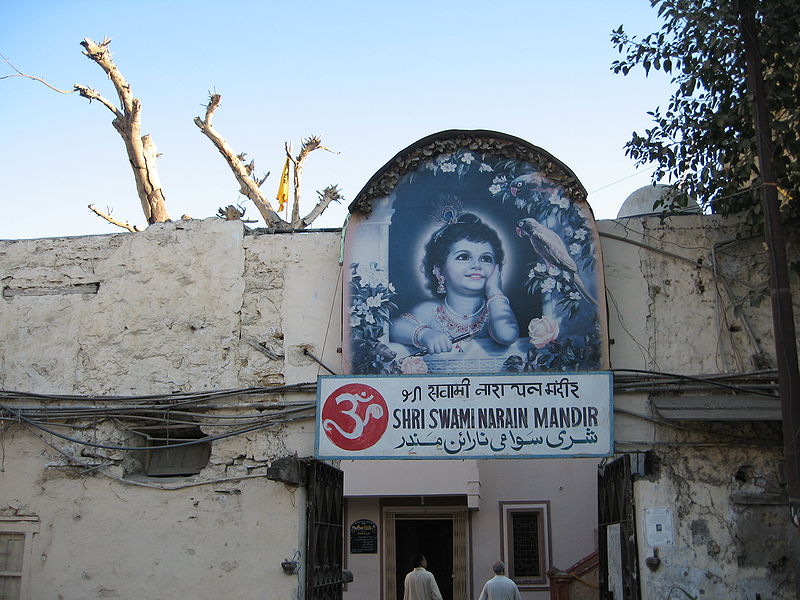
Swaminarayan Temple, Karachi: Past and Present

Shri Swaminarayan Mandir. Source: https://www.discover-pakistan.com/shri-swaminarayan-mandir.html.

Pities of Partition: Fragmented archives, claims and counter-claims, ‘actual facts’ & contested-truths, sacred and scarce, state against society, naya Pakistan & naya Bharat.

1. 31 January 1950, N. Gopalaswami Ayyangar (Minister for Transport & Railways, Govt. of Ind.) to N. Liaquat Ali Khan (Prime Minister, Govt. of Pak.):

‘I have been distressed about the action taken by the Pakistan authorities in relation to the Swaminarayan Temple at Karachi. When an allotment of a portion of the Swaminarayan Temple building was first made to a Muslim, our High-Commissioner at Karachi in December 1948, requested the Administrator, Karachi, to ensure that, for reasons of the sanctity of the temple and security of Hindus living in the temple precincts, the temple building should be reserved for the exclusive use of Hindus. By January 1949, the Administrator, Karachi, confirmed…that the Muslim allottee would be fixed up elsewhere… Later a committee of Hindus was also appointed to allot accommodation within the precincts of the temple. Lately the Administrator has abolished this committee and has withdrawn the previous assurance that the temple would be reserved for the exclusive use of Hindus. Meanwhile, further tenements in the precincts of the temple have been occupied by Muslims. The temple has not only catered for the religious and social needs of Hindus at Karachi but has also been used for accommodating Hindu refugees in transit to India…The Governments of India and Pakistan have undertaken to maintain the sanctity of the religious shrines within their territories. It is contrary to this agreement to disturb the sanctity of this temple, which is one of the important ones in Sind, particularly as Hindus in Karachi still continue to offer worship in the temple. I would strongly urge your taking suitable action in the matter…

2. 20 February 1950, N. Liaquat Ali Khan to N. Gopalaswami Ayyangar (in reply):

‘I made inquiries…The temple is surrounded by a big courtyard; all around the courtyard there are a number of tenements used as residential flats by Hindus, Muslims and others, but most of the flats do not open in the temple courtyard. A number of Muslims lived in these flats even before Pakistan was established. However, the sanctity of the temple is as well maintained as before. In order to obviate all chances of misapprehension on the part of the Hindu minority, the Administrator was willing to reserve all the flats around the temple exclusively for Hindus. Therefore, a committee of Hindus was appointed by him to recommend allotment of accommodation…It was however found that the committee took no interest in the work and allowed a number of flats to remain unoccupied. At the same time, it came to notice that the intending Hindu evacuees were transferring possession of the flats, with or without the connivance of the committee on pugree money. In view of the acute shortage of accommodation in Karachi and the recurring complaints of corruption, the Administrator had to dissolve the committee and resume the practice of making allotments direct…Preference is always given to Hindus, but when they are not available, residential accommodation cannot be allowed to remain vacant in the present-day conditions. I would reiterate that so far as the temple is concerned, its sacred position is fully maintained and the Hindus of Karachi continue to offer worship in it without let or hindrance. The High Commissioner for India recently held some of his Independence Day celebrations at the temple, which goes to show that he considered the premises exclusive enough…As regards the allocation of this whole area as a transit camp for Hindus, it is regretted that in view of the present acute shortage of accommodation, it is not possible to reserve any area in the city for this purpose. An offer is however being made to the High Commissioner for India, for allotment of sufficient land just outside Karachi for maintaining a regular transit camp…’

3. 16 March 1950, N. Gopalaswami Ayyangar to N. Liaquat Ali Khan (in reply):

‘I write to acknowledge your letter…Before replying, I had necessarily to obtain full information from our High Commissioner at Karachi in respect of the specific points you have raised…This information has since been received…You will find from [it] that the information given to you – such as that a number of Muslims lived in the flats even before Pakistan was established, that the committee of Hindus set up for advising on the allotment of accommodation took no interest in the work, that possession of some of the flats had been transferred with or without the connivance of the committee on pugree money etc. – is not in accordance with actual facts. I trust you will agree that the temple and its precincts together with the flats physically connected with it, should, for obvious reasons, be allowed to be occupied exclusively by Hindus for residential purposes and for serving as a transit camp for Hindus who pass through Karachi on their way to and back from India. You will appreciate, I am sure, the Hindu sentiment in regard to this…temple… [which] has been used as such a transit camp for over two years…I understand that our High Commissioner has been offered land at Malir for locating a transit camp. Malir is 14 miles away and the inconveniences of locating a transit camp at such a place are obvious…It is impossible for us to accept the offer and I do hope that you will be good enough to reconsider the whole matter…’

Source: File No. 12 (4)-PMS/50 (Government of Pakistan, Prime Minister’s Secretariat)

4. 12 January 2014, ‘City Faith – Shri Swaminarayan temple’, The Karachi Walla:

‘A…landmark on M.A. Jinnah Road…the temple is 200 years old according to the priest in-charge…The priest was originally from Thar. The architecture of temple is very similar to those of Jain temples in Karoonjhar range…The temple is built in the honour of Shri Swaminarayan who…lived his life in Gujrat…Naturally a link has been established between this temple and those in Gujrat and every few years, priests from both sides visit each other. The compound accommodates a Sikh Gurdwara as well. There is a sacred cowshed at the back and a gate, which leads to a neighbourhood with those fabulous balconies from yore. It is the biggest temple in Karachi and naturally a centre of celebrations during…festivals. There’s a significant Hindu population living around the temple…’

5. ‘The Shri Swaminarayan Mandir…:

‘…was built in 1849…over 32,306 square yards…on the M. A. Jinnah Road in Karachi city. The temple celebrated its anniversary of 150 years in April 2004. The temple is located at the centre of a Hindu neighbourhood in Karachi, and it is believed that not only Hindus but also adherents of Islam visit the temple…There is a sacred cowshed within the premises of this temple. [It] became a refugee camp in 1947…People who wished to settle in India from all over Sindh awaited their departure to India by ship at this temple, where they were also visited by Muhammad Ali Jinnah, during this period. In 1989, for the first time since 1947, a group of sadhus from the Shri Swaminarayan Mandir, Ahmedabad (India) visited the temple. Since then, small groups…visit every few years in a pilgrimage’.

2 Nov 84.

BBC Details Incidents. London BBC World Service 0015 2 Nov 84

[From “Radio Newsreel” program]

The outburst of anger against the Sikh community in India following the assassination of Mrs Gandhi by two Sikhs of her bodyguards has claimed about 150 lives and left more than 1,000 people injured. Mob vengeance took its tool in a number of centres and curfews have been imposed, including one in the capital, Delhi. Tim Llewelyn saw the violence there.

It was the worst day of violence in Delhi’s recent history. No area was spared – rich, poor, residential, commercial. Angry youths acting without apparent organisation gathered on the streets attacking Sikh stores, taxis, homes, and Sikhs themselves. Usually, they burned or looted whatever they could lay their hand on, twice Sikhs themselves and in one case, lynching two adults near a Sikh temple, then setting the corpses alight. Cars were attacked and burned because the mob in India identifies the Sikhs with the car and the taxi. Sometimes – but not always – the police intervened, and I watched the security forces with bayonets fixed rescue the man whose house was being put to the torch by the angry crowds of youths. A number of Sikh temples were surrounded and threatened but mostly escaped damage. They were often defended by Sikhs themselves brandishing their medieval weapons – swords and staves and spears. The prime minster, Rajiv Gandhi, has ordered that the violence must not be repeated. There are indefinite curfews in 30 towns and cities, including Delhi and parts of Calcutta.


52 Killed in Bihar. Paris AFP 0759 2 Nov 84

At least 52 people were today reported killed in Bihar state, bringing the nationwide death toll in the anti-Sikh violence sparked by Prime Minister Indira Gandhi’s murder by two Sikh bodyguards to about 200.

The PTI said the 52 deaths took place in Bokaro, in the northeastern state of Bihar, where police fired on rioters. Security forces were under order to shoot on sight anyone committing violence.

PTI said another 50 people were wounded in Bokaro.

Meanwhile in New Delhi, a dozen bodies were found in an express train which arrived from Ludhiana in the predominantly Sikh of Punjab early today, station officials reported. They gave no further details.


Death Toll Reaches 227. Paris AFP 1005 GMT 2 Nov 84

Fresh outbreak of sectarian violence rocked New Delhi and other Indian towns today as the death toll in the anti-Sikh backlash sparked by the assassination of Prime Minister Indira Gandhi soared to 227.

In East Delhi, Hindu mobs defied shoot-on-sight orders and Army and paramilitary troops to set fire to a cinema, police said. They also reported mob violence in two localities in south Delhi.

Police confirmed that 70 people had been killed in the capital since Mrs Gandhi was gunned down outside her home on Wednesday by two Sikh members of her bodyguard.

Bihar in the north-east, Uttar Pradesh in the north and Madhya Pradesh in central India were reported to be the worst hit among a dozen states reeling under the wave of violence, despite repeated calls by Prime Minister Rajiv Gandhi over the radio for calm.

The reports said that 92 people had so far been killed in Bihar, with 35 dead in Uttar Pradesh and 30 dead in Madhya Pradesh. Other casualties were reported in the western coastal state of Maharashtra.

The worst incidents occurred in Bihar state, where at least 52 people were killed as Hindus sought to revenge Mrs. Gandhi’s murder, the PTI reported.

The incidents took place in the steel town of Bokaro, PTI said, adding that the state authorities had issued security forces with shoot-on-sight orders to quell further violence. PTI said another 50 people were wounded.

Police Deputy Inspector-General Y.N. Srivastava told PTI that police in Bokaro opened fire on rival Sikh and Hindu mobs, killing one person and injuring two. Riot police were patrolling the streets.

Newspapers earlier reported other slayings in the industrial town of Ranchi as well as Hazaribagh, Arrah and Daltongaj, also in Bihar state.

An indefinite curfew was reportedly imposed on Ujjain in the central Indian state of Madhya Pradesh following a number of cases of arson and looting, while angry mobs violated curfew restrictions in nearby [words indistinct].

Trains arriving here from the Punjab reportedly carried bodies of people believed to have been lynched by crowds en route to the capital for Mrs Gandhi’s funeral tomorrow,

Eye witnesses and railway officials said they saw six bodies lying on New Delhi railway platform.

Other eye witnesses said that as many as 18 bodies were found in a train that ran between two Punjabi towns of Bhatinda and Ferozepur.

Prime Minister Rajiv Gandhi broadcast repeated radio calls for an end to the orgy of violence, but with little effect.


Death Toll Climbs. Paris AFP 1308 2 Nov 84

Thirty more people were killed in inter communal violence in New Delhi today, officials said, as the [word indistinct] nationwide death toll in violence sparked by the murder of Indira Gandhi climbed past 300.

A total of 100 people, including some reportedly burned alive in [word indistinct] New Delhi, have been killed in the capital since the prime minister was gunned down by Sikh bodyguards on Wednesday.

Police reportedly opened fire to separate Hindus and Sikhs clashing in a village in west Delhi. The groups exchanged fire, leaving some people dead before police intervened.

A toll compiled from official and unofficial sources and quoted by Indian news agencies put the dead at more than 300 nationwide.


Source: all daily reports are from the Foreign Broadcast Information Service Archive.

Reportage: 1 Nov 84

Army Controls Kanpur. Paris AFP 0628 GMT 1 Nov 84

Army troops took control of the industrial city of Kanpur in northern Uttar Pradesh state early today following violence triggered by Prime Minister Indira Gandhi’s assassination by two Sikh members of her security guard yesterday.

Earlier, authorities clamped an indefinite curfew on four districts of the city or nearly four million people, PTI said.

PTI, quoting official sources, also reported a number of cases of arson and looting, but no further details were available.

Sikhs came under attack from angry Hindu crowds in several Indian cities, including New Delhi, yesterday as news of Mrs. Gandhi’s assassination spread.


Sporadic Violence in Country. Delhi Domestic Service 0837 GMT 1 Nov 84

There are reports of sporadic violence in some parts of the country following the assassination of Mrs Gandhi.

In Delhi, arson and violence have been reported from several areas. According to agency reports, curfew has been imposed in some places including Jammu, Kanpur, Patna, Sagar, Varanasi, and Raipur.

In Bombay, shops and business establishments have closed down as a mark of respect to the departed leader. In Trivandrum, people are wearing black badges to mourn the passing away of Mrs Gandhi.


AFP on Violence, Arrests. Paris AFP 0936 GMT 1 Nov 84

The authorities today imposed a curfew on the Indian capital as angry Hindus went on a rampage of burning and looting, seeking fresh revenge for the murder of Prime Minister Indira Gandhi by Sikh gunmen yesterday

A police announcement said the decision was made to stop the violence which last night left at least three Sikhs dead, according to eyewitnesses, and 200 injured, according to police.

Army troops patrolled the streets, amid reports of sporadic gunfire between police and unidentified gunmen holed up on rooftops.

Prime Minister Rajiv Gandhi, son of assassinated leader Mrs. Gandhi, held an emergency Cabinet meeting to review the situation. officials said.

In other parts of India, the Army reportedly took control of the industrial city of Kanpur in Uttar Pradesh while police in Bihar State were under orders to shoot troublemakers on sight.

Curfews were in force in most states.

Para-military forces fanned out across this city of six million people today as mobs armed with choppers and clubs set fire to houses, cars and other properties belonging to minority Sikhs in retaliation for Prime Minister Gandhi’s assassination, eyewitnesses said

“It is terrible, they are setting fire to houses, stopping vehicles and looking for Sikhs… it appears that we are in a jungle”, said a panicky resident from the southern district, where foreigners generally live.

One Sikh was found dead here, police said, but witnesses said they saw at least two bodies near the one recovered by police.

Police sources also said 200 people, mostly Sikhs, were injured and half of them were admitted to hospitals here as buses, trucks, cars, scooters, shops and Sikh temples were set on fire last night by outraged Hindus.

Security was tightened around New Delhi’s Sikh temples, which had come under attack yesterday.

Authorities banned the assembly of more than five people in public places were, but there was no report of any arrest.

There were no reports of any new casualties, as Sikhs here appeared to have gone underground for fear of reprisals.

Police this morning also reported cases of arson and looting in Ahmednagar, in the western coastal state of Maharashtra, where police had to open fire to disperse rioters, injuring three of them.

A total of 64 people were arrested following the incidents, in which about 30 shops and 13 vehicles were burned, police sources added.

In the central city of Jabalpur, police also burst tear gas shells to disperse looters and arsonists and similar incidents were reported in other localities, press reports said.


BBC on Worsening ‘Violence’. London BBC World Service 1200 GMT 1 Nov 84

Dispatch by correspondent Tim Llewelyn

There is no doubt that this worsening violence and uncontrollable anger is aimed at the Sikh community. Even as the Army took to the streets, backing up the police and paramilitary security units, large tracts of Delhi were the preserve of the mob. I saw taxis, taxi ranks, smart stores, and small shops and kiosks – almost exclusively Sikh-owned – set alight and burning furiously. Crowds besieged Sikh temples, though the police and Sikhs themselves mostly managed to prevent casualties or damage, the Sikhs brandishing their swords and clubs.

The violence has spread all over the city – residential areas as well as working class and commercial. Casualty figures are vague, but we know of at least five dead in Delhi over the past day, two of the policemen in an exchange of shots involving a mob outside a Sikh temple, and two Sikhs burned alive by frenzied attackers. In one incident, I watched a crowd surrounding a house and finally stuffing blazing wicker chairs to the windows to act as fire torches. Eventually the Army showed up, bayonets fixed, the crowd evaporated.

It is not just Delhi by any means. A similar pattern of anger harassment, and then burning and stealing has brought the Army out onto the streets in at least five other towns – Calcutta, Allahabad, Indore, Varanasi, and Kanpur. Curfews are being imposed in uncountable towns and districts in north and central India.

Sikhs I talked to in Delhi are not satisfied with the protection offered in the capital, and it did look in some incidents as if the police could have done more.


‘Large Scale Violence’ Reported. Paris AFP 1603 GMT 1 Nov 84

At least 65 people were killed, several hundred injured, and thousands rendered homeless today in an orgy of violence that swamped India in the wake of yesterday’s assassination of Prime Minister Indira Gandhi by two Sikh members of her security guard, local news agencies reported.

Large-scale violence hit 18 towns across India, forcing the administration to call out the Army and impose an indefinite curfew in certain parts of the capital. Curfews were also imposed in most other states.

The PTI news agency said that as many as 65 people, mostly Sikhs, died in the clashes. UNI put the death toll at 60.

An official government spokesman put the nationwide toll at 10.

In two cities of Kanpur and Patna police were given shoot at sight orders after Hindu mob violence against Sikh communities erupted. Earlier similar shoot-at-sight orders were issued in eastern Bihar State.

Source: all daily reports are from the Foreign Broadcast Information Service Archive.

Durga Mandir/Juma Masjid

This slideshow requires JavaScript.

In an unassuming side street of an old residential area in Sonipat is a hidden gem and remnant of the past. Durga Mandir of Mohalla Kalan in Sonipat is still popularly known as Badi Masjid (big/greater Mosque). The latter should give an insight into the former life of this Mandir, which once was a Masjid. Even today looking at the exterior of this mandir it could quite easily be confused for a masjid. It stands tall and looks grand in the red stone façade with a courtyard for Friday prayers which probably attracted many of the local Muslims in pre-partitioned Punjab. Apart from the obvious changes of installing flags and idols, the three main domes and minarets are easily identifiable with that of a small Juma masjid.

Like many other places of East Punjab, the Muslims of Sonipat migrated to Pakistan, leaving behind their homes and places of worship. These were quickly claimed by the incoming Hindus and Sikhs. Muslims were often the second largest group in these areas. For example, Muslims were significantly present in cities like Hissar (28%), Gurgaon (34%), Karnal (32%) and Ambala (32%) Rohtak (17%); all of these are part of present-day Haryana State. Most of the Muslims abandoned their homes in the ensuing violence of August 1947 and fled to Pakistan. Similarly, in Pakistan, many of the old abandoned religious (Gurdwaras and mandirs) buildings were converted/neglected by the incoming populations to be utilised for their own purposes. See link below for more about this.

In this case, the masjid has been converted into a Durga Mandir, a temple for worshiping Goddess Durga. It is now known as ‘Sri Sanatan Dharm Sabha Panji Durga Mandir.’ The Goddess Durga assumes the central position in the mandir and is surrounded by other deities; outside in the courtyard is an encased idol of Baba Sai. The dome interior has recently been filled to mask the obvious Islamic style architecture but the exterior remains as before. The link below provides further information on the Badi Masjid but more interesting are the photos. The short article was posted in October 2015, and the pictures shared are quite different from when I went to visit the site recently. The interior now has been changed to hide all signs of its former existence as a masjid. The pictures from 2015 show the perfect domes and remnants of frescoes and tiling from before. The fact that much of the interior has been transformed in the past two years is telling of the Hindutva agenda prevailing in the region.

Sonipat in August 1947 was a small city in united Punjab, then it became a city in East Punjab and eventually a part of Haryana after the reorganisation of East Punjab in 1966. There is little in the history books about the intervening years before it became part of Haryana, yet a lot has changed in this area. Looking at Sonipat today, it is difficult to tell that this historic city was once communally diverse with Punjabi Hindus, Sikhs, Muslims and Christians. Today it feels very much like a Hindu city. Perhaps the latter is more of a reflection of the current climate in India. But hidden away are these old structures that remind us of a different time and a different history.

Read further about Sonepat’s Badi Masjid and see pictures from 2013. http://www.gounesco.com/badi-masjid-sonipat/

Pakistan’s long forgotten Hindu temples and gurdwaras. http://blogs.tribune.com.pk/story/15785/pakistans-long-forgotten-hindu-temples-and-gurdwaras/