Tag Archives: England

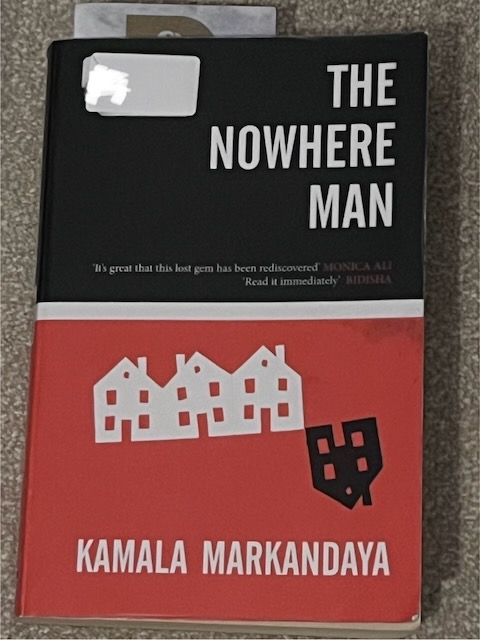
Rediscovering Kamala Markandaya’s ‘The Nowhere Man’

Kamala Markandaya (23 June 1924–16 May 2004), pseudonym of Kamala Purnaiya, married name Kamala Taylor, occupies a distinctive position in the landscape of South Asian literature. Born into a prominent Brahmin family in Mysore, India, she graduated from Madras University and established herself as a significant voice through short stories published in Indian newspapers. In 1948, shortly after independence, she uprooted herself and moved to London with literary ambitions, and thus straddled between two worlds – East and West – and also the transitional era from the colonial to the post-colonial.  
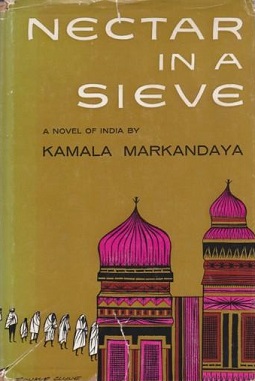
Her first novel, Nectar in a Sieve (1954), introduced readers to her unflinching examination of rural poverty and resilience and became a bestseller. The title of the novel is taken from the 1825 poem ‘Work Without Hope’, by Samuel Taylor Coleridge”

Work without hope draws nectar in a sieve,
And hope without an object cannot live.

This epigraph establishes a thematic preoccupation that would recur throughout Markandaya’s work: the question of what sustains individuals when hope seems futile, when effort appears wasted, and when displacement renders purpose elusive.

A Voice of the Indian Diaspora

According to Sunita Rani’s critical assessment, ‘Kamala Markandaya, a pioneer member of the Indian Diaspora occupies an outstanding place among the Indian women novelists writing in English… In a wider context, she comes under the umbrella of third world post-colonial writers.’ This positioning is crucial to understanding Markandaya’s unique contribution: she wrote from the margins, giving voice to experiences of displacement, cultural alienation, and the psychological toll of migration long before diaspora literature became a recognised genre.

Writing at a time when British literature was still predominantly white and male, and when post-colonial voices were only beginning to emerge, Markandaya carved out a space to explore the immigrant experience with psychological depth and nuance. Her attention to the internal lives of her characters, their negotiations between cultures, and their struggles for dignity in hostile environments marked her as a writer of considerable sophistication and empathy.

The Story of Srinivas

The Nowhere Man tells the story of Srinivas, who embodies the rootless existence its title suggests. After spending two-thirds of his life in England—during which he sacrificed a son to war—this Indian immigrant finds himself heckled by racist hoodlums and ultimately driven to his death. The tragedy of his situation is compounded by temporal irony: he has lived in England for thirty years, yet remains perpetually “foreign,” a restless, rootless individual stripped of both his Indian heritage and denied full acceptance into British society.

As Rani observes, ‘He is bewildered as to where he belongs: he has lived in England for thirty years and yet became a rootless, restless individual disposed of India and disowned by England. He represents millions of men who, for some reason or other leave their own roots and fail to strike roots in alien soil and die as rootless, restless individuals.’

Srinivas’s predicament speaks to the fundamental existential crisis of the immigrant: the loss of one identity without the gain of another, the perpetual state of being in-between. His thirty years in England count for nothing in the eyes of the racist youths who torment him; his decades of contribution, his sacrifice of a son to Britain’s war effort, cannot purchase him belonging. Markandaya captures with devastating clarity how racism reduces a lifetime of lived experience to nothing more than the colour of one’s skin.

Cultural Neglect and Critical Oversight

What makes the novel’s obscurity particularly striking is that it addresses themes that should have resonated powerfully in 1970s Britain. As Emma Garman writes in the introduction to the new reprinted edition, ‘writing ahead of one’s time risks cultural neglect, and The Nowhere Man was all but ignored on its publication.’ The novel confronted uncomfortable truths about race, belonging, and British society’s treatment of immigrants at a crucial historical moment – an era marked by increasing racial tension, the rise of far-right politics, and heated debates about immigration.

The 1970s saw the growth of the National Front, the implementation of increasingly restrictive immigration laws, and incidents of racial violence across Britain. The Nowhere Man spoke directly to these realities, yet British readers and critics seemed unwilling or unable to engage with its challenging portrait of their society. Perhaps the novel was too close to the bone, too unflattering in its depiction of British racism and xenophobia.

Garman picks up the inter-generational tension in Markandaya’s work, when newly-wed Laxman brings his wife Pat to stay at Srinivas’s home for a week, he feels embarrassed by his parents’ perceived lack of sophistication—their appearance, dress, and English. His father’s valiant attempts to fit into an awkward social environment reveal the painful immigrant experience that Markandaya captured so effectively. Garman notes how the ‘conflict and sense of separation that can arise between first and second immigrant generations would, thirty years later, be explored to great effect in Zadie Smith’s White Teeth and Jhumpa Lahiri’s The Namesake. But at the time Markandaya was writing, it was a subject few novelists had confronted.’ Yet her pioneering work went largely unrecognised, until perhaps its re-discovery through the new edition in 2019.

A Precursor to Contemporary Voices

Perhaps the most intriguing element of The Nowhere Man‘s neglect is how its outsider perspective—particularly its diagnosis of British society through the eyes of ‘a woman and a foreigner’—felt disconcerting to 1970s readers. Garman asks whether this dual marginalization could help explain the novel’s commercial and critical neglect?

Better known for her American success, Markandaya found her adopted home, Britain, a tougher market, yet she remained committed to exploring themes of cultural displacement. Garman shows how Markandaya ‘blamed the inevitable snobbishness towards an author from a former, and very recent, British colony.’ Again suggesting someone who was ahead of her time and working on the edges. And ‘perhaps discouraged by the reaction – or rather the lack of reaction – to her harrowing portrait of modern Britian, Markandaya returned to India for the setting of her subsequent four novels.’

Historically, Markandaya occupies a fascinating position: falling between the canonical generation of V.S. Naipaul (b.1932) and later Salman Rushdie (b.1947), and those who came before her such as R.K. Narayan (b.1906) and Mulk Raj Anand (b.1905). It was perhaps Ruth Praver Jhabvala (b.1927) that remained her most literary contemporary.

Her work on diaspora and displacement anticipated the themes that would define the later writers. Her work, particularly The Nowhere Man, deserves recognition as a precursor to contemporary diaspora literature—a pioneering exploration of identity, displacement, and the meaning of home that speaks with renewed urgency to our current moment.

And given the political rhetoric around nationalism in contemporary Britian, this makes for pertinent reading as a story which is set in 1968, the year of Enoch Powell’s ‘River of Blood’ speech, should resonate so much with our times today. Srinivas’s story remains tragically relevant, a reminder that the struggles for acceptance and dignity faced by immigrants are neither new nor resolved.

References and further reading:

Nasta S, Stein MU, eds. Disappointed Citizens: The Pains and Pleasures of Exile. In: The Cambridge History of Black and Asian British Writing. Cambridge University Press; 2020:193-310.

Nasta S. 1940s–1970s. In: Osborne D, ed. The Cambridge Companion to British Black and Asian Literature (1945–2010). Cambridge Companions to Literature. Cambridge University Press; 2016:23-39.

Rani, Sunita. “Probing Identities Amid Racial and Cultural Conflicts: Kamala Markandaya’s The Nowhere Man and Some Inner Fury.” Literature & Aesthetics 20, no. 1 (2010).

Harrex, S. C. (1971). A Sense of Identity: The Novels of Kamala Markandaya. The Journal of Commonwealth Literature, 6(1), 65-78. https://doi.org/10.1177/002198947100600108 (Original work published 1971)

Manoj Kumar Hemane and Mahindra Kumar H Fulzele. Endurance and Displacement: The Ethical Vision in Kamala Markandaya’s Novels. International Journal Research Engish. 2025;7(1):415-417. DOI: 10.33545/26648717.2025.v7.i1g.365

Leicester: a city of diversity

Shivalaya temple, Belgrave Road, Leicester © Pippa Virdee, 2018

There has been a lot of interest in Leicester over the weekend, following the disturbances around Green Lane Road and Belgrave. I noticed on my Twitter feed that it was picked up by journalists, activists and academic across the globe and especially from those in India. They are of course keenly watching this because of the involvement of what seems to be groups aligned to the RSS and the ruling party in India, the BJP.

I have worked in the city for most of my professional life, I have family living in the area, and I have written about multicultural Leicester as well. There has been a lot of information and misinformation being circulated around via social media, this is inevitable given the way these platforms work. I know Green Lane Road well and the ways in which it has evolved since the 1980s, when I first went there. I will perhaps write about this another time, but I wanted to share some basic facts about multicultural Leicester, and provide a list of some academic work that has been done on the city.

The demographics of Leicester have changed and evolved considerably over the decades. Migration to Leicester was interestingly later than some of the surrounding cities in England. In 1972 the Leicester Mercury headlines expressed fear and concern about the influx of East African Asians into the city following their expulsion by Idi Amin in Uganda. Yet in 2001 when the Cantle Report on Community Cohesion was published, the local press in Leicester was considered ‘very responsible’ and ‘seen to be helping to promote cohesion throughout the community.’ Indeed, only very recently several events and exhibitions have been documenting and commemorating the 50 years since the Ugandan Asians arrived in Leicester.

 Area by Birth195119611971198119912001
India5691,82711,51018,23520,84124,677
Pakistan491097751,3051,1551,854
Bangladesh6851,051
East Africa181,6306,83518,62217,16818,843
Total6363,56619,80538,16239,16446,425
South Asian Migration into Leicester, 1951-2001 according to place of birth (Source: Bonney, 2003 and National Census)

However, as a city, Leicester is today one of the most diverse areas in the UK and perhaps even in Europe. The data from the 2021 census is not available yet, it is hoped more analysis and data will be released later this year. According to the 2011 census, the majority ethnic group is still white at 50.5%. However, the next largest group is of Indian origin – 93,335 (28.3%). The Pakistani population is still quite small at 8,067 (2.5%). However, overall there are more than 60,000 Muslims of different nationalities and ethnicities in Leicester, compared to 50,000 Hindus; the Sikh community is sizeable but small in comparison.

Religion20012011
Christian125,187106,872
Buddhist6381,224
Hindu41,24850,087
Jewish417295
Muslim30,88561,440
Sikh11,79614,457
Other religion1,1791,839
No religion48,78975,280
Religion not stated19,78218,345
Total279,921329,839
Religion in the 2001 and 2011 censuses in Leicester.

RankLanguageUsual residents aged 3+Proportion
1English228,29572.47%
2Gujarati36,34711.54%
3Punjabi7,5602.40%
4Polish6,1921.97%
5Urdu3,3761.07%
The top-5 languages spoken in Leicester according to the 2011 census.

Below are references for anyone interested in knowing more about migration to the UK and specifically Leicester.

  • Anwar, M., Between Two Cultures (London: Commission for Racial Equality, 1981)
  • Ballard, Roger (ed), Desh Pardesh The South Asian Presence in Britain (London: Hurst, 1994)
  • Bhachu, Parminder. Twice migrants: east African Sikh settlers in Britain. Vol. 31100. Tavistock Publications, 1985.
  • Bishop, Sue Zeleny. “Inner-city possibilities: using place and space to facilitate inter-ethnic dating and romance in 1960s–1980s Leicester.” Urban History (2021): 1-16.
  • Bonney, Richard, ‘Understanding and Celebrating Religious Diversity in Britain: A Case Study of Leicester since 1970 making comparison with Flushing, Queens County, New York City’, Encounters, 9, 2, 2003, pp 123-151
  • Bonney, Richard, and William Le Goff. “Leicester’s cultural diversity in the context of the British debate on multiculturalism.” International Journal of Diversity in Organisations, Communities and Nations 6, no. 6 (2007): 45-58.
  • Clayton, John. “Living the multicultural city: acceptance, belonging and young identities in the city of Leicester, England.” Ethnic and Racial Studies 35, no. 9 (2012): 1673-1693.
  • Gunn, Simon, and Colin Hyde. “Post-industrial place, multicultural space: the transformation of Leicester, c. 1970–1990.” International Journal of Regional and Local History 8, no. 2 (2013): 94-111.
  • Hassen, Inès, and Massimo Giovanardi. “The difference of ‘being diverse’: City branding and multiculturalism in the ‘Leicester Model’.” Cities 80 (2018): 45-52.
  • Herbert, Joanna, ‘Migration, Memory and Metaphor: Life Stories of South Asian in Leicester’ in Burrell, Kathy and Panayi, Panikos (eds.) Histories and memories: migrants and their history in Britain (London: Tauris Academic, 2006)
  • Herbert, Joanna, Negotiating Boundaries in the City: Migration, Ethnicity, and Gender in Britain (Aldershot, Ashgate, 2008)
  • Hussian, Asaf, Haq, Tim and Law, Bill, Introduction by R. Bonney Integrated Cities. Exploring the Cultural Development of Leicester, Leicester, Society for Inter-Cultural Understanding Leicester (University of Leicester, 2003)
  • Hussian, Asaf, Haq, Tim and Law, Bill, The Intercultural State: Citizenship and National Security (Contact Cultures, 2007)
  • Law and Haq, Belgrave Memories (Leicester: Contact Cultures, 2007)
  • Leicester City Council, The Diversity of Leicester – A Demographic Profile (Leicester City Council, 2008)
  • Mamdani, Mahmood, From Citizen to Refugee: Uganda Asians Come to Britain (London, Pinter Publishers, 1973)
  • Marret, Valerie, Immigrants Settling in the City (Leicester, Leicester University Press, 1989)
  • Martin, John and Singh, Gurharpal, Asian Leicester (Gloucestershire: Sutton, 2002)
  • Panayi, Panikos, ‘The Spicing up of English Provincial Life: The History of Curry in Leicester’ in Kershen, Anne J., Food in the Migrant Experience (Aldershot: Ashgate, 2002)
  • Polimeni, Beniamino, and Theophilus Shittu. “Impact of migration on architecture and urban landscape: The case of Leicester.” DISEGNARECON 13, no. 25 (2020): 24-1.
  • Rex, John and Tomlinson, Sally, Colonial Immigrants in a British City: A Class Analysis (Routledge, 1979)
  • Sato, Kiyotaka. “Divisions among Sikh Communities in Britain and the Role of Caste System: A Case Study of Four Gurdwaras in Multi-Ethnic Leicester.” Journal of Punjab studies 19, no. 1 (2012).
  • Singh, Gurharpal, ‘Multiculturalism in Contemporary Britain: Reflections on the ‘Leicester Model’’, International Journal on Multicultural Societies, 5, 1, 2003, pp 40-54
  • Vertovec, Steve, ‘Multiculturalism, multi-Asian, multi-Muslim Leicester: dimensions of social complexity, ethnic organisation and local interface’, Innovations, 7, 3, 1994, pp. 259-76
  • Virdee, Pippa. “From the Belgrave Road to the Golden Mile: the transformation of Asians in Leicester.” (2009).
  • Visram, Rozina, Asians in Britain. 400 Years of History (London: Pluto Press, 2002)
  • Westwood, Sallie, ‘Red Star over Leicester: racism, the politics of identity, and black youth in Britain’ pp101-116 in Werbner, Pnina and Anwar, Muhammad, Black and Ethnic Leaderships in Britain: The Cultural Dimensions of Political Action (Routledge, 1991)
  • Westwood, Sallie, All Day Everyday. Factory and family in the making of women’s lives (London: Pluto, 1984)
  • Williams, John, ‘Leicester Nirvana Fighting For a Better Future’ in Asians Can Play Football. A report from the Asians in Football Forum, (2005)
  • Wilson, Amrit, From Nagpur to Nairobi to Neasden – tracing global Hindutva, Vol 3, Issue 3, 2020 https://www.ihrc.org.uk/from-nagpur-to-nairobi-to-neasden-tracing-global-hindutva/
  • Winstone, Paul, ‘Managing a multi-ethnic and multicultural city in Europe: Leicester’, International Social Science Journal, 147, 1996, pp. 32-41

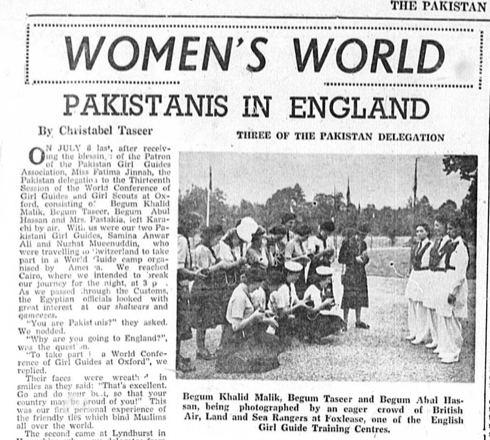
“Women’s World: Pakistanis in England”

pt 10 sep 1950Women’s World in The Pakistan Times, Sunday September 10, 1950.

Pakistanis in England by Christabel Taseer

On July last, after receiving the blessings of the Patron of the Pakistan Girl Guides Association, Miss Fatima Jinnah, the Pakistan delegation to the Thirteenth Session of the World Conference of Girl Guides and Girl Scouts at Oxford consisting of Begum Khalid Malik, Begum Taseer, Begum Abul Hassan and Mrs Pastakia, left Karachi by air. With us were our two Pakistani Girl Guides, Samina Anwar Ali and Nuzhat Mueenuddin, who were travelling to Switzerland to take part in a World Guide Camp organised by America. We reached Cairo, where we intended to break our journey for the night. As we passed through the Customs the Egyptian officials looked with great interest at our shalwars and qameezes.
“You are Pakistanis?” they asked.
We nodded.

Why are you going to England?” was the question.

“To take part in a ‘World Conference of Girl Guides at Oxford”, we replied.

Their faces were wreathing in smiles as they sald: “That’s excellent. Go and do your best, so that your country may be proud of you!” This was our first personal experience of the friendly ties which bind Muslims all over the world.

The second came at Lyndhurst in Hampshire, when we delegates from different countries were attending demonstrations of British Guiding, One day, (just after Eid), we were walking across the grass to a Ranger camp, wearing our white and green Guide uniforms, when a young woman dressed English Guide uniform came running quickly towards us.
“Tell me, are you Pakistani Muslims?” she cried,
We answered “yes” and looked at her eager face In surprise.

“I, too, am a Muslim, a Turkish Muslim from Cyprus,” she replied, “and I am here for Guide training. I am so very happy to see you, particularly because you are Muslims like myself. Here I am the only Muslim in the camp. Yesterday was Eid and there was no one with whom to share the happiness of that day.”

We all embraced with enthusiasm and sat down to talk about our respective counties and about Guiding, there. We parted with regret at the end of our stay, but again at Oxford, at the wind-up of our ten days’ Conference, when we had a huge Camp Fire of 10,000 Girl Guides from all over England, there, as all the delegates from the twenty-four countries represented marched slowly across the huge field to their respective places, there in front of everybody, leaning across the ropes, waiting to shake our hands in friendship, was our Turkish friend from Cyprus, Hatlee Tahsin!

From the moment we Pakistani delegates appeared in uniform in English, whether in London of Lyndhurst or Oxford, we attracted attention. People had become used to the dark-blue Guide uniforms of the British, the green of the Americans, the khaki of the Greeks, even to the dark-blue saris of the Indians – but spotless while starched shalwars and qameezes, with folded dark green dupattas and green ties and white shoes, were something quite out of the ordinary. Wherever we went we were surrounded by photographers and Girl Guides, and questioned by people – “How do you keep your uniforms so clean?” “Do you really wear such clothes in your country?” By the time we had been in England for two weeks, wherever we went, whether we were in uniform or wearing silk salwar and qameez or garara, people knew that ours was the dress of Pakistan.

But we found that many people, particularly the Guide delegates from the smaller European countries, still did not know where Pakistan was, and we often had to bring out a map and point out our country to them. We had to answer many questions about our food and general living habits, social customs, education, position of women, the meaning of purdah. People were tremendously interested in us as a country and full of admiration for the progress we had made in the last three years. Many people said that it must be a wonderful experience to be in a new country, where everything has to be built up by one’s own efforts.

GREAT EXPERIENCE

The Conference itself which took place in St Hugh’s College, Oxford, was a great experience. Here in the Conference Hall were hung the flags of the twenty-four nations represented at the Conference, whose delegates, of faiths as divergent as Protestant, Catholic, Jewish, Muslim, Hindu, Parsee, had met because they were united by a common purpose, viz, to work for the girl and women of the world. Think of the magnitude of the of the movement stated in 1910, which is such that a girl from Pakistan or Egypt can stop a girl who is wearing the Guide badge on the street in America or England, shake her by the hand, call her sister, and at once be friends with her. Our two Pakistani Girl Guides, who had never been abroad before, were received in London with affection and friendship, because they were Girl Guides and they were able to travel on to Switzerland with American, English and Australian Guides whom they had never seen before, but with whom they at once felt at ease.

11 LANGUAGES

In our Conference Hall, women used to chat in eleven different languages, there were women from seven countries who knew more French than English, we had an American Chairman, an English Vice-Chairman, a Belgian translator, and so on, but we were all one. For ten days at Oxford we sat and discussed subjects as diverse as training programmes, camping, finances, public relations, constitution, future policy, – sometimes in English, sometimes in French,- we were entertained in castles and palaces and country homes, we were received in Buckingham Palace by Her Majesty the Queen, we listened to concerts, saw pageants and displays of dancing, and ended a very full fifteen days’ programmes with the gigantic Camp Fire programme at Oxford, on the 29th July, which was attended by 10,000 Guides from all parts of England and which was presided over by Princess Margaret. The Camp Fire was a stupendous sight. An enormous field filled with a sea of faces, all cheering lustily as the delegates from the twenty-four countries marched slowly across the field. Over 10,000girls and women were singing the songs which are known to the two and a half million Guides all over the world, all friendly and united because they were all Guides who had taken the same promised of service to mankind and who all lived recording to the precepts of the ten Guide laws. There they all were – over 10,000 of them, representing the two and a half million Guides in the jungles of Africa, the mountains of Switzerland, the forest of Canada, the Philippine Islands, the plains of Pakistan – Guides from large towns and tiny villages, of different races and creeds and cultures, all different, but nevertheless all one.