

Earlier this year, I visited Ludhiana, Punjab, a place I try to make time for whenever I have an opportunity or a slight reason. As is often the case, no visit feels complete without visiting Mau Sahib, my father’s ancestral village near Phillaur. Although no immediate family members live there anymore, Mau Sahib holds a special place in our hearts, especially for my sister. She remembers it with warmth and nostalgia, as a place of her childhood.
Our visits have become something of a ritual—paying respects at the historic Gurudwara, partaking in the langar, and then visiting the nearby Sufi shrine. It’s a quiet pilgrimage that connects us with both our heritage and the memory of those who came before us.

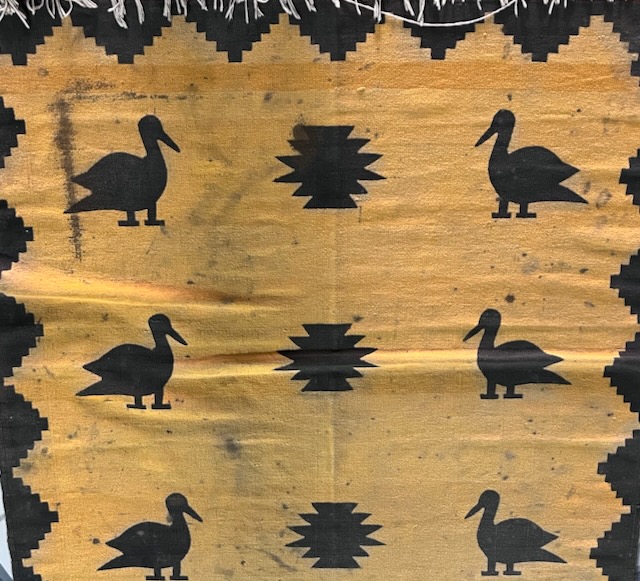
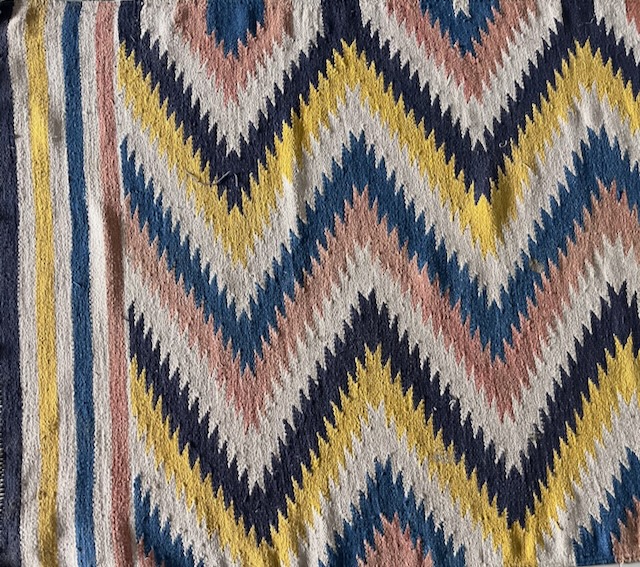
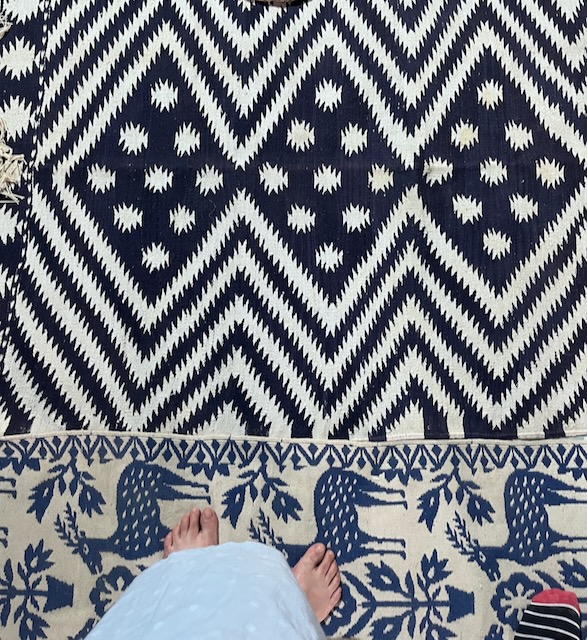
During this visit, the Gurdwara was undergoing renovations. Amid the scaffolding and signs of change, we made our way to the basement area; a large, echoing hall that was mostly empty and only partially completed. The Guru Granth Sahib rested there with solemn grace in the middle of the hall, surrounded by an assortment of vibrant dhurries scattered across the floor. The scene was simple yet striking. I couldn’t help but take photos of the colourful, handwoven patterns.
In that quiet moment, surrounded by these beautiful pieces of craft, I was instantly transported to my study back home. There, in the middle of my room, lies a black-and-white dhurrie—a treasured piece handmade by my mother. The rug, is now a relic and a reminder of her remarkable talent, one of many handcrafted creations she lovingly produced over the years.
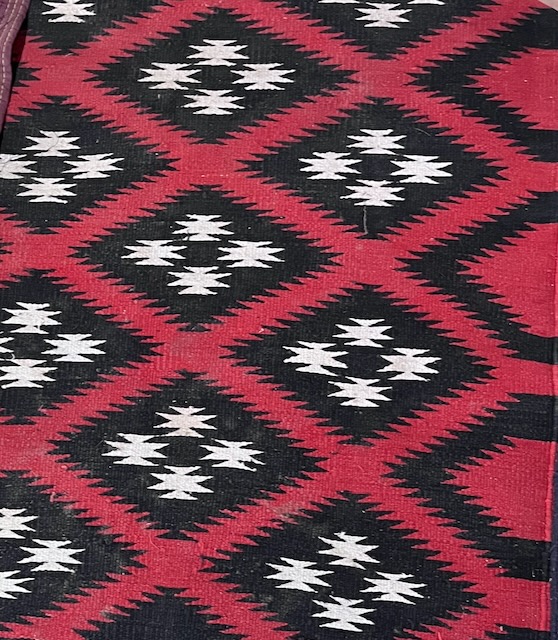


At the time, I must admit, I didn’t fully appreciate the time, effort, and skill that went into these works of art. But today, that dhurrie is a cherished heirloom. It reminds me not only of her hands at work but also of the deeper cultural traditions that she carried within her.
For those unfamiliar, a dhurrie is a handwoven rug or flat-weave carpet, traditionally made in India and Pakistan. They were mostly made from cotton or jute and thus accessible for all. Dhurries are often lighter, reversible, more versatile and useful for everyday use; they can be used as floor coverings, bedding, or even wall hangings. In rural Punjabi households, you often find these dhurries spread out for meals, prayers, weddings, and community gatherings, making them silent witnesses to the everyday rituals and rhythms of life.
What makes them so striking are the geometric patterns, vivid stripes, or sometimes floral designs, each inspired by the region and culture from which they originate. The bold designs are usually in bright colours such as red, blue, yellow, as well as using black and white.
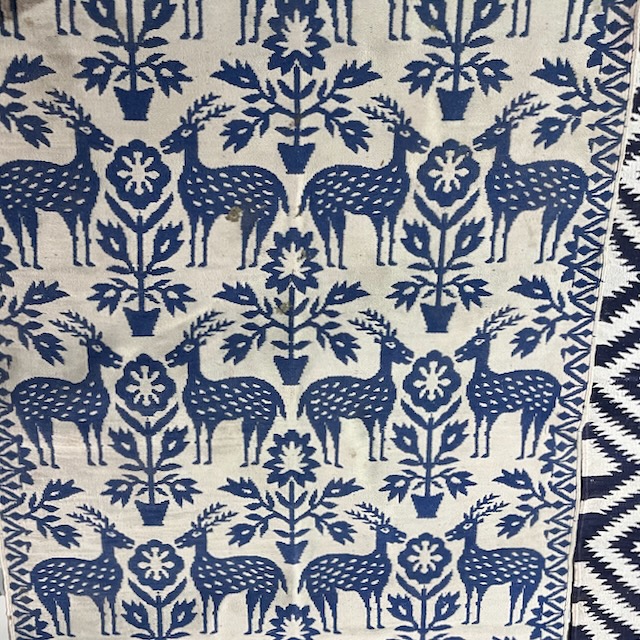


Historically, dhurrie weaving was a thriving cottage industry in rural India. But it was also something more intimate and symbolic, especially for women. Young brides-to-be were often taught the art from a young age. Many dhurries formed part of a woman’s dowry, and their patterns weren’t just decorative. They carried stories—symbols of personal, familial, and spiritual identity, passed down through generations, like a family recipe.
In many villages, it was common to see women sitting on charpoys under the shade, rhythmically working on pit looms while chatting about daily life. Though machine-made textiles are now more common, the tradition of handwoven dhurries survives in some artisan clusters, supported by cultural preservation efforts and a renewed appreciation for handmade goods.
As I stood in that hall, looking at the scattered dhurries beneath my feet, I realised how deeply woven this craft is into the fabric of our collective memory. These are not just utilitarian objects; they are vessels of heritage, art, and emotion. Each thread, each motif, tells a story.
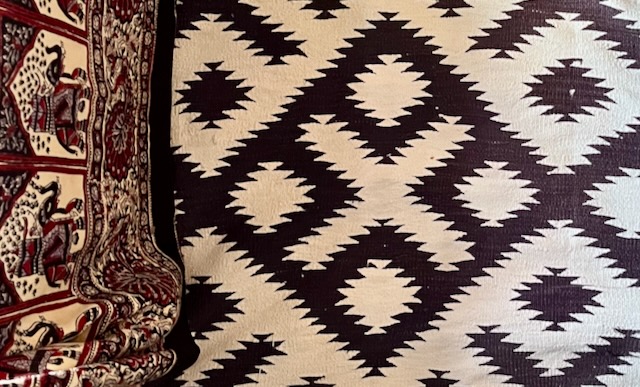
In many ways, my mother’s dhurrie now tells mine. And you may well be wondering about the one I have? This was prized away from my sister my years ago. She had a number of them, given to her when she got married, and I convinced her to part with one which then travelled with me to England!
 BAGICHA