Tag Archives: Delhi

Books, Films, Talks and a Nation

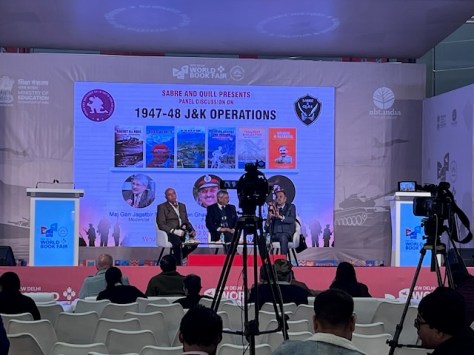
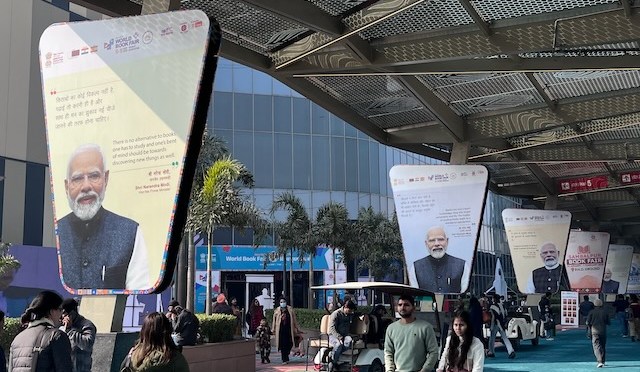
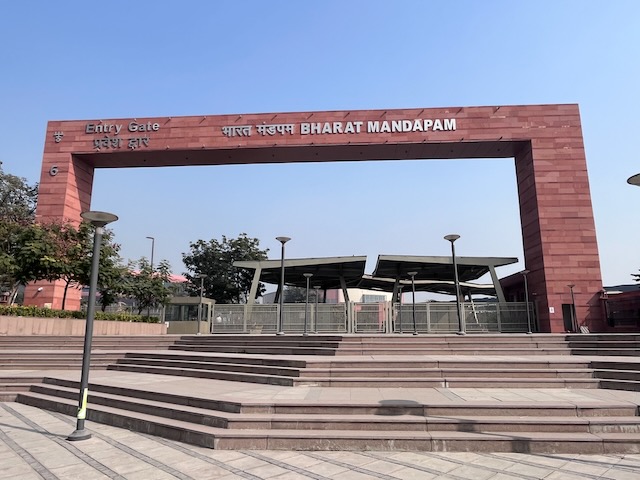
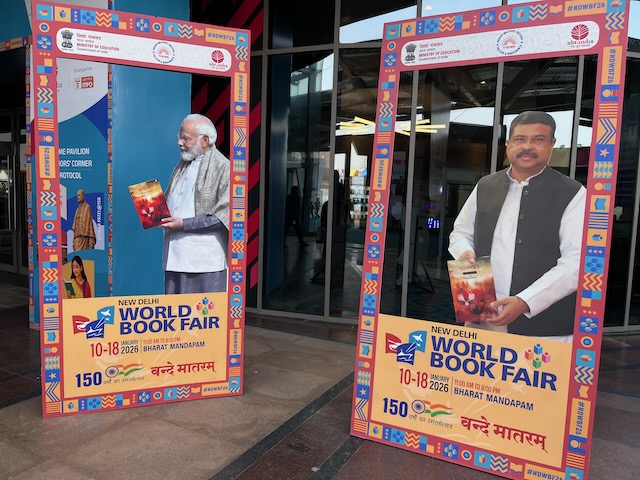
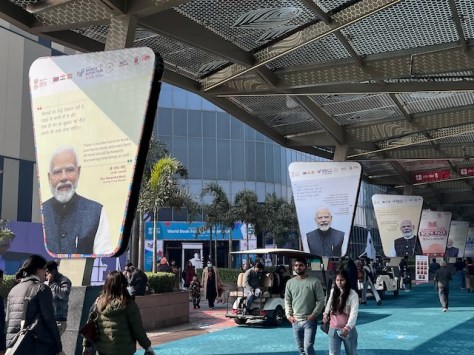
My latest visit to Delhi luckily coincided with the World Book Fair, held from January 10-18 at the Bharat Mandapam Convention Centre (Pragati Maidan), which was unveiled in 2023 ahead of the G20 summit. The book fair has been held for over half a century, and I was looking forward to it, as it was going to be my first time. Once there, I felt a suitable sense of awe, amidst the sets of huge halls and the throbbing atmosphere around them.

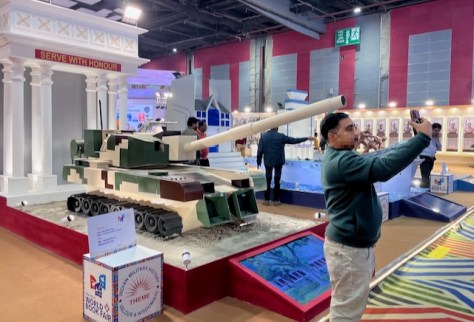
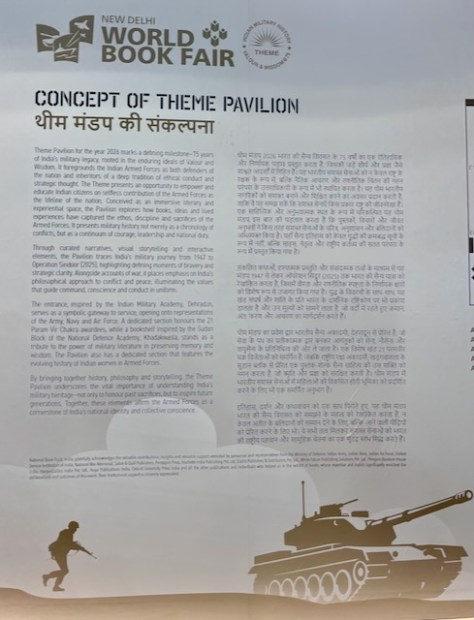
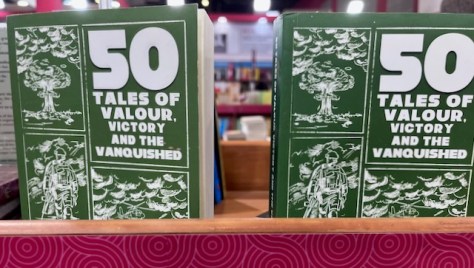
I was told this was the first time the fair had ‘free entry’, and the crowds were substantial, particularly around the stalls of major publishing houses. Secondly, this year’s theme was ‘Indian Military History: Valour and Wisdom@75.’ Book fairs are especially popular with schoolchildren and university students, and these young visitors were enthusiastically taking selfies with statues, exhibits and soldiers positioned there.
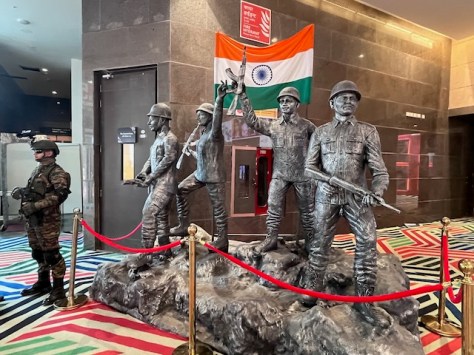
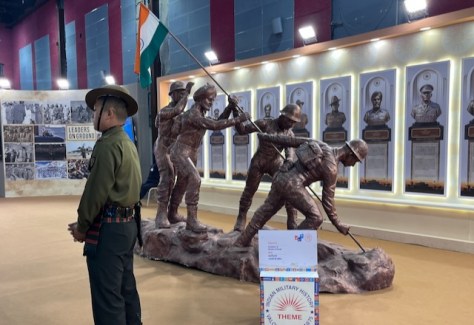
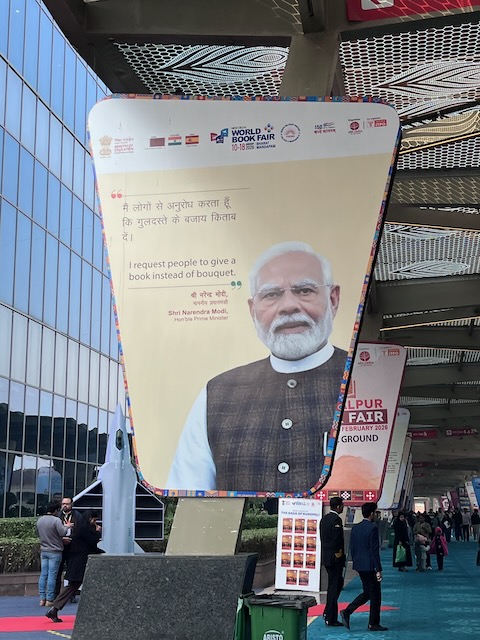
As I approached the entrance to the main hall, I was greeted by large posters encouraging young people to read and urging people to gift books, as the Fair is organised by the National Book Trust (Ministry of Education, Government of India) and the India Trade Promotion Organisation. Once inside, the presence of the military was immediately noticeable, as were the recent conflicts with neighbouring countries.

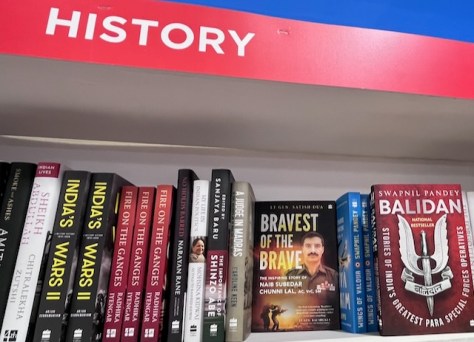
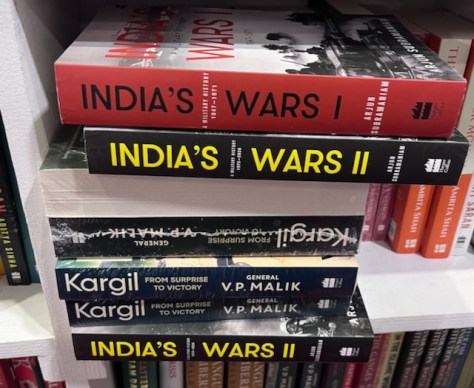
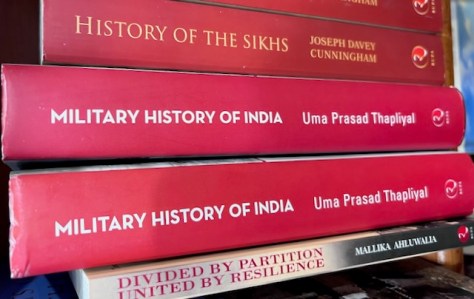
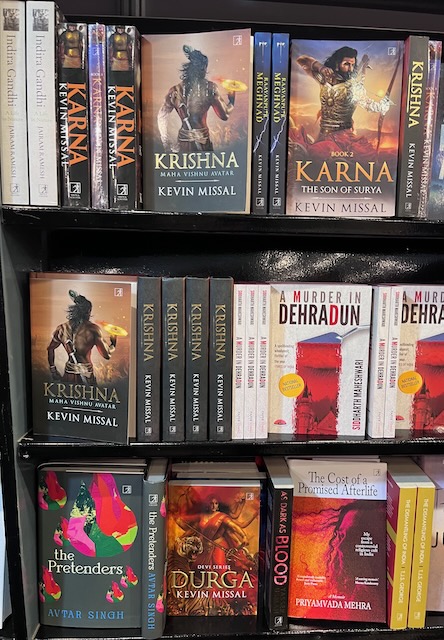
Having visited several bookshops in Delhi and Chandigarh on the trip, what had come into sharp focus was an abundance of material on military history and security studies by retired military personnel, commentators, and journalists. Popular history writing and their shelves in bookshops were never so narrowly dominated as they appeared to be now. Trends come and go, of course, and perhaps this is simply that, or perhaps something more.
The Machinery of Nationalist Discourse

In his seminal work, Imagined Communities: Reflections on the Origin and Spread of Nationalism (1983), Benedict Anderson argued that nations are socially constructed communities, imagined by people who perceive themselves as part of a group despite never meeting most of their fellow members. For our purpose here, Anderson also demonstrated how ‘print capitalism’ fuelled the rise of nationalism.

For instance, are publishers actively creating a market for narratives of conflict and war, or merely responding to demand for them? The reality is likely a mixture of both impulses. Print capitalism works by maximising circulation, leading publishers to print books designed to reach the broadest possible audience. The current surge in military history books and nationalist themes is neither coincidental nor has it emerged in a vacuum.

This trend is especially clear in India’s publishing scene. Since the 2010s, nationalist-revisionist history-writing, reshaping historical narratives, and revising textbooks have been major themes. The bookstores I visited showed this change: where history sections once had a variety of socio-cultural views on India’s multi-layered past, they are now filled with books highlighting post-1947 military bravery and intelligence activities.
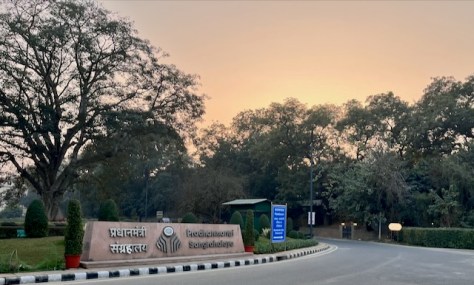
Alongside my visit to the book fair, I attended a seminar at the PMML/NMML (Teen Murti), which also featured a spirited assertion of nationalism, while confining narratives of peace to nostalgic readings of the past. It was argued that these readings offer little evidence to support these sentiments, in this case regarding the Partition’s impact in Bengal. These discussions align with a global rise in populist nationalism, which privileges narratives of conflict.
Cinema as Nationalist Pedagogy

The Book Fair and the seminar are part of the same cultural milieu as the current hit film Dhurandhar. A review in The Caravan magazine has argued that the film exemplifies what happens when public discourse is consistently fed propagandist narratives. The review noted that if the goal is to serve nationalist propaganda to the masses, few mediums work better than a slickly produced, multi-starrer, action-packed spy thriller.

Conversely, an alternative to this swashbuckling sensationalism is the film Ikkis. Writing on the Scroll website, the reviewer noted that the film is based on Arun Khetarpal, who was posthumously awarded India’s highest gallantry award, the Param Vir Chakra, for his actions during the 1971 war. As Khetarpal’s deeds are well documented, Ikkis aims higher, seeking to understand what unites men sworn to kill each other. 

The review added that the film eschews any vengeance-fuelled hyperbole, with scene after scene revealing the director’s efforts to resist jingoism. This sensitive reading of conflict and war has not resonated with audiences in the same way as Dhurandhar, which already has a sequel in the works. The Indian Express, describes Ikkis as a thoughtful exploration of masculinity and bravery that avoids Dhurandhar’s stylised machismo.

What do the divergent fortunes of these two films reveal, if anything important or long-term, about contemporary India’s cultural moment? Just as the book fair collection and the PMML/NMML discussion suggest a renewed contest over complex, layered narratives of identity, these two films capture two sides of the same coin. They represent the mixture of giving people what they want and offering them what their makers want them to want!

The Missing Voices

If Anderson’s ‘print capitalism’ helps us understand how mass media manufactures and disseminates narratives that shape national consciousness, it also reveals what is missing here: where are the voices of those who speak for peace and friendship? The current publishing industry, mirroring the broader political trend, seems to suggest that conflict is not only inevitable but desirable, a necessary component of national identity.

Yet surely, we do not all consider conflict the solution to our problems? When families feud, we try to keep talking and reach some form of amicable coexistence. Why should the same not apply to the family of nations? Instead, the religious-nationalist approach to history and politics, leisure and entertainment, which has gained prominence since the 1990s, aims to reduce content to a commodity and sentiment to profit.

The book fair’s public relations emphasis on military history and policy, then, reflects not only the sidelining or suppression of multiple voices but also an element of advertising to buyers and sellers of different kinds, enhancing familiarity and enabling involvement and investment. When every other book celebrates civilisational value and military valour against perennial ‘others’, alternative voices are drowned out not only by outrage and censorship but also by business. 

A Reimagined Community

What I witnessed at the World Book Fair, across bookshops, at the Teen Murti seminar, and what I read about the contrasting fates of Dhurandhar and Ikkis show a nation-state actively reimagining itself. If nations are ‘imagined communities’, shaped by those who control the means of communication, then, as that act of imagining is never neutral, it can always be reimagined as well. They are shaped by choices, and those choices remain ours to make.

The question facing urban, middle India today is which version of itself it will choose to recall and reimagine: one defined primarily by categories, conflicts, and eternal revenge, or one that acknowledges complexities, accepts diversities, and accommodates differences. The contested marketplace of bookshops, cinemas, and talking shops (and their digital counterparts) will play a determining role in answering that question. 

References:

Benedict Anderson, Imagined Communities: Reflections on the origin and spread of nationalism, Verso Books, 1983.

Nandini Ramnath, ‘‘Ikkis’ review: In tribute to a war hero, a rare plea for peace and empathy’, Scroll, 1 January 2026

Surabhi Kanga, ‘The Mob Comes For Film Critics’, The Caravan, 1 January 2026

Marie Lall and Kusha Anand. Bridging Neoliberalism and Hindu Nationalism: the role of education in bringing about contemporary India. Policy Press, 2022.
Embracing Nostalgia Through Music and Gardening

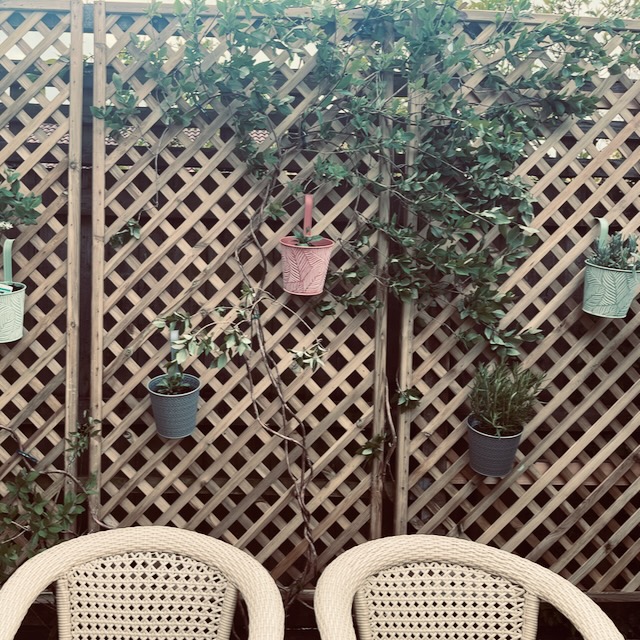
A long weekend spent revamping the garden has left me feeling quietly thankful—grateful not only for the beauty of blooming flowers but the often-overlooked moments that bring small moments of joy to us. These are the everyday miracles that ground us, offering us gentle reminders to be present, and to be grateful for the life and family that support us and get us through difficult times. They act as pillars, always there in the background but without whom we could not exist.

In August 2016, I began this blog as a space to document my experiences during a visiting fellowship in Lahore, as well as to share other events and observations that captured my interest along the way. This has grown into a broader canvas—one where I could share photographs, music, and reflections, often framed with a touch of historical context. Over time, the blog has become not just a repository of memories, but also a means of connecting with others.

When I first considered what to name this space, I wanted something that could symbolise both personal growth and a diversity of ideas. I eventually chose Bagicha—the Urdu and Punjabi word for “garden.” The name felt right, evoking a place where different thoughts, emotions, and inspirations could coexist and bloom. Like any real garden, this blog has required time and care, and though life’s demands have occasionally interrupted the rhythm of posting, I’ve done my best to return and tend to it regularly.

This past weekend, I turned my attention to my actual garden, which had begun to show signs of wear and neglect. I found myself hoping that this act of renewal would also translate into a more productivity for my Blogging and provide inspiration for other writing projects over the coming summer.

After the work was completed, I treated myself to a quiet moment with a cup of coffee and a Karachi Bakery biscuit, enjoying the fruits of my labour over the long May Bank Holiday weekend. As I unwound, scrolling casually through Instagram, I stumbled upon a deeply nostalgic song: Mai Tenu Yaad Aawan Ga (You Will Remember Me), sung by the legendary Surinder Kaur and Asa Singh Mastana. This version, recorded in Toronto in 1980, is hauntingly melodic—its rich tones and heartfelt lyrics evoke a bygone era.

Surinder Kaur, often hailed as the “Nightingale of Punjab,” remains one of the most celebrated folk singers in South Asian musical history. Her voice, both powerful and tender, became a defining sound of Punjabi folk music in the 20th century. Asa Singh Mastana, her equally iconic counterpart, was known not only for his duets with Kaur but also for his contributions to Bollywood as a playback singer. Both Kaur (born 1929 in Lahore) and Mastana (born 1926 in Sheikhupura) belonged to pre-Partition era and migrated to Delhi after 1947. They continued the musical journeys that had begun in Lahore and helped shape the soundscape of post-Partition Punjab.

Their music carries the weight of memory, migration, and resilience. Listening to them, one feels transported—not just to another time, but to a shared emotional and cultural landscape that continues to resonate deeply.

Listen to this timeless song and linger for a while in its emotional undertones. I’ve also included some photographs to accompany the mood—a small attempt to honour the spirit of nostalgia and historical connections that Bagicha has tried to capture.

What makes you feel nostalgic?

Carefree Days with Pran Nevile, April 2016. © Pippa Virdee

Today’s daily prompt on WordPress was “What makes you feel nostalgic?” I of course immediately started thinking and letting my mind wonder into the past. The past that is often nostalgic and romantic; it is after all the 31 December! Immediately one memory came back like a flash.

I recall the numerous times that I went to visit Pran Nevile at his home in Gurgaon, where we would have meet, chat, drink and eat. And almost always there would be music playing in the background, the kind of music that transports you to a bygone era, along with the conversation. These “Carefree Days” are no more, but those precious memories remain.

Beyond the nostalgia I remember I wrote a tribute for Pran, which was supposed to have been published but I suspect it never was. I most likely didn’t follow up because of work distractions. Upon a keyword search (thank goodness for that!) I found the tribute on my laptop straightaway. I sat there with the melodic voice of Begum Akhtar in the background and re-read the piece, feeling sad but happy to have met someone like Pran at the beginning of my own journey. It makes a fitting post for today’s prompt, as I will always associate Pran with the nostalgia of a pre-partitioned Punjab that is no more.

Pran Nevile (1922-2018): A Tribute

I first met Pran Nevile in 2001, when I embarked on a new journey in my life of pursuing a PhD. He was recommended to me by my supervisor, Prof. Ian Talbot. We met, like on many subsequent occasions, at his favourite place in New Delhi, the India International Centre (IIC). I was beginning my research into the impact Partition had on Punjab, exploring this through first-hand accounts of people, who were forced to abandon their homes and leave during that tumultuous and violent time. Pran was born in Lahore in 1922 and thus could recollect stories from the colonial period thereby contextualising this impact on Punjab following Partition. At the time I didn’t know much about Pran, beyond that he had written a book on Lahore and that he had a previous career in the Indian Foreign Service. In many ways, I was an outsider to both the intellectual Delhi circle and academia, more generally. We sat in the café at the IIC and had tea, while chatting about an array of subjects. Almost straightaway we bonded as he radiated with an old-school genteel charm that belongs to a by-gone era; certainly not of the India and Pakistan today. He paid me a wonderful/witty compliment, by saying that when I speak in Punjabi, I sound like a Punjaban and when I speak in English, I am a mem. He would repeat this on numerous occasions. This was the beginning a friendship, which endured until he passed away on 11 October 2018. He was my connection to the pre-partitioned Punjab, and I was his connection to Lahore, exchanging notes and comparing the-then and now. 

Growing up in Lahore

Pran’s family lived in Nisbet Road in the walled city of Lahore, where his father had migrated to in the early 1910s from their ancestral village of Vairowal, in neighbouring Amritsar district. Following his education at the DAV School, he was successful in getting a scholarship and got admission to the prestigious Government College Lahore, from where he graduated in 1943 in MA Economics. He recollects many of his early memories of growing up in Lahore in his autobiography, Carefree Days (2016), recounting the days of “pastimes, fairs and festivals”, which would keep them amused all year round. His favourite pastime though was kite flying, as he writes: “I cannot recall anything more thrilling than kite flying in my boyhood” (pp. 10-11). Pran, like many others, lamented the later ban on kite flying in Lahore, which has seen the demise of the popular Basant festival.

Writing Lahore: A Sentimental Journey (1992), a book that instantly resonated with many Lahoris, enabled Pran to visit the city of his childhood. He was one of the lucky ones because he was able to visit Lahore with ease, a romance that he rekindled with this tribute to the city of his birth. He often recited, Jine Lahore nahin Vekhya oh Jamya hi Nahin (One who has not seen Lahore is as good as not having been born at all) (p. 193). Like many other people who left their ancestral homes (thinking they would be back), he had a photographic imprint of the city in his mind, remembering every nook and cranny of the congested Androon Shehr. Professor Tahir Kamran organised a two-day conference at GC University on ‘Punjab and the Raj’ in 2006 and Pran was invited to speak at this conference. I distinctly remember a moment from then, when another friend from Lahore, Bilal Ahmed was driving the car, and Pran was seated in the front and me in the back. We were in the walled city, trying to locate a venue and unsure about the exact location. Immediately, Pran started to navigate and provide directions. He said he can never forget the streets of his Lahore, despite all the changes since his he was a student in the city. It was a heart-warming and amusing moment we never forgot.  

Never-ending Retirement

Pran graduated during the political and international upheaval of World War Two. His desire was topursue a PhD at the London School of Economics, but the uncertainty of that period prompted him to take up an opportunity at the Bureau of Public Information in 1944 as an assistant journalist. After a series of different posts, he was selected for the Indian Foreign Service Board in 1955 as second secretary (commercial) (Carefree Days, p. 46). He joined the Ministry of External Affairs as an attaché in March 1959 and subsequently was posted in Warsaw (1962), Belgrade (1966) and Moscow (1969). By 1974, he was back at the Ministry of Commerce as deputy secretary (East Europe). After that came the opportunity to go to Chicago in 1977, which he recalls ended his “eventful official link with the socialist world of East Europe” (p. 148). During this period, he also had a short stint in Geneva which allowed him to develop his links with the UNDP, which ultimately paved the way for a second career. Soon after in May 1979, he took premature retirement, leaving after 35 years of professional life. He was now the programme coordinator for the UNCTAD, based in Geneva and this allowed him to rekindle his relationship with East Europe until 1985, when he returned back to India. One of the highlights of this stint surely was when he took on the role of a priest and performed the marriage rites for one of his friends in Geneva; a story he often shared with relish.

For a conventional diplomat, Pran was more austere and radical in his personal life. As he recalls in his autobiography, he developed an “abhorrence for this ostentatious tamasha and meaningless jubilation” (p. 49) that surrounded elaborate engagements and wedding ceremonies. In this endeavour, he developed a friendship with Savitri (daughter of an uncle who was married to Pran’s father’s first cousin!), often acting as her mentor and encouraging her towards the pursuit of knowledge and education. He first noticed her in July 1941, as a young man discovering his own self, and by January 1947, they had eloped and had a civil ceremony in Delhi. Early reservations against this marriage were put aside by their families, and he remained with Savitri until she died in 2013. A spark in him went after that.

The Last Calling

After his retirement from work, he decided to embark on yet another career, but this time, it started as an unplanned script. It was in 1987, when he first started making frequent trips to the IIC, spending his days in the library and often using this as office space for his writing. Initially, he only ventured towards his expertise area and wrote on economic matters, but it was not long before his real passion emerged and he turned his gaze towards other subjects, which included his hometown Lahore, nautch girls, dance and music. Feedback from these early forays in small articles gave him confidence to continue with this newfound passion; although one of his earliest writings dates back to 1949, when he wrote ‘Problem of the Mother-in-Law’ which was published in Caravan magazine. His first full-length literary work was inevitably on Lahore, as he recalls: “My desire was to take the reader on a pilgrimage to my Lahore of a bygone era of peace and plenty” (p. 171). The idea for the book was actually conceived way back in 1963 in Hotel Astoria, Geneva. On his seventieth birthday he received the advance copy from the publisher of his first book, Lahore: A Sentimental Journey.

This journey led him to write prolifically on the era of the British Raj. Being a product of that era, he imbued the character of the Brown Sahib and carved out a niche for himself, focusing on the social and cultural history of the British Raj. His fascination for visual and performing arts led him to unearth a vivid and richer history, which he energised many around him with. During the last few years of his life, he reserved his love for K.L. Saigal, the “immortal singer and superstar” (p. 189). My own recollections of Pran were always of visiting him in Gurgaon, chatting at length while nibbling on namkeens, and with the nostalgia of 1940s and 1950s music playing in the background. Those days are no more nor are those, which is his own words read:   

“I belong to the vanishing generation of pre-partition days who were forced to leave their homeland but carried ‘Lahore’ in their hearts like the memory of a first love. Overpowered by nostalgia, we still recall the days when Lahore had attained the reputation of being the ‘Paris of the East’ where people of different communities live in harmony in the sunshine of their common heritage, historic bonds and flamboyant Punjabi culture.” (Carefree Days, p. 194).

Women, Violence and the Silences: 1984

© Pippa Virdee 2024

Forty years ago, Delhi witnessed some of the worst violence since 1947. It was the events of October-November 1984, that prompted Urvashi Butalia to revisit the Partition of 1947 and to excavate the history of the violence that was perpetrated towards women. Both 1947 and 1984 have left indelible scars on the people and region. The opening in her book, The Other Side of Silence (1998), is worth quoting detail:

“Then, in October 1984 the prime minister, Indira Gandhi, was assassinated by her security guards, both Sikhs. For days afterwards Sikhs all over India were attacked in an orgy of violence and revenge. Many homes were destroyed and thousands died. In the outlying suburbs of Delhi more than three thousand were killed, often by being doused in kerosene and then set alight. They died horrible, macabre deaths. Black burn marks on the ground showed where their bodies had lain. The government – now headed by Mrs Gandhi’s son Rajiv remained indifferent, but several citizens’ groups came together to provide relief, food and shelter. I was among the hundreds of people who worked in these groups. Every day, while we were distributing food and blankets, compiling lists of the dead and missing, and helping with compensation claims, we listened to the stories of the people who had suffered. Often older people, who had come to Delhi as refugees in 1947, would remember that they had been through a similar terror before. ‘We didn’t think it could happen to us in our own country,’ they would say. This is like Partition again.” (Page 4-5) “It took 1984 to make me understand how ever-present Partition was in our lives too, to recognize that it could not be so easily put away inside the covers of history books. I could no longer pretend that this was a history that belonged to another time, to someone else.” (page 6)

But history keeps repeating itself, again and again. In 1984, people still had fresh memories of 1947, and so those three days of carnage evoked the spectre of Partition once again. Yet each time this happens, there is collective amnesia and each time there is no justice for the “chief sufferers”, the women who bear the brunt of political-communal violence. Below are a selection of articles and abstracts available on the subject and organised chronologically. At the end, there is a recent documentary by The Quint on “The Kaurs of 1984” which brings to the fore the accounts of the women who endured this and who have continued their fight for justice. .

The Justice G.T. Nanavati commission was a one-man commission, a retired Judge of the Supreme Court of India, appointed by the National Democratic Alliance (NDA) government in May 2000, to investigate the “killing of innocent Sikhs” during the 1984 anti-Sikh riots. The report was finally published in 2005.

Mander, Harsh. “Conflict and Suffering: Survivors of Carnages in 1984 and 2002.” Economic and Political Weekly (2010): 57-65. Even through these were separated by 18 years of history, there is tragically a great deal in common between the communal massacres that played out on the streets of Delhi in 1984 and in settlements and bye-lanes across Gujarat in 2002. This paper documents some of the findings of the research conducted with survivors of these two major pogroms over more than a year in the widows’ colony established by the Delhi government in Tilak Vihar and in four of the worst-hit district of Gujarat. It examines the paths of suffering, renegotiation and healing separately for the direct victims and the vicariously affected.

Kaur, Ravinder. “Wound, Waste, History Rereading 1984.” Economic and Political Weekly (2014): 34-38. Wounds are expected to heal. Our very conception of victims and victimhood is based on this hopeful axiom. But not all wounds heal, some remain in a constant state of decay, degenerate, and ultimately risk turning into waste too. It is this possibility of waste that this article explores. The 1984 violence is one of those historical wounds that has neither faded from public memory nor fully healed. At the heart of this unhealing wound is the question of justice that has long been denied to the victims. The judicial affidavits prepared in early 1985 not only narrate the violence that unfolded systematically, but three decades later testify to the inability of the state apparatus to help heal its wounded citizens

Saluja, Anshu. 2015. “Engaging with Women’s Words and Their Silences: Mapping 1984 and Its Aftermath.” Sikh Formations 11 (3): 343–65. doi:10.1080/17448727.2015.1102554. In studying the 1984 pogrom and its aftermath, I have attempted to capture the voices of women of succeeding generations of the victim families and to gauge some sense of the arduous path which these women have had to tread on. In the present paper, I have examined and assessed the ways and means which women survivors of the 1984 pogrom have relied on to cope with their sense of trauma and hurt, and to negotiate everyday existence. In accounts seeking to document and map the experiences of trauma survivors, the themes which they raise and the issues that they speak of are taken into cognisance, while the gaps in their speech often remain unnoticed and unexplained. But these silences and gaps need to be recognised and highlighted as much as the speech of the survivors. Women survivors of 1984 also do not speak of their own agency, leaving it mostly unarticulated in words. Gauging a sense of this requires going beyond the words that are spoken and attempting, even if tentatively, to unravel and interpret the silences.

Kaur, Ishmeet. “Narrating the Experience: Oral Histories and Testimonies of the 1984 anti-Sikh Carnage Victims.” Journal of Punjab Studies 23 (2016). http://giss.org/jsps_vol_23/6_kaur.pdf This essay attempts to understand the word “testimony” and asks how oral histories can also become testimonial. It considers how new histories can unfold from oral accounts of the victims in the context of 1984 anti-Sikh carnage in Delhi. It argues that formal testimonies may misrepresent events by diminishing the gravity of the violence experienced by the victims, while oral narrations may be considered useful historical sources. As a case study, we consider selected affidavits submitted to Nanavati Commission in 2000, as well as oral narratives of the survivors recorded during a field visit to the Tilak Vihar widow’s colony in April 2015.

Arora, Kamal. “Legacies of violence: Sikh women in Delhi’s” Widow Colony”.” PhD diss., University of British Columbia, 2017. https://open.library.ubc.ca/soa/cIRcle/collections/ubctheses/24/items/1.0343994 This dissertation examines how Sikh women who survived the anti-Sikh massacre in 1984 in Delhi, India, cope with the long-term legacies of violence and trauma amid the backdrop of the urban space of the city. After the assassination of then Prime Minister Indira Gandhi by her Sikh bodyguards, approximately thirty-five hundred Sikh men were killed in October and November 1984. Many of the survivors, Sikh widows and their families, were relocated shortly after to the “Widow Colony,” a designated slum also known as Tilak Vihar, within the boundary of Tilak Nagar in West Delhi, as a means of rehabilitation and compensation. The work arises from fieldwork carried out between December 2012 and March 2014. I begin by discussing in depth the space of the Widow Colony and its relation to the rest of the city of Delhi. I then analyze the events of the 1984 massacre through the narratives of Sikh widows and how they remember their experiences of violence. I discuss how violence can have long-term ramifications for everyday life in arenas such as kinship networks, economic stability, health and wellness, and social life. These experiences are further amplified by gender, caste, and class. I also examine the impact of the stigma of widowhood in this community. This research seeks to interrogate how memories of violence inform, and are constituted by, embodied, affective practices carried out in a gendered space produced by the state. I argue that Sikh widows cope with long-term trauma by creating new forms of sociality and memory through their everyday lives and religious practices in the Widow Colony. The memory of the 1984 violence figures heavily among the Sikh diaspora. Thus, I also explore the relationship between the Widow Colony and Sikhs in the transnational arena.

Arora, Kamal, ““I Get Peace:” Gender and Religious Life in a Delhi Gurdwara” Religions 11, no. 3: 135 2020. https://doi.org/10.3390/rel11030135 In October and November of 1984, after the assassination of Prime Minister Indira Gandhi by her Sikh bodyguards, approximately 3500 Sikh men were killed in Delhi, India. Many of the survivors—Sikh widows and their kin—were relocated thereafter to the “Widow Colony”, also known as Tilak Vihar, within the boundary of Tilak Nagar in West Delhi, as a means of rehabilitation and compensation. Within this colony lies the Shaheedganj Gurdwara, frequented by widows and their families. Based on ethnographic fieldwork, I explore the intersections between violence, widowhood, and gendered religious practice in this place of worship. Memories of violence and experiences of widowhood inform and intersect with embodied religious practices in this place. I argue that the gurdwara is primarily a female place; although male-administered, it is a place that, through women’s practices, becomes a gendered counterpublic, allowing women a place to socialize and heal in an area where there is little public space for women to gather. The gurdwara has been re-appropriated away from formal religious practice by these widows, functioning as a place that enables the subversive exchange of local knowledges and viewpoints and a repository of shared experiences that reifies and reclaims gendered loss.

Agarwal, Yamini. Urban Marginalization, Exclusion and Education-the Widows’ Colony in Delhi. Bonn: Max-Weber-Stiftung-Deutsche Geisteswissenschaftliche Institute im Ausland, 2020. This paper examines the many exclusions and marginalities experienced in urban neighbourhoods which are formed as a result of communal violence. It draws on an ethnographic study of Tilak Vihar, also known as the Colony of Widows, where the survivors of the 1984 anti-Sikh violence were resettled. By examining their life histories, the paper explores how women survivors have been caught up in a vicious circle of poverty and lack of educational and occupational opportunities due to their location in a highly stigmatized and gendered space. This has affected the education of their children, as reflected in limited school choices and poverty forcing young people to drop out of schools to fend for their families. The paper also looks into the role of community groups in Tilak Vihar, which have become the main source of support for families given the retreat of the state from this space. The paper underscores the everyday violence that survivors experience due to their gender and spatial location.

Saluja, Anshu. “Gendered Erasures in Memory: Silencing of Cases of Sexual Violence in 1984.” Sikh Formations 20 (3): 149–63, 2024. doi:10.1080/17448727.2024.2384843. In this paper, I have addressed the issue of sexual violence in the specific context of the 1984 anti-Sikh carnage in Delhi. Though a significant number of cases of sexual assault took place in Delhi in November 1984, they have largely remained shrouded in obscurity. I have attempted to analyse the reasons, prompting a near total silence on these instances. In undertaking this inquiry, the paper reflects on the selective, and often disempowering, nature of memory-making and preservation. It goes on to ask the critical question: what constitutes legitimate memory?

Kaur, Jasleen, and Vinita Mohindra. “Spectral Wounds of 1984: Sikh Massacre in Harpreet Kaur’s The Widow Colony: India’s Unsettled Settlement.” Sikh Formations, March, 1–11, 2024. doi:10.1080/17448727.2024.2321416. In 1984, Sikhs were massacred following the assassination of Prime Minister Indira Gandhi. Cultural expressions attempt to foreground the haunting legacies of this genocide. This paper explores Harpreet Kaur’s documentary, The Widow Colony- India’s Unsettled Settlement which unfolds as trauma testimony of the understudied conflict, contextualizing the spectral wounds of Sikh widows and their struggle for survival. Using hauntology and postmemory as critical lens, this article examines the spectral wounds of 1984 Sikh genocide. It also focuses on the gendered dimensions of violence against Sikh women by enunciating their doubly victimized sensibility through their experiences of shame, trauma and suffering.

Kaur, Jasleen, and Vinita Mohindra. “(Un)Dead Past of 1984 Sikh Massacre in Jaspreet Singh’s Helium.” Sikh Formations, September, 1–19, 2024. doi:10.1080/17448727.2024.2408859. Prime Minister Indira Gandhi’s assassination followed the 1984 state-sanctioned massacre of Sikhs. This historical violence haunts survivors, and its mediation in cultural texts reshapes the interplay between history and memory, voicing forgotten narratives. However, the complex historical agency and collective silences on the 1984 Sikh genocide leave its cultural and literary representations undertheorized. Jaspreet Singh’s Helium (2013), serving as a cultural archive, delves into the haunting legacies of this genocide, highlighting its role in memorializing historical loss. Applying hauntology and Agamben’s homo sacer, this article investigates how spectral wounds reveal dystopic violence, excluding Sikhs from legal protection.

The Kaurs of 1984. Quint Documentary.

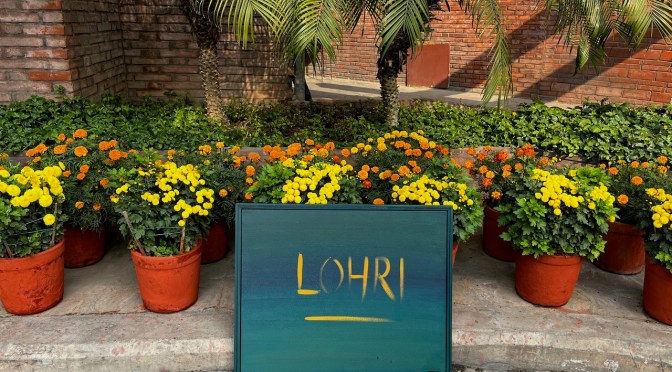
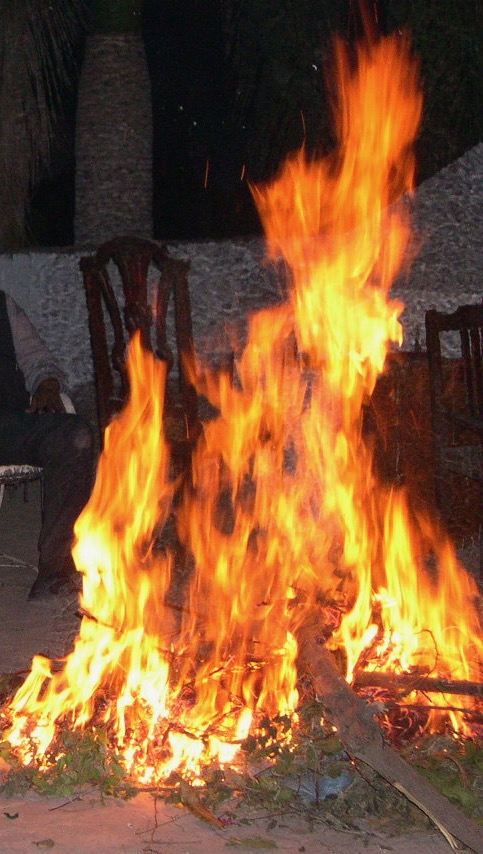
The festival of Lohri in Punjab

© Pippa Virdee 2004, celebrating lohri in Lahore.

A few days back I was in Punjab and Delhi, which were clouded and submerged in the winter chill and fog. With every passing comment about the cold, there is another reference, “it will only last until lohri, after that the weather will improve”. This points to the passing of the winter solstice and the changes in the season. Many of the popular festivals in Punjab are associated with seasonal changes, these are easy markers and reference points before formal calendars and dates arrived, and in this case the winter festival of lohri means anticipating longer and warmer days.

Growing up, there were always certain foods which we associated with lohri (and associated with the winter harvest). Rewris/revdis, jaggery and sesame-based dishes, and peanuts, are all warming and seasonal foods during the winter days of North India. Sarson da saag and makki di roti is another essential. Jaggery, sesame sweets and peanuts are quite often distributed and exchanged amongst friends and families. Traditionally, this special occasion was reserved for the birth of a son, but thankfully many have started celebrating the birth of a child, regardless of its gender.

In Indian Punjab the festival is public holiday but unfortunately across the border in Pakistan Punjab it is barely recognised. In recent years commentators and activists have been trying to revive it and re-introduce it to the wider public, with limited impact. Lohri is not and was not a religious festival, and yet the division of such festivals is emblematic of Partition, which increasingly entrenched what was deemed to be Hindu/Sikh and what was considered Islamic. In the video above for BBC Urdu, you can hear Mazhar Abbas narrate the history of lohri for a new generation.

Going back to Delhi, I was fortunate enough to meet up with Harinder Singh (1469) who was busy curating his lohri exhibition at the India International Centre. Do go and have a look, if you are around Delhi.

Read more about the history and origins of lohri.

Lohri: A joyous bonfire festival of Punjab to mark the end of winter by Mala Chandrashekhar

Lohri the legend of Dulla Bhatti by Aashish Kochhar

Watch lohri de rang with Noor Art and co.

City Monument – Masjid Mubarak Begum, Chawri Bazar

Like a wounded fairy tale. It is among Delhi’s most melancholic souvenirs. One of the domes no longer exists. The missing portion is wrapped in a …

City Monument – Masjid Mubarak Begum, Chawri Bazar

City Library – Jawaharlal Nehru’s Book Collection, Teen Murti House

Statesman’s books. Hundreds of books have been written on India’s first prime minister. One day The Delhi Walla checked out the books that …

City Library – Jawaharlal Nehru’s Book Collection, Teen Murti House

1984: Who are the Guilty?

Report of a joint inquiry into the causes and impact of the riots in Delhi from 31 October to 10 November 1984. Published jointly by Gobinda Mukhoty, President, PUDR, 213, Jor Bagh, New Delhi- 110003 AND Rajni Kothari, President, PUCL, 1, Court Road, Delhi – 110054. November 1984

Following the assassination of Prime Minister Indira Gandhi by her Sikh Bodyguards on 31 October 1984, parts of Delhi, North India and other areas with Sikh populations became engulfed in an anti-Sikh pogrom. From 31 October to 3 November 1984 in the national capital, organised violence against the Sikh community was unleashed, unlike anything it had witnessed previously since the anti-Muslim carnage of September 1947. The ‘official’ claim later was that 2,800 Sikhs were killed in Delhi and 3,350 elsewhere in the country. However, independent sources suggest a much high figure. Among these, one of the first to come out was this fact-finding report by political scientist Rajni Kothari of the People’s Union For Civil Liberties and Gobinda Mukhoty of the People’s Union for Democratic Rights, which investigated the murders, looting and rioting that took place during those 10 days and published it later the same month. It starkly concluded that:

…the attacks on members of the Sikh Community in Delhi and its suburbs during the period, far from being a spontaneous expression of “madness” and of popular “grief and anger” at Mrs. Gandhi’s assassination, as made out to be by the authorities, were the outcome of a well organised plan marked by acts of both deliberate commissions and omissions by important politicians of the Congress (I) at the top and by authorities in the administration. Although there was indeed popular shock, grief and anger, the violence that followed was the handiwork of a determined group which was inspired by different sentiments altogether.

Further reading:

Manoj, Mitta & H S Phoolka. When a tree shook Delhi: the 1984 carnage and its aftermath. Lotus. 2007.

Mukhopadhyay, Nilanjan. Sikhs: The Untold Agony of 1984. Westland, 2015.

Pandey, Gyanendra. “Partition and Independence in Delhi: 1947-48.” Economic and Political Weekly (1997): 2261-2272.

Suri, Sanjay. 1984: The Anti-Sikh Riots and After. HarperCollins, 2015.