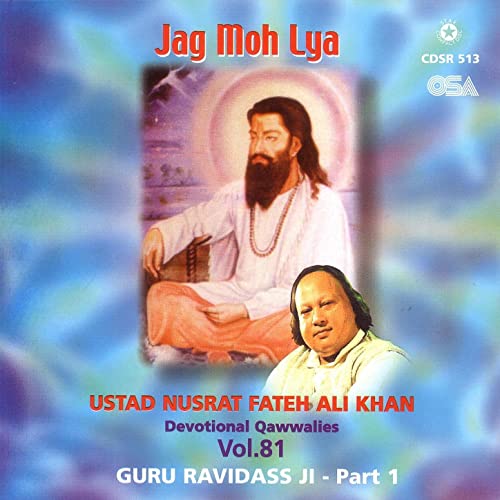
Guru Ravidas was a mystic poet-sant and belonged to the reformist Bhakti movement. Thought to have been born circ. 1450 CE and a contemporary of Guru Nanak (founder of the Sikh faith); some scholars think the two even met. He is revered as a Guru/Bhagat/Sant and is well-known and respected as a social reformer who was keen to see the erasure of caste and gender inequalities. He was born a Chamar (untouchable/dalit) and his fight against social oppression has elevated him as an icon for the Dalit community in contemporary society. His devotional versus are also included in the Guru Granth Sahib but his influence is wide-ranging, spanning across much of northern and central India.
I tired hard to find an English translation of ‘Guru Ravidas’ by Nusrat Fateh Ali Khan but so far I haven’t been successful. It was recorded under the Oriental Star Agency label, circ. 1992 If anyone knows of a translation, please do share it because I think the lyrics, sentiments are just heart rendering. They deserve a much wider audience. While I can follow most of the qawwali myself, I am not able to translate it and do justice to the lyrics. Two lines near the end provide a good sense of the what is being conveyed. The translation is difficult because the word “prayer” does not capture the sentiment sufficiently, because Pooja is performed by Hindus, paath is associated with Sikhs and the azaan with Muslims. There is no direct translation.
na pooja paath azaanan vich (the Lord does not reside in the prayer [of Hindus, Sikhs, Muslim]) rabb wasda e insaanan vich (the Lord resides in humanity)
It is sentiments like these that make Nusrat completely transnational and appealing to people across all faiths.
ravidaas bhagwaan da roop laike aaya jag de dukh niwaarne nu gote khaandi sansaar di aap bedi bhawsaagar ton paar utaarne nu unch neech da fark mitaun khaatir ravidas insaaf da pakad daaman kasam rabb di rabb da roop laike aaya satgur sach satkaarne nu
ravidas guru ravidas guru ravidas guru ravidas guru
dukhiyan di sunne ardaas guru kar sab di poori ardaas guru ravidas guru ravidas guru
kite raajeyan anni paayi si har paase machi duhayi si kite kambdi payi khudayi si kite jaan laban te aayi si insaan si dushman insaan da har dil vich peerh sawaayi si panditan di puththiyan reetan ne sagon hor chavati naayi si oh daur si zaalim kehran da mee wareya pyasi zehran da amrit baani naal jadon si sab di bujhaayi pyas guru ravidas guru ravidas guru
eh raaja ki te parja ki hath bandi wala darja ki eh mandir ki te masjid ki eh puja ki te sharda ki bhala es khuda di dharti te bandeyan da jhutha kabja ki sabb os khuda de bande ne eh wadda ki te chchota ki eh dharm karam da jhagda ki eh deen dharam da jhagda ki hai raazik sabhda oh khaalik nukta samjhaaya khaas guru ravidas guru ravidas guru
us daur di ajab kahaani si har paase daur shaitaani si haq sach te kalme di kidre na kadar kise ne jaani si sab kojiyan bharman di ravidas ne ramz pachchani si harbhajan dillan vich dard bade koi meera sur di rani si oh rahbar kaamal akmal si dil andar naal koi wal chchal si inj hoka de sacheyayi da sab kite kaaraj raas guru ravidas guru ravidas guru
gaya murshid kaamil ki aakhan os swarg bana ke duniya nu bedaar banake duniya nu gulzaar banake duniya nu paigaam sunake amlan da gaflat chon jaga ke duniya nu ujdi hoyi sunji dharti te khud aap wasa ke duniya nu na pooja paath azaanan vich rabb wasda e insaanan vich chauhaan khuda nu yaad karo oh har dam wasda paas guru ravidas guru ravidas guru
The Muslim League’s Resolution on Pakistan has called forth different reactions. There are some who look upon it as a case of political measles to which a people in the infancy of their conscious unity and power are very liable. Others have taken it as a permanent frame of the Muslim mind and not merely a passing phase and have in consequence been greatly perturbed.The question is undoubtedly controversial. The issue is vital and there is no argument which has not been used in the controversy by one side to silence the other. Some argue that this demand for partitioning India into two political entities under separate national states staggers their imagination; others are so choked with a sense of righteous indignation at this wanton attempt to break the unity of a country, which, it is claimed, has stood as one for centuries, that their rage prevents them from giving expression to their thoughts. Others think that it need not be taken seriously. They treat it as a trifle and try to destroy it by shooting into it similes and metaphors. “You don’t cut your head to cure your headache,” “you don’t cut a baby into two because two women are engaged in fighting out a claim as to who its mother is,” are some of the analogies which are used to prove the absurdity of Pakistan. In a controversy carried on the plane of pure sentiment, there is nothing surprising if a dispassionate student finds more stupefaction and less understanding, more heat and less light, more ridicule and less seriousness. My position in this behalf is definite, if not singular. I do not think the demand for Pakistan is the result of mere political distemper, which will pass away with the efflux of time. As I read the situation, it seems to me that it is a characteristic in the biological sense of the term, which the Muslim body politic has developed in the same manner as an organism develops a characteristic. Whether it will survive or not, in the process of natural selection, must depend upon the forces that may become operative in the struggle for existence between Hindus and Musalmans. I am not staggered by Pakistan; I am not indignant about it; nor do I believe that it can be smashed by shooting into it similes and metaphors. Those who believe in shooting it by similes should remember that nonsense does not cease to be nonsense because it is put in rhyme, and that a metaphor is no argument though it be sometimes the gunpowder to drive one home and imbed it in memory. I believe that it would be neither wise nor possible to reject summarily a scheme if it has behind it the sentiment, if not the passionate support, of 90 p.c. Muslims of India. I have no doubt that the only proper attitude to Pakistan is to study it in all its aspects, to understand its implications and to form an intelligent judgement about it.
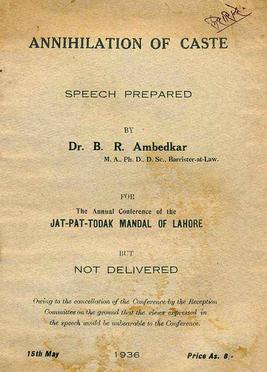
The Annihilation of Caste was an undelivered speech written in 1936 and to be delivered at the Jat-Pat Todak Mandal (Society for the Abolition of Caste system). However, the organiser found elements within the speech objectionable and Ambedkar refused to censor his words.
Other contemporary abominations like apartheid, racism, sexism, economic imperialism and religious fundamentalism have been politically and intellectually challenged at international forums. How is it that the practice of caste in India – one of the most brutal modes of hierarchical social organisation that human society has known – has managed to escape similar scrutiny and censure? Perhaps because it has come to be so fused with Hinduism, and by extension with so much that is seen to be kind and good – mysticism, spiritualism, non-violence, tolerance, vegetarianism, Gandhi, yoga, backpackers, the Beatles – that, at least to outsider, it seems impossible to pry it loose and try to understand it.
Listen to The Doctor and The Saint: The Ambedkar—Gandhi debate: Race, Caste and Colonialism with Arundhati Roy (2014)
O’Boyle, Jane “The New York Times and the Times of London on India Independence Leaders Gandhi and Ambedkar, 1920–1948” American Journalism, Volume 35, 2018 – Issue 2, 214-235.
During the years before India’s independence, the Times of London published news stories that were derisive and skeptical of Mahatma Gandhi, reflecting a national policy to diminish his power in the process to “quit India.” The Times was respectful of the untouchables’ leader Bhimrao Ambedkar and his civil rights movement for untouchables, perhaps to further distract from Gandhi’s popularity. The New York Times lavished positive attention on Gandhi and largely ignored Ambedkar altogether. The American newspaper framed a hero of colonial independence and never his oppression of untouchables, adhering to news policy during the Jim Crow era of racial persecution.
While the caste system has been formally abolished under the Indian Constitution, according to official statistics, every eighteen minutes a crime is committed in India on a Dalit-untouchable. The Persistence of Caste uses the shocking case of Khairlanji, the brutal murder of four members of a Dalit family in 2006, to explode the myth that caste no longer matters. In this exposé, Anand Teltumbde locates the crime within the political economy of post-Independence India and across the global Indian diaspora. This book demonstrates how caste has shown amazing resilience – surviving feudalism, capitalist industrialization and a republican constitution – to still be alive and well today, despite all denial, under neoliberal globalization.
Teltumbde, Anand. “Deconstructing Ambedkar,” Economic and Political Weekly (May 2, 2015).
Electoral politics became competitive bringing to the fore vote blocks in the form of castes and communities, both skilfully preserved in the Constitution in the name of social justice and religious reforms, respectively. The competing Ambedkar icons offered by various political manufacturers in India’s electoral market have completely overshadowed the real Ambedkar and decimated the potential weaponry of Dalit emancipation. The rhetoric of aggressive development, modernity, open competition, free market, etc, necessitated the projection of a new icon which would assure people, particularly those of the lower strata whom it would hit most, of the possibility of a transition from rags to riches with the adoption of the free-market paradigm.
Patangbaazi greets one at the magnificent Parivartan Sthal (Ambedkar Memorial Park) complex constructed by the orders of Chief Minister Mayawati and completed by 2009-10. It is a park today and has from khomche to ice-cream, from couples to families, from beggars to bourgeoisie and all castes in the midst. Stretching along the river-front, a tourist-spot complete with statues and footpaths, in marbles and sandstones, it has a marvellous sense of space. An extraordinary, larger-than-life and gargantuan assertion of identity, dignity and deities – Ambedkar and wife, Kanshiram and Mayawati on opposite sides – this is not merely a reclaiming, recovery of history. It is not even an attempt to re-write history. This set-up, so reminiscent of the Lincoln and Luther King Memorials in Washington, is a grabbing of past and present by its throat and laying down a marker for future.
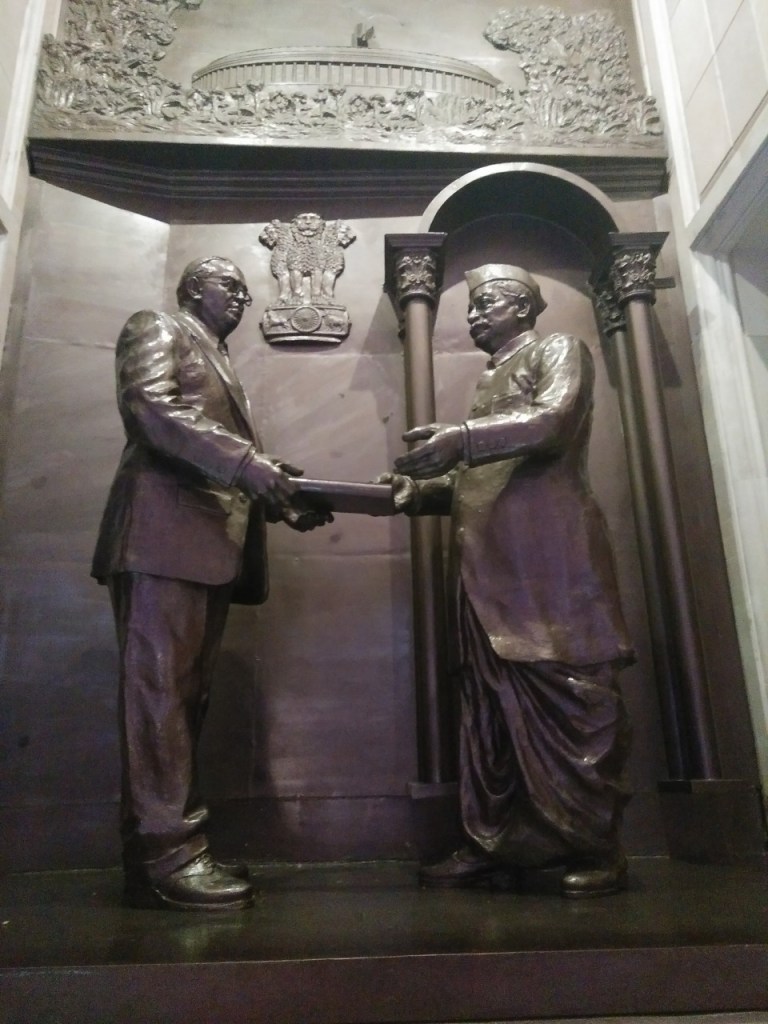
The geometrically precise, expansive space – rational and theistic with its human-Gods – has a jarring note struck by the VIP Lounge on one side of the entrance with the other side being for reserved for others. One long path takes tourist-pilgrims to a stupa-hill, rock-cut alignment with huge mural depictions of Ambedkarite Buddhism from deeksha to nirvana. Hues of blue lighting enhanced the sandstone, soil-coloured backdrop amidst which stood exceptionally well-done, real-life-likeness statues. Ambedkar is sitting majestically in the Lincoln pose in the sanctum-sanctorum. On the circular walls, on one side, Ambedkar is ‘giving’ the gift of Constitution to Babu Rajendra Prasad, the upper-caste Chairman of the Indian Constituent Assembly and on the other, Ambedkar is shown receiving the gift of deeksha from a Baudh-Bhikshu.


 Ambedkar, Bhimrao Ramji.
  BAGICHA