Tag Archives: Buddhism

Dr. B.R. Ambedkar: Castes in India: Their Mechanism, Genesis, & Development

© 2017 Pippa Virdee

Dr. B.R. Ambedkar (born April 14, 1891, Mhow, India—died December 6, 1956, New Delhi), leader of the Dalits (Scheduled Castes; formerly untouchables), chairman of the drafting committee of the Constituent Assembly of India (1946-49) and law minister of the government of India (1947-51).

On his 131st birth anniversary, I share below an excerpt from a paper read by a 25-year-old Ambedkar titled Castes in India: Their Mechanism, Genesis, and Development, at Columbia University, New York, U.S.A. on 9 May 1916:

Subtler minds and abler pens than mine have been brought to the task of unravelling the mysteries of Caste ; but unfortunately it still remains in the domain of the “unexplained”, not to say of the “un-understood” I am quite alive to the complex intricacies of a hoary institution like Caste, but I am not so pessimistic as to relegate it to the region of the unknowable, for I believe it can be known. The caste problem is a vast one, both theoretically and practically. Practically, it is an institution that portends tremendous consequences. It is a local problem, but one capable of much wider mischief, for “as long as caste in India does exist, Hindus will hardly intermarry or have any social intercourse with outsiders; and if Hindus migrate to other regions on earth, Indian castes would become a world problem.”

Dr Babasaheb Ambedkar: Writings and Speeches, Vol. 1, pp. 5-6

And pasted below are a slice of the meagre UK newspaper reportage across the first three decades after Ambedkar’s death, when he was not the indispensable icon that he has become in the India since 1990-91:

“Dr Ambedkar”, ‘…had once thought of asking to be received as a Sikh’ – political rather than theological conversion to Buddhism, therefore – opinion is equally divided on whether Untouchability is dying out or whether the caste system is still rigid, though it may take rather new forms’ – ‘the Untouchables would be happier if, without exaggerating their separateness from the main body of Hindus, they can produce more leaders to carry on Ambedkar’s work’.

7 December 1956, The Manchester Guardian, p. 10

“India’s former Untouchables seek arrest” – ‘Harijans all over India have launched an agitation to press their demands…yesterday 500 demonstrators courted arrest…but the Harijans lack the political organisation or the strength within society to raise anything more than a matter of discontent, easily ignored…the Harijan agitation is being directed by the RPI, the descendent of the old SCF, which the late Dr Ambedkar made a political force in the years before independence but which has shrunk in influence [since]…the agitation was launched on Dr Ambedkar’s birthday yesterday in support of a charter of 10 demands placed before the PM two months ago (land, houses, fair distribution of food grains, enforcement of the laws against untouchability and “immediate cessation of harassment” of Harijans)…the Harijans are stirring…stiffening through desperation or anger [as evidenced] by clashes between caste Hindus and “neo-Buddhists” (Harijans who have converted to Buddhism) in Maharashtra’.

8 December 1964, The Times, p. 9

“The timeless untouchable Indian problem” – ‘not a small minority: 20% in UP, WB, Haryana, Punjab; 10% in Gujarat, Maharashtra, Kerala, and Assam… ‘what has happened to [them] in these past 30 years? Very little, according to Mr. Dilip Hiro, The Untouchables of India. [On] the Untouchability (Offences) Act, 1955, ‘if we took this law seriously, said one state police chief, half the population in the state would have to be arrested’. [Reservation] ‘has tended to break up or drain off any kind of movement fighting for untouchable rights…Dr Ambedkar, the first Untouchable leader, believed that their status would be ameliorated only when the caste system itself was ended in India and there are no signs at all of that. Among western anthropologists, this…may be seen as an effective and defensible ordering of society. Nor does it seem likely that Mrs. Gandhi’s new order, powered by the authority of Kashmiri Brahmins, is going to start at the bottom of the Indian social heap’.

23 February 1976, The Times, p. 6

“14 killed as caste violence strikes at Bihar village” – ‘the third serious outbreak of caste violence [against Harijans by middle-ranking caste Hindus] in northern India in just over one month’ – ‘during the Janata rule in Bihar, the middle-ranking so-called “backward” castes seized the advantage over the former upper castes’ – ‘atrocities had increased recently against Harijans and other economically weaker groups…because other communities had become jealous of their advance, according to Mrs. Savita Ambedkar, widow of Mr. B.R. Ambedkar, the prominent Harijan leader who helped to draft the Indian constitution’.

27 February 1980, The Times, p. 9

Postscript:

On 7 August 1990, Vishwanath Pratap Singh, the prime minister at the time, announced that Other Backward Classes (OBCs) would get 27 per cent reservation in jobs in central government services and public sector units. The announcement was made before both Houses of Parliament. The decision was based on a report submitted on 31 December 1980 that recommended reservations for OBCs not just in government jobs but also central education institutions. The recommendation was made by the Mandal Commission, which was set up in 1979 under the Morarji Desai government and chaired by B.P. Mandal (former chief minister of Bihar). 30 years since Mandal Commission recommendations  — how it began and its impact today by Revathi Krishnan 7 August 2020, The Print.

Read more:

Educate, Agitate, Organise – a short biography of Dr B R Ambedkar by Sonali Campion, 26 April 2016.

Mr. Gandhi and the Emancipation of the Untouchables by Dr. B. R. Ambedkar.

The Annihilation of Caste by Dr. B. R. Ambedkar.

Looking for Buddha…

The Remains of Buddha in Taxila

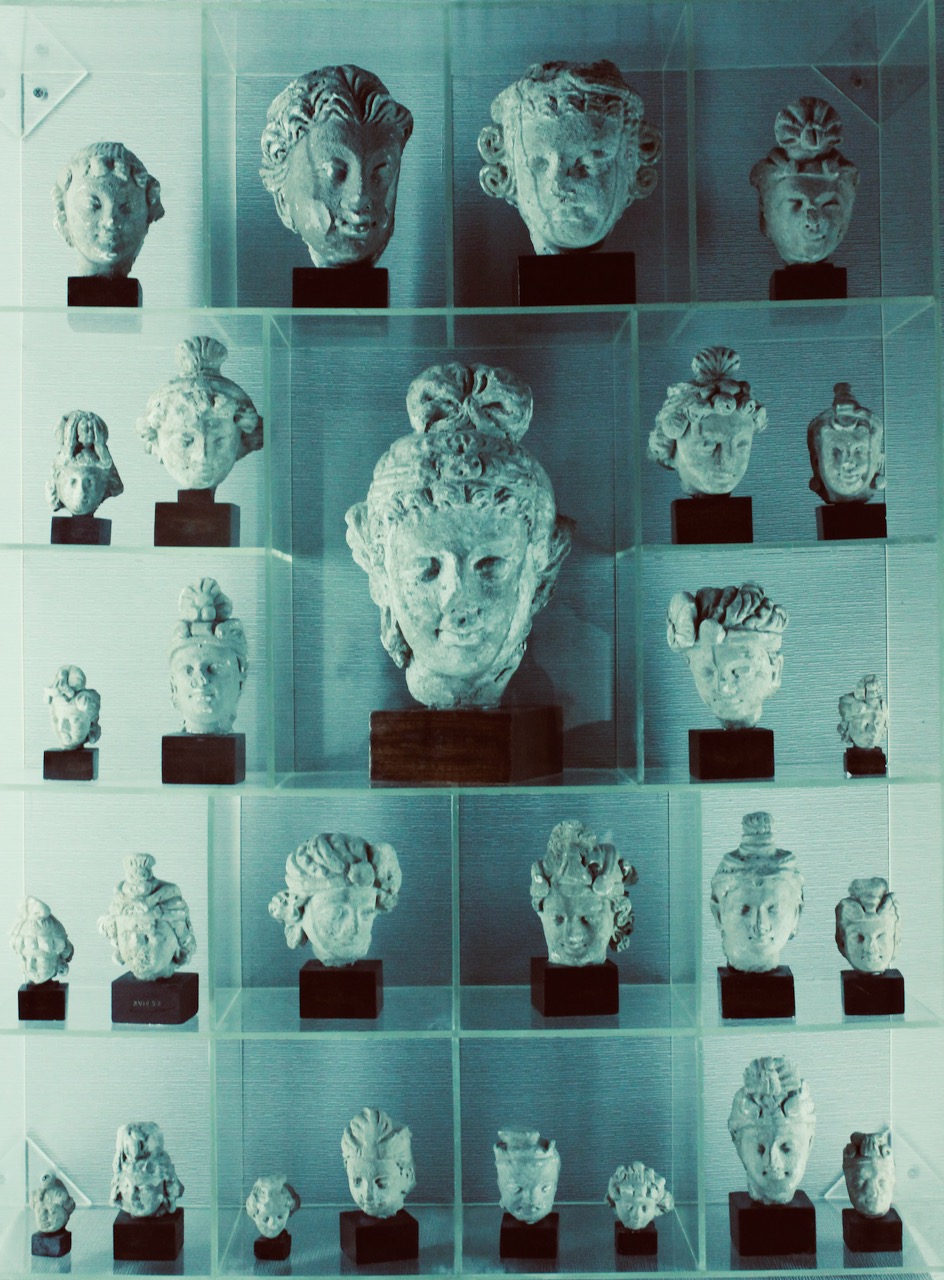
While the present nation-states of Pakistan and Afghanistan are Islamic Republics, there was a time when the religion of Buddha registered a strong presence in areas, now part of these states. Back in 2001, when the ‘Buddhas of Bamiyan’ were blasted by the Taliban in Afghanistan, the visuals were received with astonishment and horror across the world. These ancient, iconic carvings were UNESCO protected monuments and represented the classic syncretic style of Gandhara art. The Taxila Museum in Punjab province of Pakistan is home to the largest collection of ancient Gandharan artefacts in the country dating back to the time from the 1st to the 7th c. AD. Most of these were excavated at the nearby ruins of the ancient city of Taxila. The museum itself dates back to 1918.

John Marshall (1876-1958), was one of the most famous directors of the Archaeological Survey of India and excavator of the city of Taxila. Marshall began the excavations at Taxila in 1913, which carried on for another twenty years, apart from laying the foundation stone of the museum in Taxila. Later, he produced An Illustrated Account of Archaeological Excavation of Taxila in 1951. This 3-volume work details the Taxila excavations of 1913-1934 and opens with an apt description of the importance of topography in situating ancient Taxila:

‘The remains of Taxila are situated immediately to the east and north-east of Sarai-kala, a junction on the railways, 20 miles north-west of Rawalpindi. The valley in which they lie is a singularly pleasant one, well-watered by the Haro river and its tributaries, and protected by a girdle of hills – on the north and east by the snow mountains of Hazara and the Murree ridge, on the south and west by the well-known Margalla spur and other lower eminences. This position on the great trade route, which used to connect Hindustan with Central and Western Asia, coupled with strength of its natural defences, the fertility of its soil, and a constant supply of good water, readily account for the importance of the city in early times’.

While Buddha (5th-4th c. BC) did not venture to Gandhara, growth of Buddhism in this region happened under the Mauryan Empire (322-185 BC). Gandhara was a province of the Persian Empire under Darius I. In 327 BC, Alexander advanced as far as Taxila in his conquests, but shortly thereafter, the region was consolidated with the territorial reach the Mauryan dynasty. It was Chandragupta’s grandson, Emperor Ashoka, who converted to Buddhism in c. 263 BC, following the especially bloody Kalinga War.

It was under the Kushans’ (people of Scythian origin) rule that the Gandhara region assumed its important place in the history of Buddhism and especially its art. Under ruler Kanishka in the 1st c. AD, ‘Buddhist sages made Gandhara a sacred region by the compilation of texts associating local sites with previous incarnations of the Buddha’ (1956). The Kushans’ ‘greatest contribution of Gandhara to the art of Asia was the invention of the Buddha image. The first anthropomorphic representation of the Great Teacher was probably related to the emergence of the devotional sects of Buddhism and demand for the portrayal of the object of worship in an accessible human form in place of the entirely symbolic portrayals of the master in the art of early Hinayana Buddhism’ (1960).

Great Stupas were subsequently built in the region, of which some still survive and are preserved in the Taxila Museum. In Takht-i-Bahi (Mardan, KP province), there is a large Buddhist monastic complex, which forms an important site of this period in the region, representing the Gandhara school of art and architecture. Dating from 1st – 2nd c. AD, Buddhism flourished here, leading to a new, syncretic Greco-Buddhist art/architecture & culture. Mediterranean and Persian influences gave Gandhara sculpture characteristics, which distinguishes it from other Buddhist art notably the Mathura school (1956).

While the archaeological evidence of the extent and importance of Gandhara only came to light in early-20th c., textual evidence and knowledge about it was available through accounts by Chinese Buddhist pilgrims. They recorded and left behind incredibly detailed descriptions of their travels, for example, the stories of Fa Hsien’s journey in c. 400 AD, the journey of Sung Yun in the 6th c., and the most detailed of all, Hiuen Tsang’s Hsi Yii Chi, Records of the Western Countries, composed in early-7th c. (1960).  


Sources:

Marshall, John. Taxila: An Illustrated Account of Archaeological Excavations Carried out at Taxila under the Orders of the Government of India between the years 1917 and 1934. 3 Volumes. Cambridge University Press, 1951.

Rowland, Benjamin. Gandhara Sculpture from Pakistan Museums. Asia Society, 1960.

Gandhara Sculpture in the National Museum of Pakistan, published for the Department of Archaeology by The Department of Advertising, Films and Publications. Printed by Ferozsons, October 1956.

Further Reading:

Asif H., Rico T. ‘The Buddha Remains: Heritage Transactions in Taxila, Pakistan’. In: Rico T. (eds) The Making of Islamic Heritage. Heritage Studies in the Muslim World. Palgrave Macmillan, (2017).

Van Aerde, M. E. J. J. ‘Revisiting Taxila: A new approach to the Greco-Buddhist archaeological record.’ Ancient West & East 2018 (2018).

A Pakistani homeland for Buddhism: Buddhist art, Muslim nationalism and global public history

Buddhist iconography is an important element in India’s national flag and national emblem, and Buddhist sites in India, such as the Ajanta Caves and Bodh Gaya are well known. In contrast, Pakistan’s engagement with its own Buddhist heritage has received far less attention. Andrew Amstutz (University of Arkansas, USA) explains his ongoing research that examines…

via Long Read: A Pakistani homeland for Buddhism: Buddhist art, Muslim nationalism and global public history — South Asia @ LSE