Tag Archives: Bengal

The Aurat Raj of Sultana’s Dream

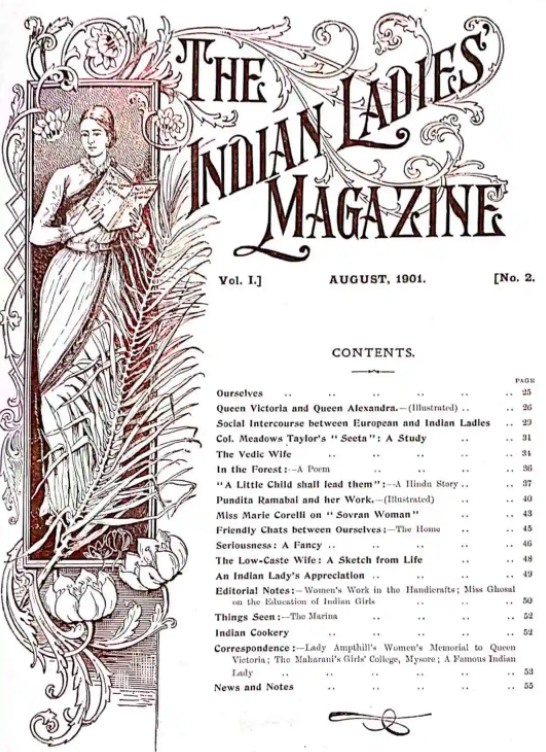
Recently I noticed in several social media forums that people have been sharing details of Rokeya Sakhawat Hossain and her short story, Sultana’s Dream (1905). This story was originally published in The Indian Ladies’ Magazine, Madras, 1905, in English and translated by the author into Bengali. The story takes the form of a dream, set in a futuristic feministic world, in which women through education, opportunity and their innovative ability to use technology have been able to flourish. The science and technology featured in the story is not far off the realities of today and shows immense foresight by the imagination of the author.

The story also highlights how unjust it was, and still is, to deny women education and freedoms, which men have. The imagined place is a generous, green, and friendly environment, in which feminist science has created a space for everyone to thrive and reap the benefits. Although the story was published over a hundred years ago, we are still far from this utopian land.

Rokeya Sakhawat Hossain was born circ. 1880 to an orthodox Bengali Muslim upper-class family in the small village of Pairaband (district Rangpur in Bengal Presidency and present-day Bangladesh). Her father insisted that she learn only Arabic and remain in strict purdah. But with the assistance of her siblings, she learned to read and write Bangla and English. In 1896 her older brother Ibrahim Saber sought to arrange her marriage to a widower in his late 30s. Syed Sakhawat Hossain was the district magistrate in the Bihar region of Bengal Presidency and Ibrahim thought Rokeya would do well under Syed’s open-minded attitude, who had received education in both Bengal and London.

“Rokeya and her husband settled in Bhagalpur, Bihar. None of her children lived. Syed, who was convinced that the education of women was the best way to cure the ills of his society, encouraged his willing wife to write, and set aside 10,000 rupees to start a school for Muslim women.”

After 11 years of marriage, Syed passed away in 1909, leaving Rokeya alone. Soon thereafter she opened a school in Bhagalpur. Later, she moved to Calcutta where she re-opened the Sakhawat Memorial Girls’ School on March 16, 1911. The number of students went from 8 in 1911 to 84 in 1915.

[Source: Hossain, Rokeya Sakhawat – Postcolonial Studies (emory.edu)]

The pioneering concept behind Sultana’s Dream has inevitably inspired other writers and artists to take their cue from a world in which women have the power and men are the submissive other. Aurat Raj, a 1979 Pakistani film, which on the surface appears to be inspired by Rokeya’s work, is also a commentary on the military (and masculine) regime that had come into power, under General Zia. Aurat Raj, is a strange and kitsch interpretation, at whose heart is a social message, centred on exposing the oppression of women. But when the roles are reversed, the women behave in a similar fashion too, unlike Hossain’s short story.
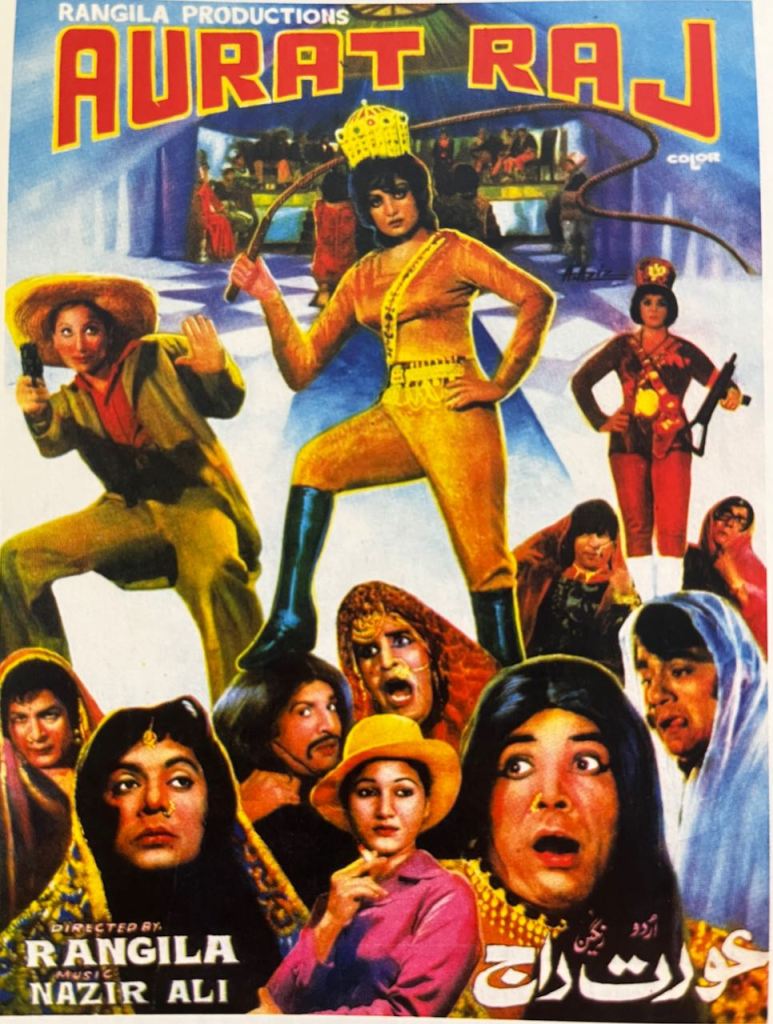
Source: Cinema and Society edited by Ali Khan & Ali Nobil Ahmad (OUP, 2016)

The poster for the film Aurat Raj is equally intriguing as the film itself. It “depicts a woman dressed in a tight-fitting suit and long boots with a crown on her head and a whip in hand, all the more intriguing. She has a commanding, imperious expression on her face. To her right another woman in men’s clothes brandishes a gun. A third woman confidently smokes a cigarette. At the feet of the ‘Empress’ a series of men, including Sultan Rahi, are dressed in women’s clothes. Rahi demurely wears a dupatta on his head, his expression one of effeminate alarm. A subversive and experimental drag movie directed by Rangeela, who had appeared in scores of films in side-comic roles usually playing to the front benchers, Aurat Raj is perhaps Pakistan’s only satire to date and it lampoons not only the naked chauvinism that prevails in Pakistani society but also pokes fun at the way that this attitude pervades the industry. The film targets the machismo of Pakistani men and revels in inverting the gender and power roles, making the women literally wear the pants and leaving the men, including Sultan Rahi and Waheed Murad, wearing frilly frocks and helpless expressions.” Ali Khan, “Film Poster: Reflections of Change in the Pakistani Film Industry” in Cinema and Society: Film and Social Change in Pakistan, edited by Ali Khan & Ali Nobil Ahmad (OUP, 2016), P251.

Despite its well-known star cast of Waheed Murad, Rani, Rangeela and Sultan Rahi, the film was a commercial flop. However, it is certainly worth revisiting, if only as a reminder of the subversive message of the film, which dreams of a more equal society.

Read further:

Sound of Lollywood: When men turned into dupatta-covered minions in ‘Aurat Rar’ by Nate Rabe, 15 April 2017. 

Online edition available to read: Sultana’s Dream. (upenn.edu) 

The manless world of Rokeya Sakhawat Hossain – DAWN.COM by Rafia Zakaria, 13 December 2013. 

Rokeya Sakhawat Hossain — a pioneer of women’s education who strove for a feminist utopia (theprint.in) by Taran Deol, 9 December 2020.

Watch the animation of Sultana’s Dream by WOW Festival Pakistan:

WOW POP-UP: Sultana’s Dream – animated featurette
Aurat Raj 1979 | Rani | Waheed Murad | Sultan Rahi | Rangeela | Pakistani Classic Film

From Blighty to Patna: Objections to the building of railways

Pakistan Quarterly, 1962, 11, 1, Page 23

I came across this fascinating article on ‘The Origin and Growth of Pakistan Railways’ by M. B. K. Malik in Pakistan Quarterly, 1962, Vol 11, No. 1. It provides a brief history of building the railways in British India, especially the motivations and impact this had on the two outer regions of Bengal and Punjab. What captured my interest was actually the objections put forward in the initial days. The first one is from the British perspective, but the second one is from a high-caste Hindu, who obviously envisages multiple problems for those guided by astrologers. Both however, express suspicion and concern at this new system of transport and the wider impact it will have on society and the environment. Of course the railways went on to be built in both Britain and British India, and became pivotal to colonial rule. The economy of empire, with key towns and port cities, coupled with the ability to swiftly move the colonial army from cantonment towns was only made possible because of the railways in British India. But that’s another story. Read below the extract from pages 22-23.

Pakistan Quarterly, 1962, 11, 1, Page 23

The earliest proposals to build railways in India had been made to the East India Company in England in 1844 by Mr. R. M. Stephenson and others. But the time was not propitious. The land had not yet recovered from the effects of the Sind Wars, and the British power and the Sikhs in the Punjab were on the verge of an armed conflict. Nor were the Court of Directors of the East India Company convinced of the feasibility of railways in India. Even in England and Europe railways had met with opposition. In 1835 John Bull had denounced the railways as a menace:

“If they succeed” wrote the paper, “they will give an unnatural impetus to society, destroy all the relations which exist between man and man, over-throw all mercantile regulations, over-turn the metropolitan markets, drain the provinces of all their resources, and create at the peril of life, all sorts of confusion and distress. If they fail, nothing will be left but the hideous memorials of public folly”. It further remarked : “Does anybody mean to say that decent people …. would consent to be hurried along through the air upon a railroad, from which, had a lazy schoolboy left a marble, or wicked one a stone, they would be pitched off their perilous track into the valley beneath; …. being at the mercy of a tin pipe copper boiler, or the accidental dropping of a pebble on the line of way?…. We denounce the mania as destructive of the country in a thousand particulars …. the whole face of the kingdom is to be tattooed with these or a odious deformities …. huge mounds are to intersect our beautiful valleys; the noise and stench of locomotive steam-engines are to disturb the quietude of the peasant, the farmer and the gentleman; and the roaring of the bullocks, the bleating of sheep and the grunting of pigs to keep up one continual uproar through the night along the lines of these most dangerous and disfiguring abominations”.

Objections by Hindus
The orthodox Indians had religious objections. A civilian District Officer, posted in the province of Bihar during the sixties of the last century, has recorded an interesting story showing how orthodox Hindus regarded railway travelling in those days. The officer questioned a nobleman, who had just returned from his first journey by rail, about his views on railway travel. The nobleman replied that it made great noise and that it would be difficult for persons of his high caste to travel at all by such means:

The trains only go at stated times; now I cannot commence a journey except at the minute decided upon by my astrologer as a favourable moment for starting. This makes it very difficult for me to travel at all. Tomorrow I have to go to Muzafferpur, and the astrologer has decided that I must start at 1 A.M. Now my cousin Gadahur went by railway the other day with his wife, and daughter of six years old, and a baby. He started at an unfavourable moment. His wife and two children and a maid-servant were put in a palanquin, which was placed on a truck, which prevented their being seen; and he went in an ordinary carriage. Somehow or other a spark from the engine flew into the palanquin and set fire to some of the linen in which the baby was wrapped; and the servant in her confusion, thinking it was only a bundle of clothes, threw it out. The moment it was done she found out the mistake and they all shrieked. This was only a mile from the Patna station and the train soon stopped. The station master was very kind and did his best, but the palanquin was on fire, and the wife in getting out was seen by many persons. It is not a fit subject even for conversation”.

But all the objections came to naught. England was just entering the age of ‘railway mania’ and it was decided to construct railways in India through Guaranteed British Companies.