Tag Archives: Bangla

The Aurat Raj of Sultana’s Dream

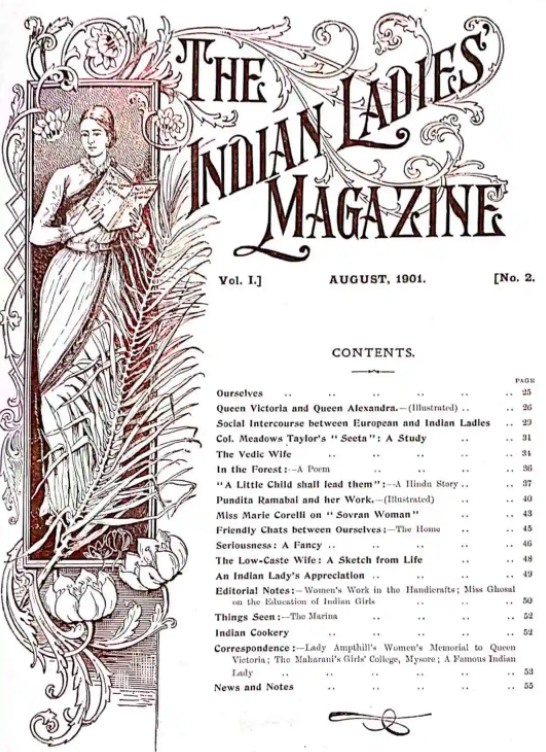
Recently I noticed in several social media forums that people have been sharing details of Rokeya Sakhawat Hossain and her short story, Sultana’s Dream (1905). This story was originally published in The Indian Ladies’ Magazine, Madras, 1905, in English and translated by the author into Bengali. The story takes the form of a dream, set in a futuristic feministic world, in which women through education, opportunity and their innovative ability to use technology have been able to flourish. The science and technology featured in the story is not far off the realities of today and shows immense foresight by the imagination of the author.

The story also highlights how unjust it was, and still is, to deny women education and freedoms, which men have. The imagined place is a generous, green, and friendly environment, in which feminist science has created a space for everyone to thrive and reap the benefits. Although the story was published over a hundred years ago, we are still far from this utopian land.

Rokeya Sakhawat Hossain was born circ. 1880 to an orthodox Bengali Muslim upper-class family in the small village of Pairaband (district Rangpur in Bengal Presidency and present-day Bangladesh). Her father insisted that she learn only Arabic and remain in strict purdah. But with the assistance of her siblings, she learned to read and write Bangla and English. In 1896 her older brother Ibrahim Saber sought to arrange her marriage to a widower in his late 30s. Syed Sakhawat Hossain was the district magistrate in the Bihar region of Bengal Presidency and Ibrahim thought Rokeya would do well under Syed’s open-minded attitude, who had received education in both Bengal and London.

“Rokeya and her husband settled in Bhagalpur, Bihar. None of her children lived. Syed, who was convinced that the education of women was the best way to cure the ills of his society, encouraged his willing wife to write, and set aside 10,000 rupees to start a school for Muslim women.”

After 11 years of marriage, Syed passed away in 1909, leaving Rokeya alone. Soon thereafter she opened a school in Bhagalpur. Later, she moved to Calcutta where she re-opened the Sakhawat Memorial Girls’ School on March 16, 1911. The number of students went from 8 in 1911 to 84 in 1915.

[Source: Hossain, Rokeya Sakhawat – Postcolonial Studies (emory.edu)]

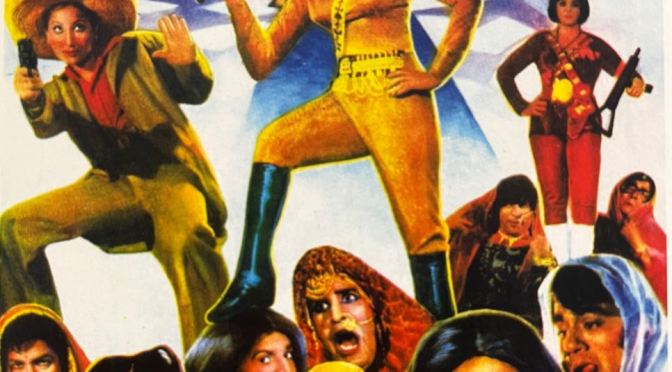
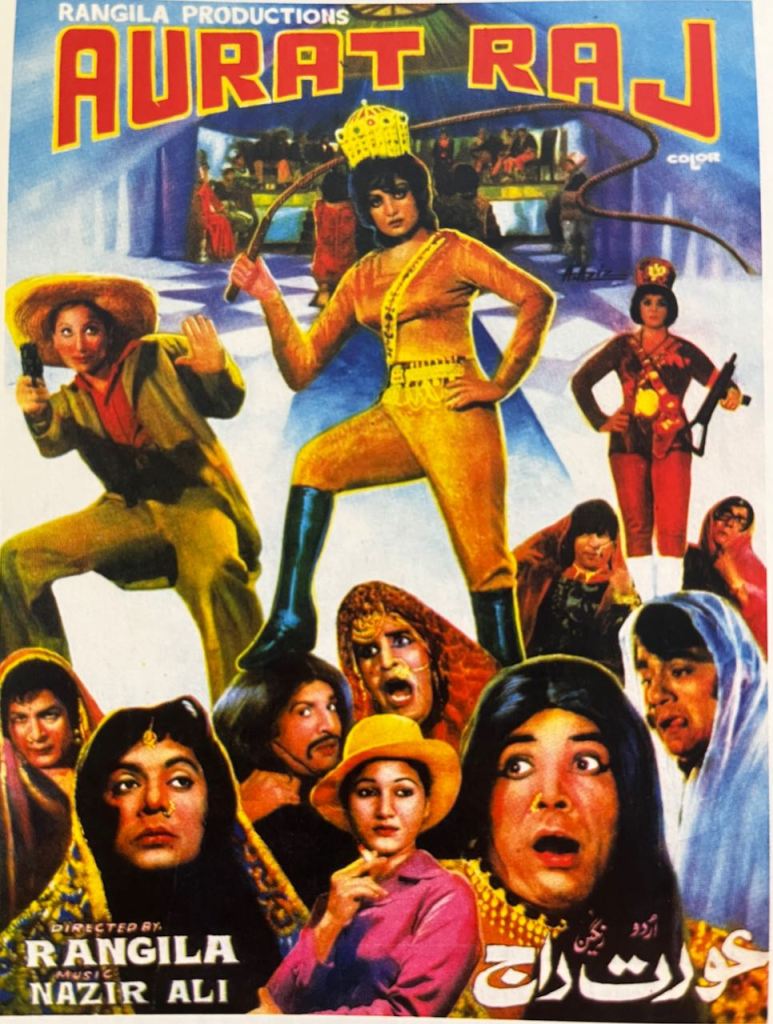
The pioneering concept behind Sultana’s Dream has inevitably inspired other writers and artists to take their cue from a world in which women have the power and men are the submissive other. Aurat Raj, a 1979 Pakistani film, which on the surface appears to be inspired by Rokeya’s work, is also a commentary on the military (and masculine) regime that had come into power, under General Zia. Aurat Raj, is a strange and kitsch interpretation, at whose heart is a social message, centred on exposing the oppression of women. But when the roles are reversed, the women behave in a similar fashion too, unlike Hossain’s short story.
Source: Cinema and Society edited by Ali Khan & Ali Nobil Ahmad (OUP, 2016)

The poster for the film Aurat Raj is equally intriguing as the film itself. It “depicts a woman dressed in a tight-fitting suit and long boots with a crown on her head and a whip in hand, all the more intriguing. She has a commanding, imperious expression on her face. To her right another woman in men’s clothes brandishes a gun. A third woman confidently smokes a cigarette. At the feet of the ‘Empress’ a series of men, including Sultan Rahi, are dressed in women’s clothes. Rahi demurely wears a dupatta on his head, his expression one of effeminate alarm. A subversive and experimental drag movie directed by Rangeela, who had appeared in scores of films in side-comic roles usually playing to the front benchers, Aurat Raj is perhaps Pakistan’s only satire to date and it lampoons not only the naked chauvinism that prevails in Pakistani society but also pokes fun at the way that this attitude pervades the industry. The film targets the machismo of Pakistani men and revels in inverting the gender and power roles, making the women literally wear the pants and leaving the men, including Sultan Rahi and Waheed Murad, wearing frilly frocks and helpless expressions.” Ali Khan, “Film Poster: Reflections of Change in the Pakistani Film Industry” in Cinema and Society: Film and Social Change in Pakistan, edited by Ali Khan & Ali Nobil Ahmad (OUP, 2016), P251.

Despite its well-known star cast of Waheed Murad, Rani, Rangeela and Sultan Rahi, the film was a commercial flop. However, it is certainly worth revisiting, if only as a reminder of the subversive message of the film, which dreams of a more equal society.

Read further:

Sound of Lollywood: When men turned into dupatta-covered minions in ‘Aurat Rar’ by Nate Rabe, 15 April 2017. 

Online edition available to read: Sultana’s Dream. (upenn.edu) 

The manless world of Rokeya Sakhawat Hossain – DAWN.COM by Rafia Zakaria, 13 December 2013. 

Rokeya Sakhawat Hossain — a pioneer of women’s education who strove for a feminist utopia (theprint.in) by Taran Deol, 9 December 2020.

Watch the animation of Sultana’s Dream by WOW Festival Pakistan:
WOW POP-UP: Sultana’s Dream – animated featurette
Aurat Raj 1979 | Rani | Waheed Murad | Sultan Rahi | Rangeela | Pakistani Classic Film

A bouquet of five flowers and the Battle for Pakistan

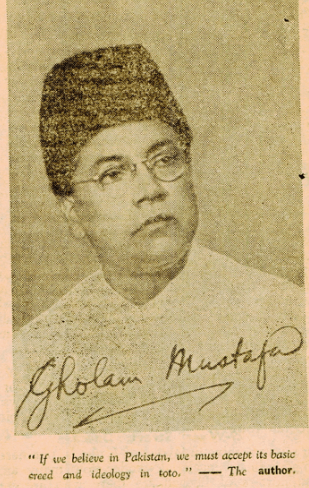
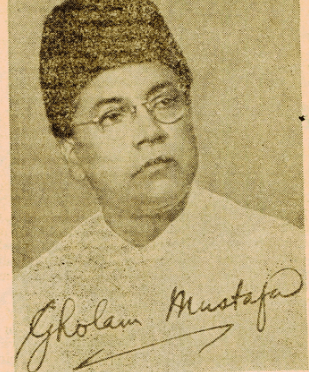
Picture taken from ‘The Battle for Pakistan’ pamphlet

I recently came across Golam Mostofa and his rather state-centric as opposed to peoples-oriented 20-page pamphlet on The Battle for Pakistan, which examines the entangled questions of state-language and the basis of Pakistan. Mostofa was the secretary of the East Bengal Government’s Language Reform Committee, while being a strong proponent of the two-nation theory and an advocate for Urdu as the national language for Pakistan.

As the ideological imagination, and its linguistic articulation, in early-Pakistan was taking shape, Firoz Khan Noon (Governor of East Pakistan) had his vision of converting Bengalis into Urdu speakers by using religion to play on their sentiments (Jalal 2014, 87). Urdu was deemed the only language that could strengthen national unity over ethnic groups. Noon commissioned various argumentative material to this end, including Mostofa’s pamphlet that presented a case for adopting Urdu in East Pakistan. Below are some extracts from the pamphlet, which was published c. 1952.

The Ideology of Pakistan

An unwarranted bitterness has been created over the question, of whether Urdu or Bengali should be the State-language of Pakistan. This sort of domestic quarrel at this nascent stage of Pakistan is really very sad…Long before the announcement of the Quaid-i-Azam, I said at a public meeting in Dacca that Urdu should be the State-language of Pakistan, though, of course, Bengali should not be discarded. The following extract from the report of the Hindustan Standard will bear me out:

“Poet Gholam Mustafa said that those who wanted to make Bengali as the State-language of Pakistan were looking at a narrow angle of geographical limits; but if they consider Pakistan as a dynamic unifying force in the world, they could not brush aside Urdu. He was inclined to the view that Bengali language was responsible for the decline of the Bengali Muslims as that language reflects the idea of non-Muslims”. (12-11-1947)

Significance of State-Language

The very expression “State-language” pre-supposes the existence of a State. The State-language of a State should therefore be that language by which the interests of the State can be served best. [emphasized in original] …The question of the safety and integrity of the State therefore comes first in determining a State-language. If we quarrel amongst ourselves over this issue and the ‘State’ disappears as a result thereof, what shall we do with the ‘language’ left behind? Language is a means to an end, not an end in itself. When the British conquered this country, they made English the State-language, not for our convenience, but for the interests and ideals of their State. The same principle will apply equally to Pakistan.

Our Problems

The argument of those who say that Bengali should be the State-language of Pakistan because of the numerical superiority of the Bengali Muslims has no leg to stand upon. Had numerical strength been the only determining factor in solving national problems like this, surely, we could not get Pakistan in India, as the Hindus commanded an overwhelming majority over us…Ideals cannot be judged by votes alone.

Pakistan is one State. It is, as it were, a bouquet of five flowers, none of which can be separate from the others. There is no such thing as Eastern Pakistan and Western Pakistan…The different provinces are to the Pakistan State what the limbs are to the body. If the limbs fall out and do not co-operate with one another, the body cannot exist…Pakistan is still beset with various dangers and difficulties…If Bengali and Urdu are both given the status of two State-languages, one for the East, the other for the West, it will only serve the purpose of the enemies. It will give rise to narrow provincialism among us, culminating in the ultimate separation between the two wings.

The demand for Bengali as the State-language of Pakistan therefore signified the triumph of Hindu culture and, as such, is in itself a strong symptom for the intravenous injection of Urdu in the cultural life of the Bengali Muslims. It is really very amazing that the Bengali Muslims are unwilling to accept Urdu for fear of Punjabi domination, but are quite agree-
able to be slaves of Bengali culture which is dominated by the Hindus.

On analysis, it will be found that the ‘Bengali for Bengal’ movement owes its origin to the borrowed idea of nationalism. Bengali Muslims are a separate unit having distinct culture of their own – this territorial patriotism has prompted the agitators to go in for Bengali. But they do not perhaps know that there is no such nationalism in Islam. Islam is preacher of internationalism or extra-territorialism.

Conclusion

We have got Pakistan. But real Pakistan is still far away…It is a thorny path and, as such, we have got to sacrifice much before we reach our goal. We must not be satisfied with our geographical Pakistan. Pakistan is an ideal…Islam is appearing in a new historic role and Pakistan will be the stage board of that great episode. For that ultimate goal, the entire Muslim World should first of all unite under one banner. Egypt, Arabia, Iran, Syria, Afghanistan, Pakistan, Indonesia: all the Muslim States of the world are therefore combining together to form a “Sixth Continent”. Will the Muslims of East Pakistan lag behind?

Following biographical details are provided on Wikipedia: Golam Mostofa (1897 – 13 October 1964): “Mostofa started teaching at Barakpore Government School in 1920. He retired as headmaster of Faridpur Zila School in 1949…His book Biswanabi (1942), a biography based on the life of the Prophet Muhammad, provided him with recognition.”

Other references

Jalal, Ayesha. The Struggle for Pakistan. Harvard University Press, 2014.

‘Remembering poet Golam Mostofa’: https://www.observerbd.com/2014/10/16/48987.php

Poem Hunter: https://www.poemhunter.com/golam-mostafa/biography/.

The Bengali Language Movement: Noon to Nazimuddin, 1952

When Pakistan was created in August 1947, it was made up of two wings, East and West. In 1951, when its first census took place, the combined population of both wings was 76 million; 34 million in West and 42 million in East. The Bengalis made up the majority of the population of East and this made Bengali/Bangla the language spoken by the numerical majority of Pakistan. But Urdu was seen as the national language, while being the mother tongue of barely 5 per cent of the population then. However, it was more than a language; it was attached to the very core of the Pakistan Movement as the Quaid-i-Azam Mohd. Ali Jinnah declared in Dacca (Dhaka) in 1948. Yet, soon thereafter, the fractures and fissures between the two wings began to open up, due to the discriminatory and step-brotherly treatment of the East Pakistanis; not just in the language sphere.

By 1952, there were large-scale demonstrations and unrest centred around the University of Dhaka and on 21 February 1952, these ended in violence, in which the police clamped down on the protestors resulting in numerous casualties. Since 2000, the United Nations has observed 21 February as the International Mother Language Day. Bengali/Bangla was eventually recognised as an official language of Pakistan (alongside Urdu) in article 214(1), when the first constitution of Pakistan was enacted on 29 February 1956. Longer term though, this parity in the Constitution failed to address the underpinning problems and East Pakistan eventually became Bangladesh following the civil war of 1971.

The letter below, sent a week after these protests, from Malik Firoz Khan Noon, a prominent landowning Punjabi and future PM (1957-58) of Pakistan, then-Governor, East Bengal Governor to Sir Khwaja Nazimuddin, an aristocrat Bengali and Jinnah’s successor as Governor-General (1948-51) of Pakistan, then-PM (1951-53), shows the failure to recognise the legitimate grievances of the language movement.

Noon to Nazimuddin, 28 February 1952

The Vice-Chancellor and other members of the Executive Committee have closed the University. Some students are leaving: others will try to hang on in Dacca. Out in the districts no untoward incidents have taken place except this that students have been trying to make themselves a nuisance at railway stations and in the cities, and the papers who write explaining true facts are not allowed by the students to be distributed by the hawkers in the district headquarter towns. The Government are now planning to drop pamphlets from the air throughout the province. I do not think that the Muslim League Ministers or other leaders can go out into the province as yet for three or four weeks to explain their point of view, but our propaganda has been very weak: almost non-existent. The Government point of view has not had the chance to go before the public yet.

I feel that both in Western Pakistan and in East Pakistan our propaganda machine should be put into full force and the true situation exposed to the public, viz. that this was a conspiracy between the communists and some of the caste Hindus of Calcutta, and certain political elements in East Pakistan who wanted to replace the Ministry: the students were made the cat’s paw. Their idea was to set up a puppet Ministry here, with Fazlul Huq as the Chief Minister, and then negotiations were to start for the unification of the two Bengals. I feel that it is most important that this true position must be exposed to the public who should realise the danger that we still continue to face in this province. The language question was only a subterfuge very cleverly exploited. In this province we are doing what we can to put forth our point of view, and Mr Fazl-i-Karim – Education Secretary – who has just returned from abroad has been asked to take charge of this work.

The second point to which I should like to draw your attention is that during the coming session of the Central Legislature, this Bengali language question must be settled once for all, and I do not think that you can get out of it without accepting Bengali as one of the state languages, but it must be Bengali written in the Arabic script. The sooner this resolution is passed the sooner will this controversy be settled. I have no doubt that the Hindus will create trouble about the script, but no Muslim will be able to raise his voice against the Arabic script, because in this way we shall have all the Provincial languages written in the same Arabic script, and this is most essential from the national point of view. I am told that during the time of Shaista Khan, Bengali was written in the Arabic script: there are some books in the museum here written in that script. If Bengali were written in the Arabic script – 85 % of the words being common between Urdu and Arabic if properly pronounced soon a new and richer language will emerge which may be called ‘Pakistani’. But something has to be done in this matter. We cannot let matters adrift.

The Arabic script will be the biggest disappointment to the Hindus who have been at the bottom of it, and that is the real crux of the whole question. The Jamiat ul Ulama-i-Islam in this province under the presidency of Pir Sahib of Sarsina and Secretary-ship of Maulana Raghib Asan have already passed a resolution demanding the writing of Bengali in the Arabic script, and no Muslim M.L.A. – either in Karachi or here – will be able to oppose the Arabic script. As a matter of fact, the Muslim League Party here last year went to the extent of passing a resolution saying that Arabic should be the national language of Pakistan. The object really was to do away with Urdu, but it is certainly a point which may be used by you in your speech, if necessary. The Aga Khan has written a very good pamphlet on this subject. It was going to be published but unfortunately it has been burnt with the Jubilee Press. The Aga Khan has promised his followers to be provided with a revised copy and I will try and let you have one as soon as it becomes available.

One of the main points the Aga Khan brought out was this that Persia changed their script from the old Pehlvi script into the Arabic script and in that way their literature became richer than ever, and by changing the script the Persian language did not lose anything nor would the Bengali language. He also tried and impressed that by enforcing the Arabic script the Bengali literature will be available to all other Muslim countries who will be able to appreciate the work of the Bengali authors. Similarly, the literature of all other Muslim countries will be open to Bengali Musalmans who know the Arabic script. He also pointed out in his pamphlet that every Musalman has to learn Arabic in any case because the boys and girls must read the holy Quran, and if they are conversant with the Arabic script why should this Dev Nagri script be thrust on them unnecessarily. It will be conceded on all hands that if in the schools in East Bengal boys and parents were given the option for children to learn Bengali either in the Arabic script or in the Dev Nagri script, they would all choose the Arabic script.

Quite a large amount of money is being earned by Calcutta Hindu authors who have the monopoly of all our school text books and it is they who are spending money in support of the Bengali language and would even spend money in support of the Dev Nagri Script. It should not be forgotten that people in West Bengal themselves have not asked for Bengali language to be accepted as a State language in Bharat: they have accepted Hindi as their national language.

Further Reading:

Rahman, Tariq. ‘Language and ethnicity in Pakistan‘ Asian Survey 37, no. 9 (1997): 833-839.

S.M. Shamsul Alam (1991) ‘Language as political articulation: East Bengal in 1952’, Journal of Contemporary Asia, 21:4, 469-487, DOI: 10.1080/00472339180000311

Tarun Rahman, ‘The Bengali Story Behind International Mother Language Day‘, Medium, 11 February 2016

Salman Al-Azami, ‘The Bangla Language Movement and Ghulam Azam‘, Open Democracy, 21 February 2013