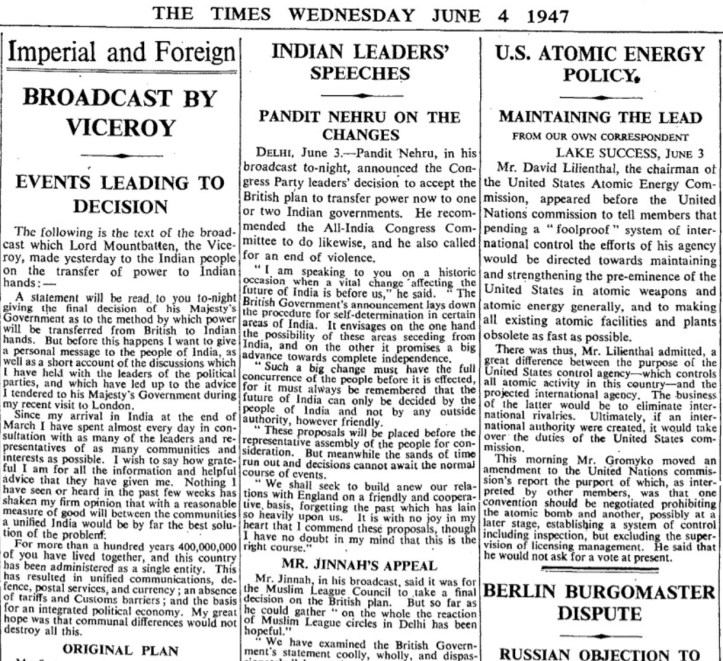
© The Times Wednesday June 4 1947
Below is the full transcript of the speech, which was delivered by Lord Mountbatten, the last Viceroy of India. It is followed by statements by Attlee, Nehru, Jinnah and Baldev Singh. The latter’s parting words make for interesting, wishful reading considering that it was the Sikh community that was impacted the most by this Partition Plan. This is also fully acknowledged by Mountbatten in his speech.
BROADCAST BY VICEROY
EVENTS LEADING TO DECISION
The following is the text of the broadcast which Lord Mountbatten, the Viceroy, made yesterday to the Indian people on the transfer of power to Indian hands:-
A statement will be read to you tonight giving the final decision of his Majesty’s Government as to the method by which power will be transferred from British to Indian hands. But before this happens I want to give a personal message to the people of India, as well as a short account of the discussions which I have held with the leaders of the political parties, and which have led up to the advice I tendered to His Majesty’s Government during my recent visit to London.
Since my arrival in India at the end of March I have spent almost every day in consultation with as many of the leaders and representatives of as many communities and interests as possible. I wish to say how grateful I am for all the information and helpful advice that they have given me. Nothing I have seen or heard in the past few weeks has shaken my firm opinion that with a reasonable measure of good will between the communities a unified India would be far the best solution of the problem.
For more than a hundred years, 400,000,000 of you have lived together, and this country has been administered as a single entity. This has resulted in unified communications, defence, postal services and currency; an absence of tariffs and Customs Barriers; and the basis for an integrated political economy. My great hope was that communal differences would not destroy this.
ORIGINAL PLAN
My first course, in all my discussions, was therefore to urge the political leaders to accept unreservedly the Cabinet mission plan of May 16, 1946. In my opinion that plan provides the best arrangement that can be devised to meet the interests of all the communities of India. To my great regret it has been impossible to obtain agreement either on the Cabinet mission plan or on any other plan that would preserve the unity of India. But there can be no question of coercing any large areas in which one community has a majority to live against their will under a Government in which another community has a majority—and the only alternative to coercion is partition.
But when the Muslim League demanded the partition of India, Congress used the same arguments for demanding in that event the partition of certain provinces. To my mind this argument is unassailable. In fact neither side proved willing to leave a substantial area in which their community have a majority under the government of the other. I am, of course, just as much opposed to the partition of provinces as I am to the partition of India herself, and for the same basic reasons. For just as I feel there is an Indian consciousness which should transcend communal differences, so I feel there is a Punjabi and Bengali consciousness which has evoked a loyalty to their province. And so I felt it was essential that the people of India themselves should decide this question of partition.
The procedure for enabling them to decide for themselves whether they want the British to hand over power to one or two governments is set out in the statement which will be read to you. But there are one or two points on which 1 should like to add a note of explanation.
It was necessary, in order to ascertain the will of the people of the Punjab. Bengal, and part of Assam, to lay down boundaries between the Muslim majority areas and the remaining areas, but I want to make it clear that the ultimate boundaries will be settled by a boundary commission and will almost certainly not be identical with those which have been provisionally adopted.
POSITION OF SIKHS
We have given careful consideration to the position of the Sikhs. This valiant community forms about an eighth of the population of the Punjab, but they are so distributed that any partition of this province would inevitably divide them. All of us who have the good of the Sikh community at heart are very sorry to think that the partition of the Punjab which they themselves desire, cannot avoid splitting them to a greater or lesser extent. The exact degree of the split will be left to the boundary commission on which they will, of course, be represented.
The whole plan may not be perfect: but like all plans its success will depend on the spirit of good will with which it is carried out. I have always-felt that once it was decided in what way to transfer power, the transfer should take place at the earliest possible moment, but the dilemma was that if we waited until a constitutional set-up for all India was agreed, we should have to wait a long time, particularly if partition were decided on, whereas if we handed over power before the Constituent Assemblies had finished their work we should leave the country without a constitution.
The solution to this dilemma, which I put forward, is that his Majesty’s Government should transfer power now to one or two governments of British India each having Dominion status as soon as the necessary arrangements can be made. This I hope will be within the next few months. I am glad to announce that his Majesty’s Government have accepted this proposal and are already having legislation prepared for introduction in Parliament this session. As a result of these decisions the special function of the India Office will no longer have to be carried out, and some other machinery will be set up to conduct future relations between his Majesty’s Government and India.
I wish to emphasize that this legislation will not impose any restriction on the power of India as a whole or of the two new States if there is partition, to decide in the future their relationship to each other and to other member states of the British Commonwealth.
Thus the way is now open to an arrangement by which power can be transferred many months earlier than the most optimistic of us thought possible, and at the same time leave it to the people of British India to decide for themselves on their future, which is the declared policy of his Majesty’s Government.
INDIAN STATES
I have made no mention of the Indian States, since the new decisions of his Majesty’s Government are concerned with the transfer of power in British India.
If the transfer of power is to be effected in a peaceful and orderly manner, every single one of us must bend all his efforts to the task. This is no time for bickering, much less for the continuation in any shape or form of the disorders and lawlessness of the past few months. Do not forget what a narrow margin of food we are all working on. We cannot afford any toleration of violence. All of us are agreed on that.
Whichever way the decision of the Indian people may go, I feel sure any British officials or officers who may be asked to remain for a while will do everything in their power to help implement that decision. His Majesty as well as his Government have asked me to convey to all of you in India their sincere good wishes for your future and the assurance of their continued good will.
I have faith in the future of India and am proud to be with you all at this momentous time. May your decisions be wisely guided and may they be carried out in the peaceful and friendly spirit of the Gandhi-Jinnah appeal.
MR. ATTLEE’S MESSAGE
A recording of the Viceroy’s message to the Indian people was broadcast in this country last night. It was introduced by the Prime Minister who said that the twofold purpose of the plan now put forward was to make possible the maximum degree of harmony and cooperation between the Indian political parties in order that the partition of India, if decided upon, might involve as little loss and suffering as possible, and secondly to enable the British Government to hand over its responsibilities in an orderly and constitutional manner at the earliest opportunity.
“I would make an earnest appeal to everyone to give calm and dispassionate consideration to these proposals,” Mr. Attlee went on. “It is, of course, easy to criticize them, but weeks of devoted work by the Viceroy have failed to find any alternative that is practicable. They have emerged from the hard facts of the situation in India”.
INDIAN LEADERS’ SPEECHES
PANDIT NEHRU ON THE CHANGES
DELHI, June 3.-Pandit Nehru, in his broadcast to-night, announced the Congress Party leaders’ decision to accept the British plan to transfer power now to one or two Indian governments. He recommended the All-India Congress Committee to do likewise, and he also called for an end of violence.
“I am speaking to you on a historic occasion when a vital change ‘affecting the future of India is before us,” he said. The British Government’s announcement lays down the procedure for self-determination in certain areas of India. It envisages on the one hand the possibility of these areas seceding from India, and on the other it promises a big advance towards complete independence.
“Such a big change must have the full concurrence of the people before it is effected, for it must always be remembered that the future of India can only be decided by the people of India and not by any outside authority, however friendly.
“These proposals will be placed before the representative assembly of the people for consideration. But meanwhile the sands of time run out and decisions cannot await the normal course of events.
“We shall seek to build anew our relations with England on a friendly and cooperative, basis, forgetting the past which has lain so heavily upon us. It is with no joy in my heart that I commend these proposals, though I have no doubt in my mind that this is the right course.”
MR. JINNAH’S APPEAL
Mr. Jinnah, in his broadcast, said it was for the Muslim League Council to take a final decision on the British plan. But so far as he could gather “on the whole the reaction of Muslim League circles in Delhi has been hopeful.”
“We have examined the British Government’s statement coolly, wholly, and dispassionately,” he went on. “We have to take momentous decisions, and have very big issues facing us in the solution of this complex political problem. Therefore we must galvanize and concentrate all our energies to see that the transfer of power is effected in a peaceful and orderly manner.
“It is clear that the plan does not meet in some important respects our point of view, and we cannot say or feel that we are satisfied or that we agree with some of the matters dealt with by the plan. It is for us now to consider whether the plan as presented to us by the British Government should be accepted by us as a compromise or a settlement. On this point I do not wish to prejudge the decision of the council of the All-India Muslim League, which has been summoned to meet on Monday. I appeal to every community in India, and especially to the Muslims, to maintain peace and harmony.”
Sardar Baldev Singh, the Sikh leader, said: We have closed a dreary chapter. It would be untrue if I were to say that we are altogether happy. Our common quest for freedom need never have divided and torn us asunder one from the other. This has actually taken place. The shadow of our differences has thrown its gloom over us. We have let ourselves be rent apart.”
The British plan did not please everybody, “not the Sikh community, anyway, but it is certainly something worthwhile. Let us take it at that.
“I believe with all my heart that the divisions that tend to keep us apart now will not last long. The very blueprint of our plans, so soon as we view it with care, will bind us together.”
-Reuter.


 BAGICHA