Tag Archives: Ayub Khan

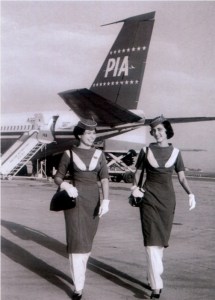
Women and Pakistan International Airlines in Ayub Khan’s Pakistan

pia-airhostesses

Abstract:

This article weaves together several unique circumstances that inadvertently created spaces for women to emerge away from the traditional roles of womanhood ascribed to them in Pakistan. It begins by tracing the emergence of the Pakistan International Airlines (PIA) as a national carrier that provided an essential glue to the two wings of Pakistan. Operating in the backdrop of nascent nationhood, the airline opens an opportunity for the new working women in Pakistan. Based on first-hand accounts provided by former female employees, and supplementing it with official documents, newspaper reports and the advertising used for marketing at the time, it seeks to provide an illuminating insight into the early history of women in Pakistan. While the use of women as markers of modernity and propaganda is not new, here within the context of Cold War and American cultural diplomacy, the ‘modernist’ vision of the Ayub-era in Pakistan (1958-69), and its accompanying jet-age provide a unique lens through which to explore the changing role of women. The article showcases a different approach to understanding the so-called ‘golden age’ of Pakistani history: a neglected area of the international history on Pakistan, which is far too often one-dimensional.

Link to the article: https://doi.org/10.1080/07075332.2018.1472622
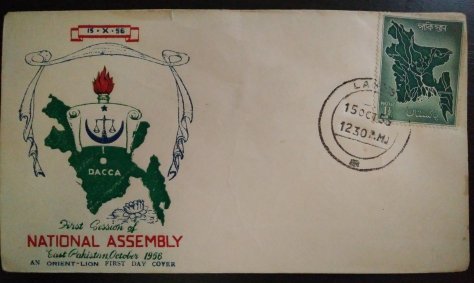
The first session of the National Assembly, Dacca, 1956

national-assembly-pakistan

To commemorate the first session at Dacca, East Pakistan, of the National Assembly of Pakistan, three postage stamps were issued on and from the 15th October 1956:—

  • 1½-anna, bottle green
  • 2-anna, dark brown
  • 12-anna, deep red

The picture above is the first day cover with a 1 ½ anna stamp. I just came across it during a stroll at the book fair on The Mall, Lahore which is held on Sundays. The commemorative stamp was issued on the eve of Pakistan becoming the first Islamic Republic in the world. At the time Pakistan was made up of two wings, East Pakistan (now Bangladesh) and West Pakistan. The National Assembly of Pakistan is the lower house of parliament and initially met in the capital Karachi. However, this was the first session of the National Assembly in Dacca and in fact the last time as well because two years later Ayub Khan became the first military dictator in Pakistan and eventually by the 1971, the country was on the brink of splitting up.

The stamp encapsulates the period when Pakistan ended its status as a dominion and was declared an Islamic Republic of Pakistan on 23 March. Hence this is day is celebrated as Republic Day in Pakistan. This of course is also the same day that Mohammad Ali Jinnah adopted the Pakistan Resolution (Lahore Resolution) outlining the two-nation theory. The full text of the 1940 Resolution is available via: http://www.columbia.edu/itc/mealac/pritchett/00islamlinks/txt_jinnah_lahore_1940.html.

The Constituent Assembly became the interim National Assembly with Governor General Iskander Mirza as the first President of Pakistan. The Assembly had 80 members, half each from East Pakistan and West Pakistan. A turning point in Pakistan’s history, the Constitution required the president to be a Muslim and he (typically it was a he), had the power appoint the Prime Minister and he was also empowered with the ability to remove the Prime Minister, if there was a lack of confidence in his abilities. The Constitution of 1956 was written almost ten years after Pakistan was created, but crucially it set in motion a dangerous precedent; the President had the power to suspend fundamental rights in case of an emergency. Crucially though the Constitution of 1956 was short-lived because by 7 October, 1958, General Mirza dissolved the constitution and declared Martial law in Pakistan.