Tag Archives: art

Exploring the Legacy of William Morris: Art, Design, and Socialism

I first encountered William Morris (1834–1896) during my A-levels when I was studying Art, a subject that was always my first choice before I gradually gravitated toward politics and history. There, among images of densely patterned wallpapers and tapestries, I discovered not just a designer but a complete philosophy about how we should live, work, and create. His influence on my thinking has never waned.

A Victorian Polymath

Morris was born into a wealthy Essex family and discovered his passion for medievalism while studying classics at Exeter College, Oxford. There he befriended Edward Burne-Jones, beginning associations with Pre-Raphaelite artists including Dante Gabriel Rossetti and architect Philip Webb. Webb designed Red House for Morris and his wife Jane Burden, where they lived from 1859 to 1865.

Morris was a Victorian polymath, designer, poet, novelist, translator, and socialist activist, but what makes him extraordinary is how seamlessly he wove these identities together. For Morris, there was no separation between art and life, between beauty and utility, between the aesthetic and the political. This holistic vision, radical in the 1880s, feels remarkably relevant today.

Beauty and Utility

His central belief was disarmingly simple: have nothing in your houses that you do not know to be useful or believe to be beautiful. This wasn’t about minimalism or austerity. Rather, Morris argued for a world where everyday objects, the chairs we sit on, the curtains at our windows, the cups we drink from, should be thoughtfully crafted and beautiful. He despised the shoddy mass-produced goods flooding Victorian Britain, seeing them as symptomatic of a deeper malaise: a society that had separated workers from the joy of creation.

John Ruskin profoundly shaped Morris’s thinking, particularly through “On the Nature of Gothic Architecture” in The Stones of Venice, which Morris called “one of the very few necessary and inevitable utterances of the century.” From Ruskin, Morris adopted the rejection of industrial manufacturing in favour of hand-craftsmanship, elevating artisans to artists and advocating for affordable, handmade art without hierarchies between mediums.

The Arts and Crafts Movement

The Arts and Crafts movement that Morris championed was fundamentally about human dignity. He believed that factory production degraded workers, turning them into mere cogs in a machine, repeating mindless tasks divorced from creativity or pride. His vision of craft-based production wasn’t nostalgic romanticism, it was a radical reimagining of labour itself. Work, he insisted, should be a source of fulfilment, not merely survival.

In 1861, Morris co-founded Morris, Marshall, Faulkner & Co. with Burne-Jones, Rossetti, Webb, and others. The firm revolutionized Victorian interior design through Morris’s tapestries, wallpapers, fabrics, furniture, and stained glass, becoming hugely fashionable. Morris took sole control in 1875, renaming it Morris & Co.

His nature-inspired designs, those sinuous stems, intricate flowers, and medieval-influenced patterns, remain ubiquitous, adorning everything from Liberty fabrics to contemporary homeware. But beyond their aesthetic appeal, they represent Morris’s deep respect for the natural world, another aspect of his thinking that speaks urgently to our moment.

Socialism and Community

Morris’s socialism was no drawing-room affectation, it was passionately lived. In 1883, he joined the Social Democratic Federation before founding the Socialist League, throwing himself into street-corner speeches, organizing meetings, and even facing arrest for his activism. He surrounded himself with radical thinkers and artists: Eleanor Marx, daughter of Karl Marx, became a close comrade; Edward Burne-Jones remained his lifelong friend and artistic collaborator despite occasional political tensions; and his Kelmscott Press brought together craftspeople and intellectuals committed to beautiful, accessible books.

Morris’s utopian novel News from Nowhere painted his vision of a future society without class distinctions, where work was voluntary and joyful. For Morris, socialism and craft were inseparable, both were about human liberation, about creating conditions where everyone could develop their creative capacities rather than being crushed by poverty or soul-destroying labour.

An Enduring Legacy

What captivates me most is how Morris’s ideas transcend their Victorian context. Today, as we grapple with fast fashion, planned obsolescence, and the environmental costs of endless consumption, Morris’s call for quality over quantity resonates powerfully. His emphasis on sustainability, making things that last, that can be repaired, that connect us to makers and materials, feels prescient.

Morris wasn’t without contradictions. His handcrafted goods were often too expensive for ordinary people, despite his socialist convictions. Yet his fundamental questions endure: What is good work? How do we create a society where everyone can flourish? How do we balance beauty, utility, and justice?

Nearly 130 years after his death (3 October), William Morris remains an important figure for many, reminding us about sustainability, equity, compassion, and the beauty of the everyday objects that surround us.

Dhurries: the Woven Threads of Memory


Earlier this year, I visited Ludhiana, Punjab, a place I try to make time for whenever I have an opportunity or a slight reason. As is often the case, no visit feels complete without visiting Mau Sahib, my father’s ancestral village near Phillaur. Although no immediate family members live there anymore, Mau Sahib holds a special place in our hearts, especially for my sister. She remembers it with warmth and nostalgia, as a place of her childhood.

Our visits have become something of a ritual—paying respects at the historic Gurudwara, partaking in the langar, and then visiting the nearby Sufi shrine. It’s a quiet pilgrimage that connects us with both our heritage and the memory of those who came before us.

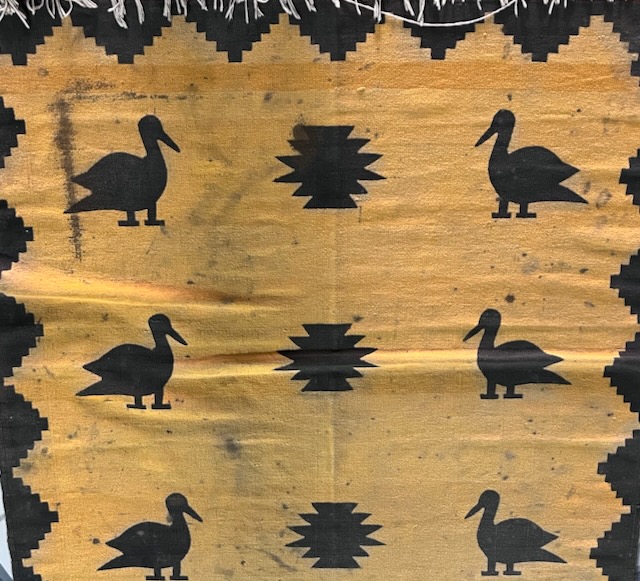
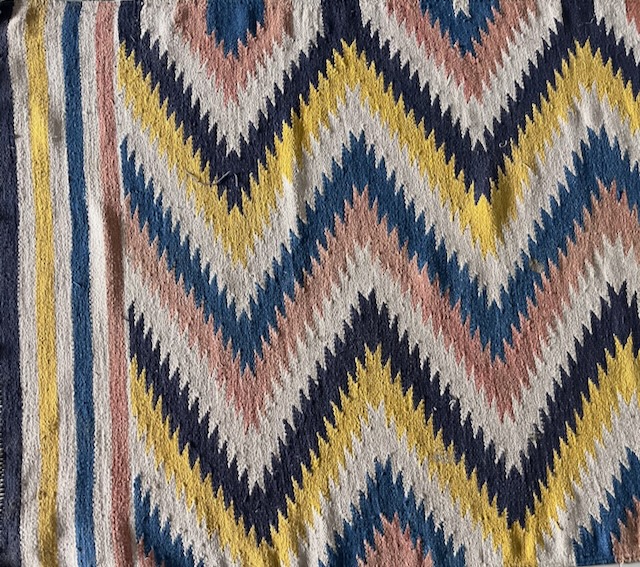
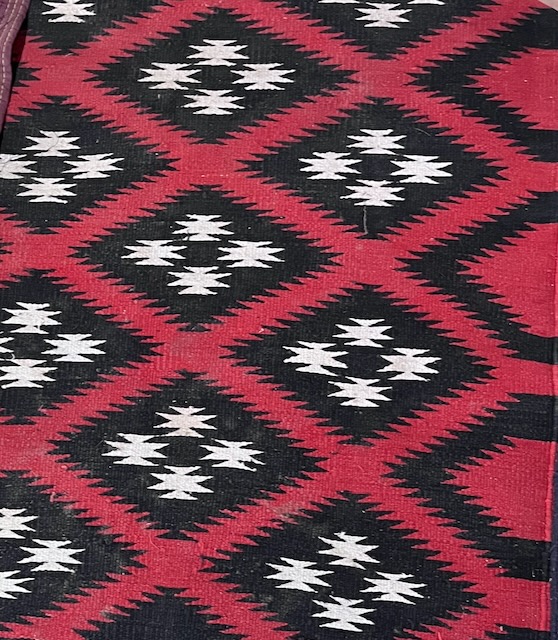
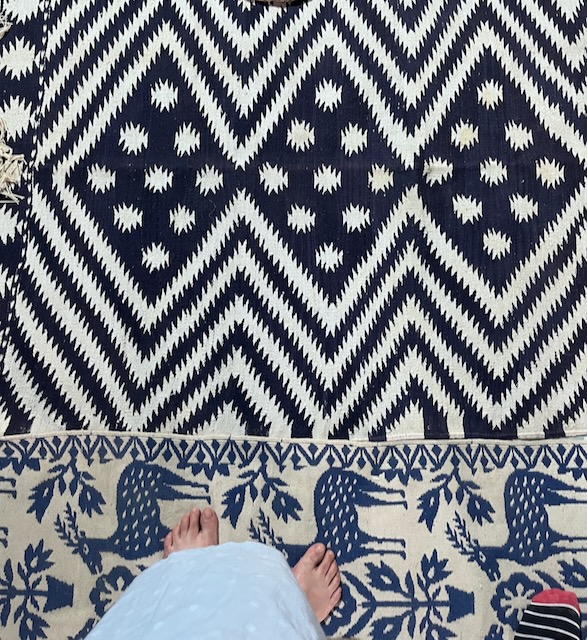
During this visit, the Gurdwara was undergoing renovations. Amid the scaffolding and signs of change, we made our way to the basement area; a large, echoing hall that was mostly empty and only partially completed. The Guru Granth Sahib rested there with solemn grace in the middle of the hall, surrounded by an assortment of vibrant dhurries scattered across the floor. The scene was simple yet striking. I couldn’t help but take photos of the colourful, handwoven patterns.

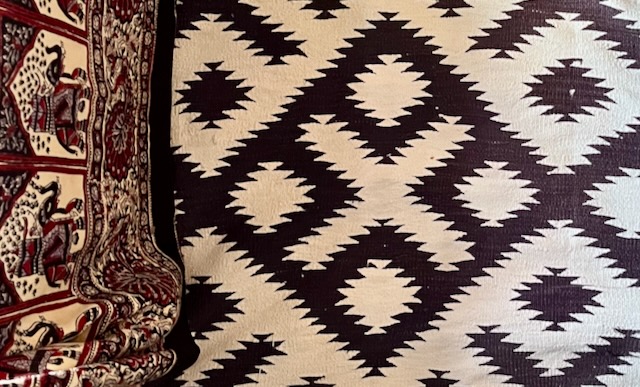
In that quiet moment, surrounded by these beautiful pieces of craft, I was instantly transported to my study back home. There, in the middle of my room, lies a black-and-white dhurrie—a treasured piece handmade by my mother. The rug, is now a relic and a reminder of her remarkable talent, one of many handcrafted creations she lovingly produced over the years.

At the time, I must admit, I didn’t fully appreciate the time, effort, and skill that went into these works of art. But today, that dhurrie is a cherished heirloom. It reminds me not only of her hands at work but also of the deeper cultural traditions that she carried within her.

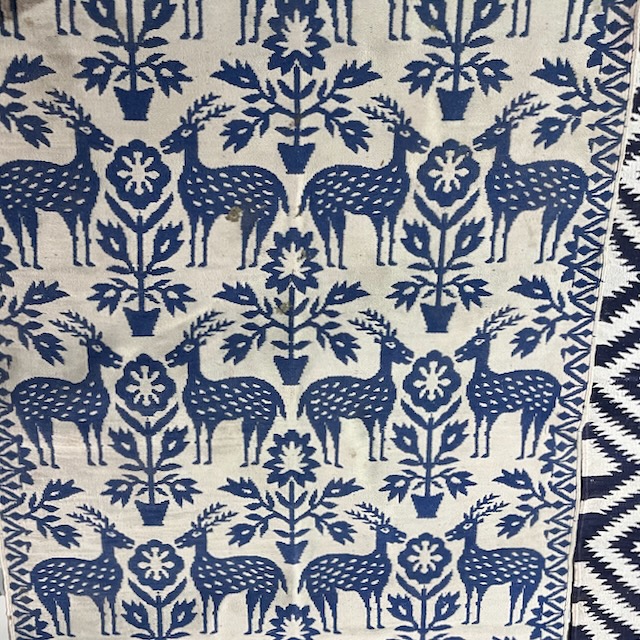
For those unfamiliar, a dhurrie is a handwoven rug or flat-weave carpet, traditionally made in India and Pakistan. They were mostly made from cotton or jute and thus accessible for all. Dhurries are often lighter, reversible, more versatile and useful for everyday use; they can be used as floor coverings, bedding, or even wall hangings. In rural Punjabi households, you often find these dhurries spread out for meals, prayers, weddings, and community gatherings, making them silent witnesses to the everyday rituals and rhythms of life.

What makes them so striking are the geometric patterns, vivid stripes, or sometimes floral designs, each inspired by the region and culture from which they originate. The bold designs are usually in bright colours such as red, blue, yellow, as well as using black and white.

Historically, dhurrie weaving was a thriving cottage industry in rural India. But it was also something more intimate and symbolic, especially for women. Young brides-to-be were often taught the art from a young age. Many dhurries formed part of a woman’s dowry, and their patterns weren’t just decorative. They carried stories—symbols of personal, familial, and spiritual identity, passed down through generations, like a family recipe.

In many villages, it was common to see women sitting on charpoys under the shade, rhythmically working on pit looms while chatting about daily life. Though machine-made textiles are now more common, the tradition of handwoven dhurries survives in some artisan clusters, supported by cultural preservation efforts and a renewed appreciation for handmade goods.

As I stood in that hall, looking at the scattered dhurries beneath my feet, I realised how deeply woven this craft is into the fabric of our collective memory. These are not just utilitarian objects; they are vessels of heritage, art, and emotion. Each thread, each motif, tells a story.

In many ways, my mother’s dhurrie now tells mine. And you may well be wondering about the one I have? This was prized away from my sister my years ago. She had a number of them, given to her when she got married, and I convinced her to part with one which then travelled with me to England!

Mayo at Cockermouth

This slideshow requires JavaScript.

Richard Southwell Bourke (1822-72), 6th Earl of Mayo, 4th Viceroy of India (1869-72)

Born and educated in Dublin; MP (Conservative Party) for Kildare (1847-52), Coleraine (1852-57) and Cockermouth (1857-68); Chief Secretary for Ireland (1852, 1858, 1866); Assassinated in Andaman Islands by Sher Ali Afridi (1872); Memorial Statue in Cockermouth (1875)

Termed Disraeli’s Viceroy by George Pottinger (1990) and a ‘reckless partisan of Irish landlordism’ by Karl Marx in the New York Daily Tribune (1859) (https://www.irishtimes.com/opinion/letters/lord-mayo-in-a-pickle-1.3777905)

For biography:

Library Ireland: https://www.libraryireland.com/biography/RichardBourkeSouthwell.php

WW Hunter, The Earl of Mayo (Oxford, 1891)   https://www.gutenberg.org/files/35809/35809-h/35809-h.htm

On assassination:

Norman Freeman, “Death of a viceroy – An Irishman’s Diary on the assassination of Lord Mayo”, The Irish Times, 28 Jan 2019.  https://www.irishtimes.com/opinion/death-of-a-viceroy-an-irishman-s-diary-on-the-assassination-of-lord-mayo-1.3773683

Clare Anderson, “The murder of Mayo: why Britain kept quiet about a Viceroy’s assassination” 7 Sep 2011. https://www2.le.ac.uk/news/blog/2011-archive/september/the-murder-of-mayo-why-britain-kept-quiet-about-a-viceroys-assassination

With wider political-cultural context:

Julia Stephens, ‘The Phantom Wahhabi: Liberalism and the Muslim fanatic in mid-Victorian India’, Modern Asian Studies 47: 1 (2013) 22-52

Of legacy:

Mayo College Ajmer (India) (1875): https://mayocollege.com/

Mayo School of Industrial Art Lahore (Pakistan) (1875): http://lahore.city-history.com/places/mayo-school-of-industrial-art-later-national-colle/

It was of course his legacy that is most associated with the city of Lahore, where the Mayo School of Industrial Art was set up in 1875, following his assassination in 1872. The Mayo School later became the National Collage of Arts (NCA) in 1958 and this still remains the premier institution for the Arts in Pakistan.

Lockwood Kipling was appointed the first Principal of Mayo School, alongside his other role of Curator of the Lahore Museum, which was the Ajaib Ghar in Rudyard Kipling’s Kim.

Frida

“Nothing is absolute. Everything changes, everything moves, everything revolves, everything flies and goes away.” Frida Kahlo

Frida Sunsine
© 2019 Pippa Virdee

A Pakistani homeland for Buddhism: Buddhist art, Muslim nationalism and global public history

Buddhist iconography is an important element in India’s national flag and national emblem, and Buddhist sites in India, such as the Ajanta Caves and Bodh Gaya are well known. In contrast, Pakistan’s engagement with its own Buddhist heritage has received far less attention. Andrew Amstutz (University of Arkansas, USA) explains his ongoing research that examines…

via Long Read: A Pakistani homeland for Buddhism: Buddhist art, Muslim nationalism and global public history — South Asia @ LSE

The Artisans of the Walled City of Lahore — Harry Johnstone

Perched outside his workshop in Lahore’s Walled City, Mohamed Tahir plays a harmonium while watching the passing melee. The melancholy sounds of the instrument are barely audible over the din of motorbikes and wheel cutters, but still they evoke something of Lahore’s history, a world that lives on beneath the dust and frantic rhythms of […]

via The Artisans of the Walled City of Lahore — harryjohnstone

23 Sir Ganga Ram Mansion: The house of Amrita Sher-Gil

No 23 Sir Ganga Ram

A few years back I had the pleasure of wondering around and exploring the old city remnants of Lahore, accompanied by Najum Latif, a migrant of 1947 and resident of the Androon Shehr. We start off where he lives, Sir Ganga Ram Mansion located just behind The Mall and a hidden gem of the who’s who in the history of Lahore’s former life. In its heyday of the 1930s, Lahore was a cultural centre for North India and writers such as Khushwant Singh and the artist like Abdur Rahman Chughtai (and a friend of Amrita Sher-Gil’s father) lived nearby. Only a few doors away from Latif’s house was where Amrita Sher-Gil rented an apartment with her husband, Dr Victor Egan. When Latif was growing up he was a frequent visitor to No 23, at the time he was unaware that Sher-Gil, the great Punjabi-Hungarian painter once lived there.

Sher-Gil was born in 1913 in Budapest, her father was the aristocratic landlord Sardar Umrao Singh Majitha and her mother a Hungarian opera singer. Educated in Paris, she took to the bohemian lifestyle of the Parisian art scene that allowed her to express herself truly. European in style, yet her paintings also reflect the multiple layers and textures of her own life and identity. Influenced by the work of Paul Cezanne, Amedeo Modigliani and Paul Gaugain, she later looked to India for inspiration, trying to fuse these two together. After spending four years in Paris, Amrita decided to return to India. She noted that, “My professor had often said that, judging by the richness of my colouring, I was not really in my element in the grey studios of the West, that my artistic personality would find its true atmosphere in the colour and light of the East” (Rizvi). During her time in India, she painted scenes from India, learning new techniques and getting inspiration from the breath of the sub-continent. Today she is considered one of the most important Indian painters of the 20th Century and certainly one of the most expensive female painters in India.

She was only 28 when died at 23 Sir Ganga Ram Mansion apartments, where she spent the last few months of her life. Her husband had a clinic on the ground floor and she painted upstairs, where they also lived. She first came to Lahore in 1937 from Paris when her work was exhibited at the famous Faletti’s Hotel. It was a resounding success and challenged the status quo of the art world. In September 1941 she came to Lahore so that she could plan for her solo exhibition in December; this never happened as she was suddenly taken ill and died in a matter of days. The planned discussion between Abdur Rahman Chugtai and Amrita Sher-Gil never happened and instead the exhibition opened but posthumously. Most of these works are now located in the National Gallery of Modern Art in New Delhi.

Amrita Sher-Gil still remains an enigma in death, as she was in life. The young artist was never to see the great legacy that she would leave behind and sadly few Lahoris would be aware that she once lived and worked in the great historic city. Her painting, Vina Player, still finds space in Lahore Museum but otherwise sadly her association with Lahore has all but evaporated. She was cremated on banks of the Ravi in Lahore on December 7, 1941, a river that now forms a natural boundary between India and Pakistan.

Other articles to read more about Amrita Sher-Gil:

Yours, Amrita by Dua Abbas Rizvi. http://www.thefridaytimes.com/beta3/tft/article.php?issue=20130726&page=16

Amritsar sisters posed for painter Amrita’s ‘Three Girls’ by Nirupana Dutt. http://www.hindustantimes.com/punjab/amritsar-sisters-posed-for-painter-amrita-s-three-girls/story-WsZhRAtCcX5BTMxicxcdBO.html

Chughtai’s Art Blog, http://blog.chughtaimuseum.com/?p=978

Finding Amrita in Lahore by Dalmia. http://indianexpress.com/article/opinion/columns/finding-amrita-in-lahore/

Great success in a short life. http://budapesttimes.hu/2016/01/23/great-success-in-a-short-life/