Main Tenu Fir Milaan Gi
Kithey? Kis Tarah? Pata Nai
Shayad Terey Takhayul Di Chinag Ban Ke
Terey Canvas Tey Utraan Gi
Ya Khowrey Terey Canvas Dey Utey
Ikk Rahasmayi Lakeer Ban Ke
Khamosh Tenu Tak Di Rawaan Gi

I will meet you yet again
How and where? I know not.
Perhaps I will become a
figment of your imagination
and maybe, spreading myself
in a mysterious line
on your canvas,
I will keep gazing at you.

Yaa Khowrey Sooraj Di Loo Ban Ke
Terey Rangaan Wich Ghulaan Gi
Yaa Rangaan Diyan Bahwaan Wich Baith Ke
Terey Canvas Nuu Walaan Gi
Pata Nai Kiss Tarah? Kithey?
Par Tenu Zaroor Milaan Gi

Perhaps I will become a ray
of sunshine, to be
embraced by your colours.
I will paint myself on your canvas
I know not how and where –
but I will meet you for sure.

Yaa Khowrey Ikk Chashma Bani Howaan Gi
Tey Jeevan Jharneyaan Da Paani Udd-da
Main Paani Diyaan Boondaan
Terey Pindey Tey Malaan Gi
Tey Ikk Thandak Jahi Ban Ke
Teri Chaati Dey Naal Lagaan Gi
Main Hor Kujh Nai Jaandi
Par Aena Jaandi
Ke Waqt Jo Vii Karey Ga
Aey Janam Mairey Naal Turey Ga

Maybe I will turn into a spring,
and rub the foaming
drops of water on your body,
and rest my coolness on
your burning chest.
I know nothing else
but that this life
will walk along with me.

Aey Jism Mukda Hai
Tay Sab Kujh Muk Jaanda
Par Chaityaan Dey Dhaagey
Kaainaati Kana Dey Hundey
Main Onhaan Kana Nuu Chunaan Gi
Dhaageyaan Nuu Walaan Gi
Tey Tenu Main Fair Milaan Gi…

When the body perishes,
all perishes;
but the threads of memory
are woven with enduring specks.
I will pick these particles,
weave the threads,
and I will meet you yet again.

Poetry in Punjabi by Amrita Pritam
Translation in English by Nirupama Dutt
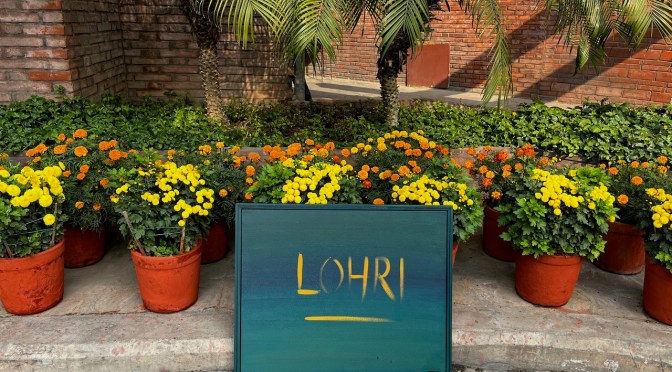
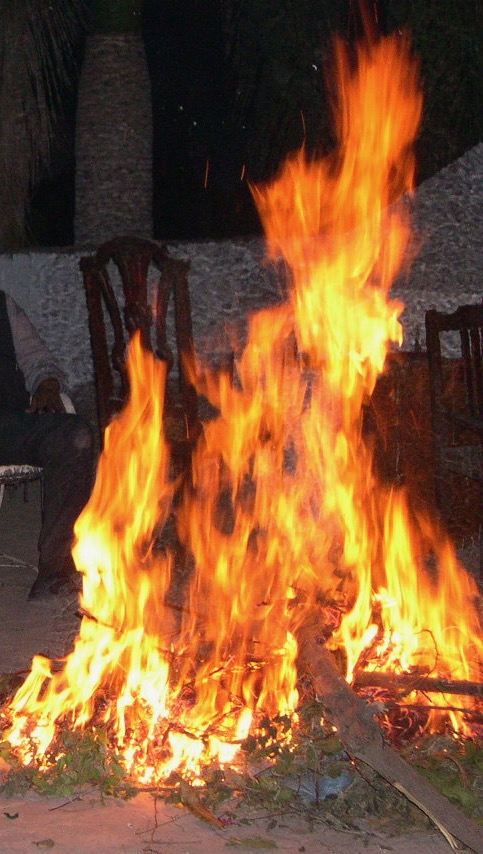
A few days back I was in Punjab and Delhi, which were clouded and submerged in the winter chill and fog. With every passing comment about the cold, there is another reference, “it will only last until lohri, after that the weather will improve”. This points to the passing of the winter solstice and the changes in the season. Many of the popular festivals in Punjab are associated with seasonal changes, these are easy markers and reference points before formal calendars and dates arrived, and in this case the winter festival of lohri means anticipating longer and warmer days.
Growing up, there were always certain foods which we associated with lohri (and associated with the winter harvest). Rewris/revdis, jaggery and sesame-based dishes, and peanuts, are all warming and seasonal foods during the winter days of North India. Sarson da saag and makki di roti is another essential. Jaggery, sesame sweets and peanuts are quite often distributed and exchanged amongst friends and families. Traditionally, this special occasion was reserved for the birth of a son, but thankfully many have started celebrating the birth of a child, regardless of its gender.
In Indian Punjab the festival is public holiday but unfortunately across the border in Pakistan Punjab it is barely recognised. In recent years commentators and activists have been trying to revive it and re-introduce it to the wider public, with limited impact. Lohri is not and was not a religious festival, and yet the division of such festivals is emblematic of Partition, which increasingly entrenched what was deemed to be Hindu/Sikh and what was considered Islamic. In the video above for BBC Urdu, you can hear Mazhar Abbas narrate the history of lohri for a new generation.
Going back to Delhi, I was fortunate enough to meet up with Harinder Singh (1469) who was busy curating his lohri exhibition at the India International Centre. Do go and have a look, if you are around Delhi.
There has been a lot of interest in Leicester over the weekend, following the disturbances around Green Lane Road and Belgrave. I noticed on my Twitter feed that it was picked up by journalists, activists and academic across the globe and especially from those in India. They are of course keenly watching this because of the involvement of what seems to be groups aligned to the RSS and the ruling party in India, the BJP.
I have worked in the city for most of my professional life, I have family living in the area, and I have written about multicultural Leicester as well. There has been a lot of information and misinformation being circulated around via social media, this is inevitable given the way these platforms work. I know Green Lane Road well and the ways in which it has evolved since the 1980s, when I first went there. I will perhaps write about this another time, but I wanted to share some basic facts about multicultural Leicester, and provide a list of some academic work that has been done on the city.
The demographics of Leicester have changed and evolved considerably over the decades. Migration to Leicester was interestingly later than some of the surrounding cities in England. In 1972 the Leicester Mercury headlines expressed fear and concern about the influx of East African Asians into the city following their expulsion by Idi Amin in Uganda. Yet in 2001 when the Cantle Report on Community Cohesion was published, the local press in Leicester was considered ‘very responsible’ and ‘seen to be helping to promote cohesion throughout the community.’ Indeed, only very recently several events and exhibitions have been documenting and commemorating the 50 years since the Ugandan Asians arrived in Leicester.
Area by Birth
1951
1961
1971
1981
1991
2001
India
569
1,827
11,510
18,235
20,841
24,677
Pakistan
49
109
775
1,305
1,155
1,854
Bangladesh
–
–
685
–
–
1,051
East Africa
18
1,630
6,835
18,622
17,168
18,843
Total
636
3,566
19,805
38,162
39,164
46,425
South Asian Migration into Leicester, 1951-2001 according to place of birth (Source: Bonney, 2003 and National Census)
However, as a city, Leicester is today one of the most diverse areas in the UK and perhaps even in Europe. The data from the 2021 census is not available yet, it is hoped more analysis and data will be released later this year. According to the 2011 census, the majority ethnic group is still white at 50.5%. However, the next largest group is of Indian origin – 93,335 (28.3%). The Pakistani population is still quite small at 8,067 (2.5%). However, overall there are more than 60,000 Muslims of different nationalities and ethnicities in Leicester, compared to 50,000 Hindus; the Sikh community is sizeable but small in comparison.
Religion
2001
2011
Christian
125,187
106,872
Buddhist
638
1,224
Hindu
41,248
50,087
Jewish
417
295
Muslim
30,885
61,440
Sikh
11,796
14,457
Other religion
1,179
1,839
No religion
48,789
75,280
Religion not stated
19,782
18,345
Total
279,921
329,839
Religion in the 2001 and 2011 censuses in Leicester.
Rank
Language
Usual residents aged 3+
Proportion
1
English
228,295
72.47%
2
Gujarati
36,347
11.54%
3
Punjabi
7,560
2.40%
4
Polish
6,192
1.97%
5
Urdu
3,376
1.07%
The top-5 languages spoken in Leicester according to the 2011 census.
Below are references for anyone interested in knowing more about migration to the UK and specifically Leicester.
Anwar, M., Between Two Cultures (London: Commission for Racial Equality, 1981)
Ballard, Roger (ed), Desh Pardesh The South Asian Presence in Britain (London: Hurst, 1994)
Bhachu, Parminder. Twice migrants: east African Sikh settlers in Britain. Vol. 31100. Tavistock Publications, 1985.
Bishop, Sue Zeleny. “Inner-city possibilities: using place and space to facilitate inter-ethnic dating and romance in 1960s–1980s Leicester.” Urban History (2021): 1-16.
Bonney, Richard, ‘Understanding and Celebrating Religious Diversity in Britain: A Case Study of Leicester since 1970 making comparison with Flushing, Queens County, New York City’, Encounters, 9, 2, 2003, pp 123-151
Bonney, Richard, and William Le Goff. “Leicester’s cultural diversity in the context of the British debate on multiculturalism.” International Journal of Diversity in Organisations, Communities and Nations 6, no. 6 (2007): 45-58.
Clayton, John. “Living the multicultural city: acceptance, belonging and young identities in the city of Leicester, England.” Ethnic and Racial Studies 35, no. 9 (2012): 1673-1693.
Gunn, Simon, and Colin Hyde. “Post-industrial place, multicultural space: the transformation of Leicester, c. 1970–1990.” International Journal of Regional and Local History 8, no. 2 (2013): 94-111.
Hassen, Inès, and Massimo Giovanardi. “The difference of ‘being diverse’: City branding and multiculturalism in the ‘Leicester Model’.” Cities 80 (2018): 45-52.
Herbert, Joanna, ‘Migration, Memory and Metaphor: Life Stories of South Asian in Leicester’ in Burrell, Kathy and Panayi, Panikos (eds.) Histories and memories: migrants and their history in Britain (London: Tauris Academic, 2006)
Herbert, Joanna, Negotiating Boundaries in the City: Migration, Ethnicity, and Gender in Britain (Aldershot, Ashgate, 2008)
Hussian, Asaf, Haq, Tim and Law, Bill, Introduction by R. Bonney Integrated Cities. Exploring the Cultural Development of Leicester, Leicester, Society for Inter-Cultural Understanding Leicester (University of Leicester, 2003)
Hussian, Asaf, Haq, Tim and Law, Bill, The Intercultural State: Citizenship and National Security (Contact Cultures, 2007)
Law and Haq, Belgrave Memories (Leicester: Contact Cultures, 2007)
Leicester City Council, The Diversity of Leicester – A Demographic Profile (Leicester City Council, 2008)
Mamdani, Mahmood, From Citizen to Refugee: Uganda Asians Come to Britain (London, Pinter Publishers, 1973)
Marret, Valerie, Immigrants Settling in the City (Leicester, Leicester University Press, 1989)
Martin, John and Singh, Gurharpal, Asian Leicester (Gloucestershire: Sutton, 2002)
Panayi, Panikos, ‘The Spicing up of English Provincial Life: The History of Curry in Leicester’ in Kershen, Anne J., Food in the Migrant Experience (Aldershot: Ashgate, 2002)
Polimeni, Beniamino, and Theophilus Shittu. “Impact of migration on architecture and urban landscape: The case of Leicester.” DISEGNARECON 13, no. 25 (2020): 24-1.
Rex, John and Tomlinson, Sally, Colonial Immigrants in a British City: A Class Analysis (Routledge, 1979)
Sato, Kiyotaka. “Divisions among Sikh Communities in Britain and the Role of Caste System: A Case Study of Four Gurdwaras in Multi-Ethnic Leicester.” Journal of Punjab studies 19, no. 1 (2012).
Singh, Gurharpal, ‘Multiculturalism in Contemporary Britain: Reflections on the ‘Leicester Model’’, International Journal on Multicultural Societies, 5, 1, 2003, pp 40-54
Vertovec, Steve, ‘Multiculturalism, multi-Asian, multi-Muslim Leicester: dimensions of social complexity, ethnic organisation and local interface’, Innovations, 7, 3, 1994, pp. 259-76
Virdee, Pippa. “From the Belgrave Road to the Golden Mile: the transformation of Asians in Leicester.” (2009).
Visram, Rozina, Asians in Britain. 400 Years of History (London: Pluto Press, 2002)
Westwood, Sallie, ‘Red Star over Leicester: racism, the politics of identity, and black youth in Britain’ pp101-116 in Werbner, Pnina and Anwar, Muhammad, Black and Ethnic Leaderships in Britain: The Cultural Dimensions of Political Action (Routledge, 1991)
Westwood, Sallie, All Day Everyday. Factory and family in the making of women’s lives (London: Pluto, 1984)
Williams, John, ‘Leicester Nirvana Fighting For a Better Future’ in Asians Can Play Football. A report from the Asians in Football Forum, (2005)
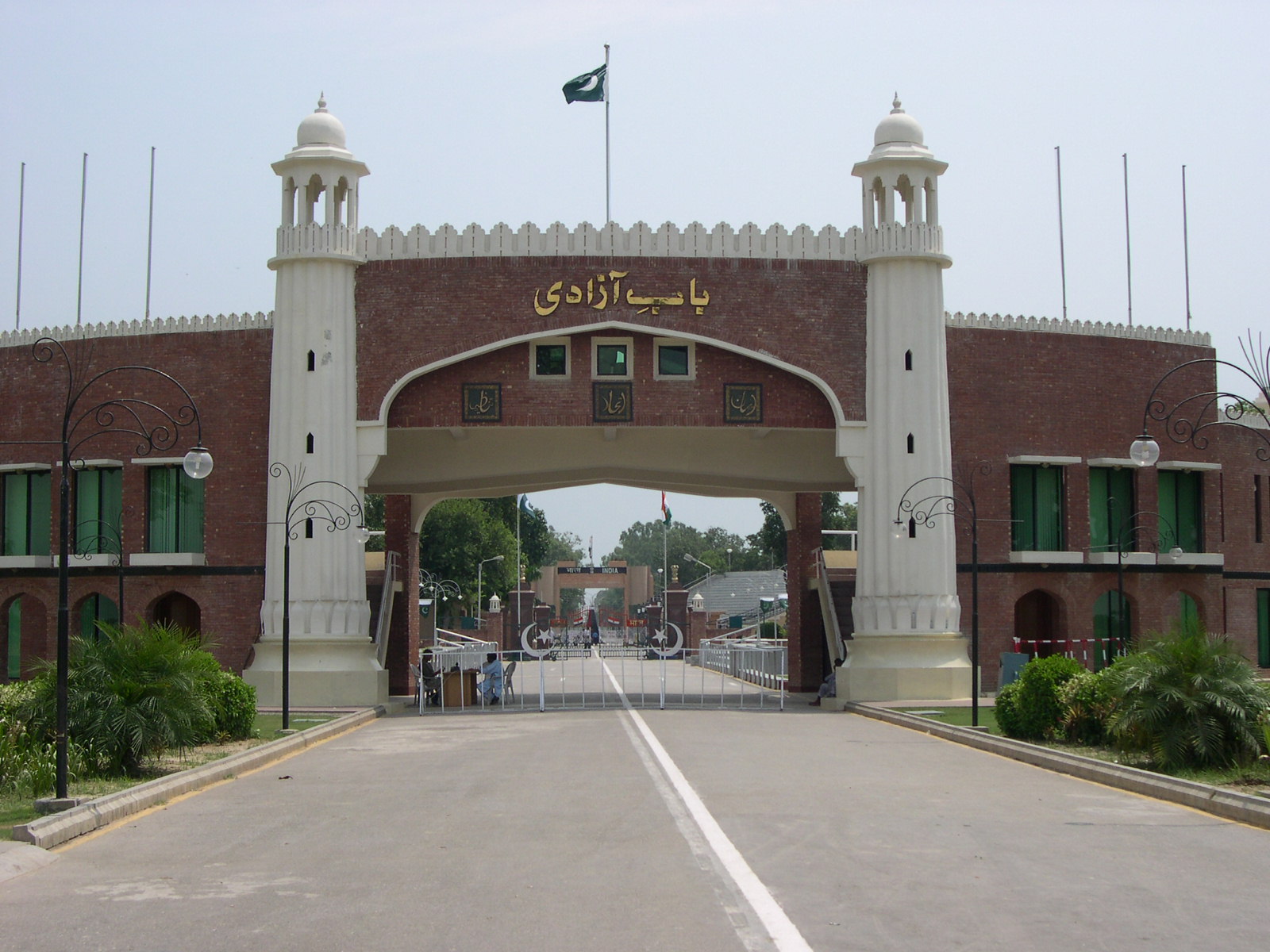
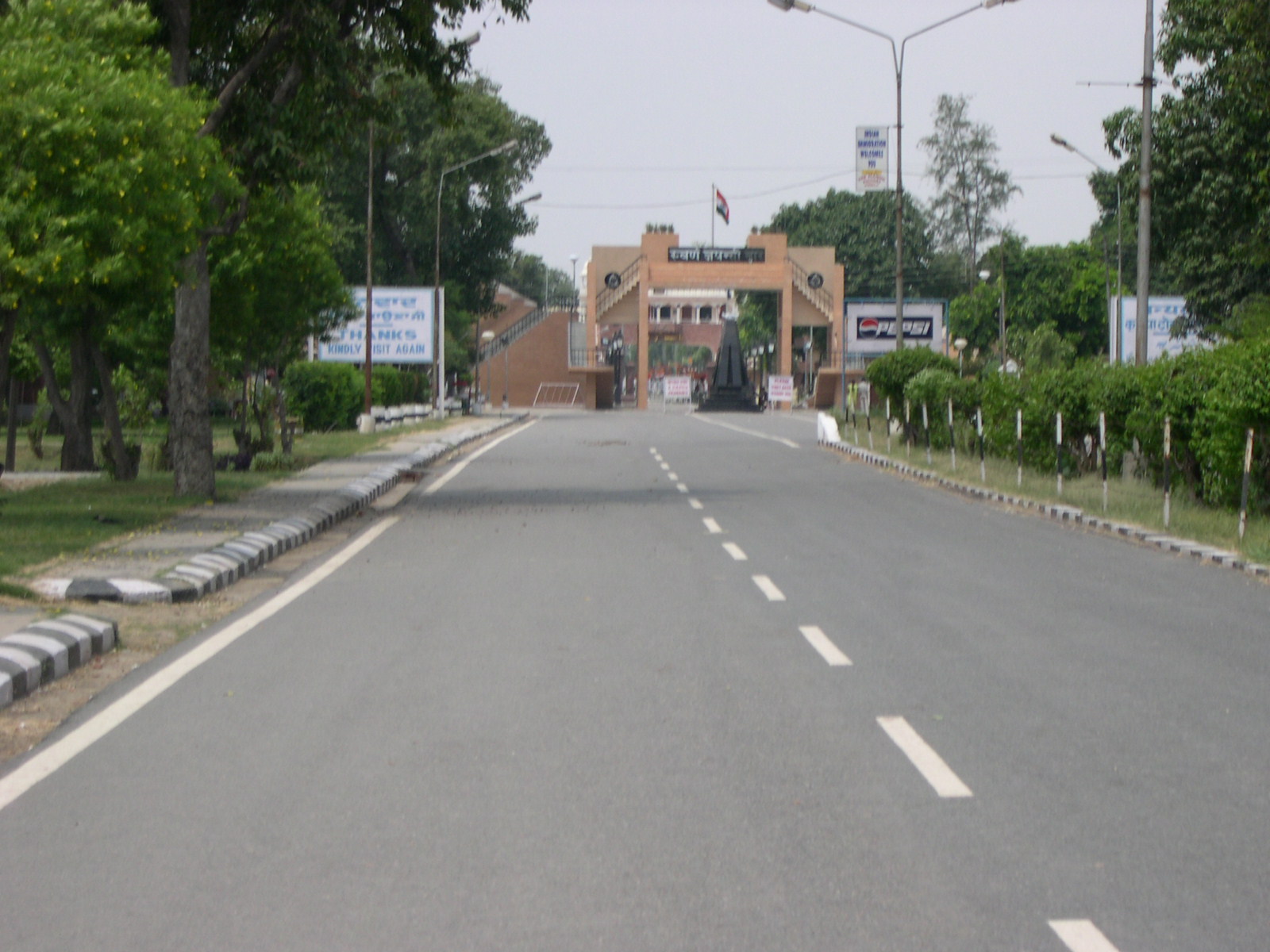
In 2001, I crossed the Wagah-Attari border for the first time. Since then, I have used this official land crossing between India and Pakistan numerous times, in the process seeing the border undergo multiple changes. It used to be the Grand Trunk Road split in half, with a few meters of “no man’s land” to separate them. I could literally walk from one side to the other, while remaining on the GT Road. Then, the authorities decided to uplift, gentrify, and replace the colonial bungalows. Gone was the quaint and informal space with scattered flower beds and plants and in came the flashy buildings, followed by the airport style security, customs, and immigration; culminating eventually in the hideous and expensive battle for who can hoist the largest flag and keep it flying high!
To be fair, the development of the check post at Wagah-Attari was probably a response to the expectation that relations between the two countries would improve, and with that the foot traffic would increase. The bungalows were not equipped to deal with high volumes of people. Hence, they first established the goods/transit depot on one side of the border, so as to divert the trucks carrying the items of import/export. This separated the trade traffic from the people traffic. Whilst the establishment of a goods depot offered signs of improved trade between the two countries, even this was subject to cordial relations.
With numerous crossings since then, I have seen the border change, not just physically but also its ambience and vibes that the place gives. Indeed, the new buildings and transit buses which take passengers from one side to other have functioned to create further distance between the lines of control. These were not there previously, and the cool formality evokes the illusion of being remote and separate. Borders do not have to be harsh and austere.
These moments and emotions are difficult to capture on camera, but they can be felt when encountering the staff and officials. When I first crossed the border, I had the compact Canon Sure Shot AF-7, which was a popular model in the 1990s and gifted to me. I enjoyed taking photographs, but cameras were not cheap then, and the 35mm film was expensive too, both to buy and to develop, so photos were taken sparingly. When I embarked on my doctoral research, taking my camera was essential for my trips to India and Pakistan, as it was an instrument to visually document my journey. I would normally pack 1-3 rolls of ISO 200 (sometimes also ISO 400) speed film, usually 36 EXP, good for general photographs. But one was never entirely sure until the film was taken back home, handed in for developing, which then produced the joy of physically going through the photographs a week later! Time had passed between undergoing the actual trip and now feeling those photographs in my hands, and the images allowed me to recreate and relive those moments again.
Today everything is instant. In a moment I can be taking a photograph at the border, and then share it with the wider public around the world via social media. The only caveat here is that, generally the phone signals are non-existent within 1-2 kilometres of the border area, so you would probably need to wait until you were able to pick up the phone signal. More importantly, this also disrupted any arrangements one had made to meet people on the other side. If I was crossing the border, I might contact my friends/family beforehand and say, I’m crossing at X time (keeping in mind the 30 minutes times difference between the two countries), so I estimate that I will be out at Y time (usually 60 minutes from one side to the other). But if things didn’t go to plan, there is no way of contacting the person to alert them of the delays. And when you did finally make it to the other side, there were always a small number of people anxiously waiting and looking to see when their friends/family will pass through those doors.
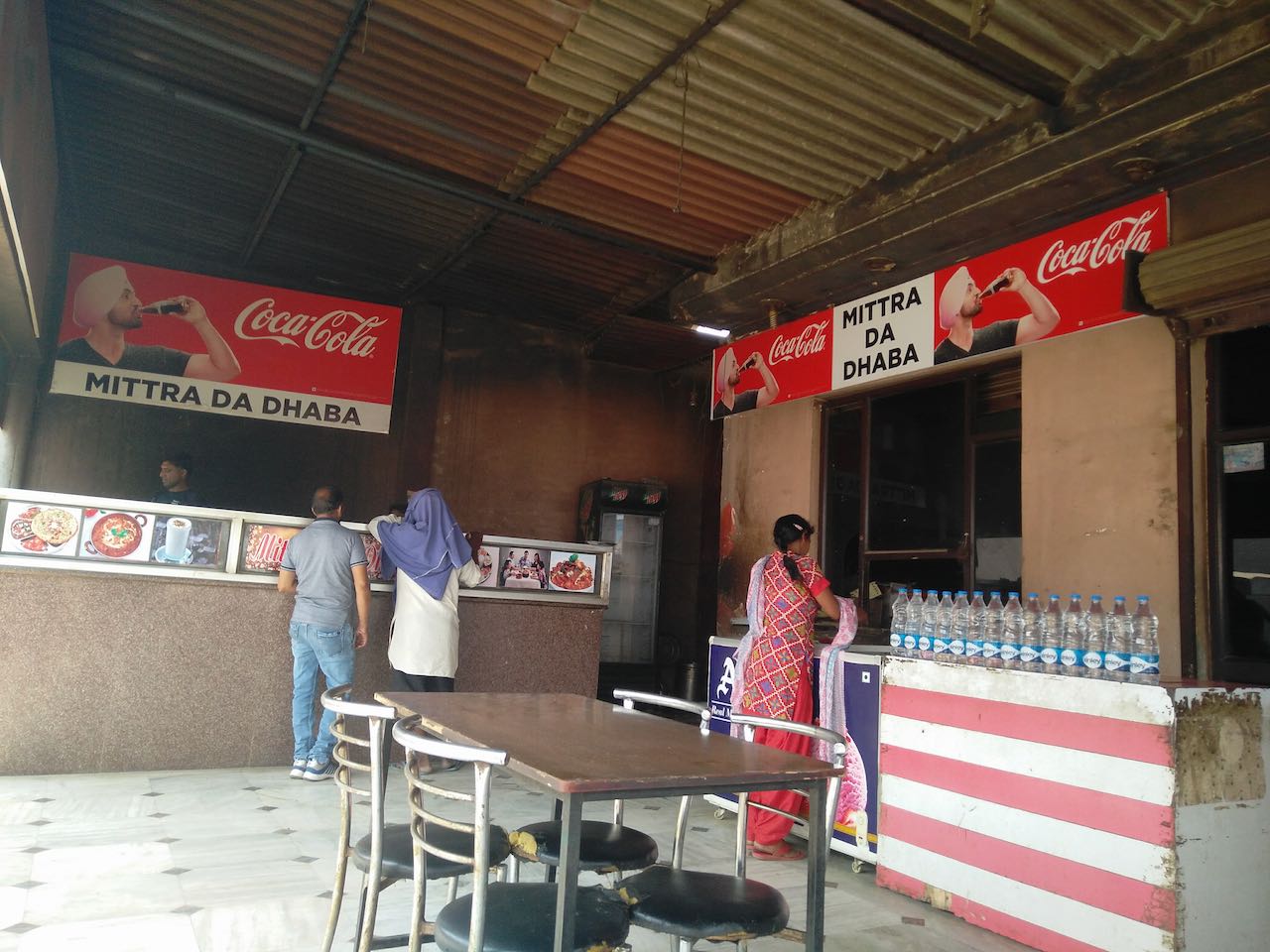
There are many other stories of this rather strange and intriguing no man’s land but to end with a more positive story, I share a picture of a dhaba at Attari, Mittra da dhaba (literal translation – friends’ roadside restaurant) is located close to the entrance to check post, catering to travellers and tourists who come for the daily lowering of the flag ceremony. I have gone there many times, but on one occasion in 2017, I asked the owner to pack some food for me, food which I planned to take across the border and share with my friends in Lahore. He took great care to make it extra special and pack the food tightly, so that it wouldn’t spill. I could see that it also brought him great joy to know that his food would travel to the other side. As we parted, he said come back and tell me if they enjoyed it!
Alas, these stories are in the past tense, and with Covid the border faced further restrictions and closures. I have no idea if my friend is still there, I hope so. We need more friends in these otherwise hostile spaces.
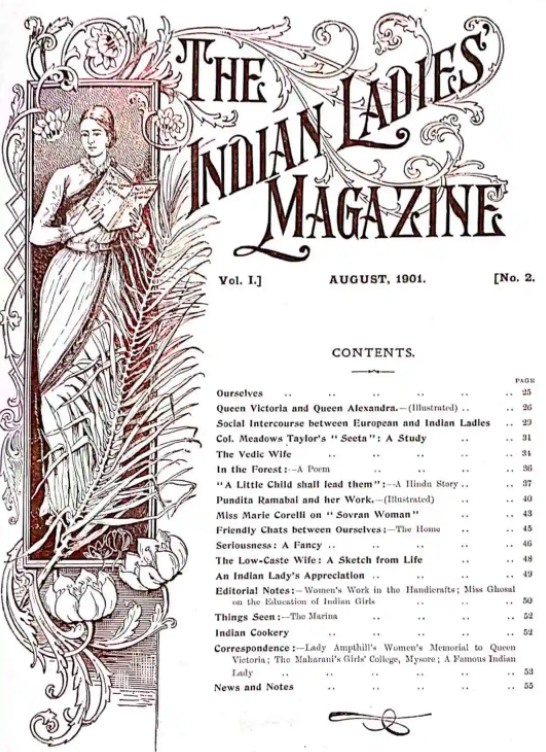
Recently I noticed in several social media forums that people have been sharing details of Rokeya Sakhawat Hossain and her short story, Sultana’s Dream (1905). This story was originally published in The Indian Ladies’ Magazine, Madras, 1905, in English and translated by the author into Bengali. The story takes the form of a dream, set in a futuristic feministic world, in which women through education, opportunity and their innovative ability to use technology have been able to flourish. The science and technology featured in the story is not far off the realities of today and shows immense foresight by the imagination of the author.
The story also highlights how unjust it was, and still is, to deny women education and freedoms, which men have. The imagined place is a generous, green, and friendly environment, in which feminist science has created a space for everyone to thrive and reap the benefits. Although the story was published over a hundred years ago, we are still far from this utopian land.
Rokeya Sakhawat Hossain was born circ. 1880 to an orthodox Bengali Muslim upper-class family in the small village of Pairaband (district Rangpur in Bengal Presidency and present-day Bangladesh). Her father insisted that she learn only Arabic and remain in strict purdah. But with the assistance of her siblings, she learned to read and write Bangla and English. In 1896 her older brother Ibrahim Saber sought to arrange her marriage to a widower in his late 30s. Syed Sakhawat Hossain was the district magistrate in the Bihar region of Bengal Presidency and Ibrahim thought Rokeya would do well under Syed’s open-minded attitude, who had received education in both Bengal and London.
“Rokeya and her husband settled in Bhagalpur, Bihar. None of her children lived. Syed, who was convinced that the education of women was the best way to cure the ills of his society, encouraged his willing wife to write, and set aside 10,000 rupees to start a school for Muslim women.”
After 11 years of marriage, Syed passed away in 1909, leaving Rokeya alone. Soon thereafter she opened a school in Bhagalpur. Later, she moved to Calcutta where she re-opened the Sakhawat Memorial Girls’ School on March 16, 1911. The number of students went from 8 in 1911 to 84 in 1915.
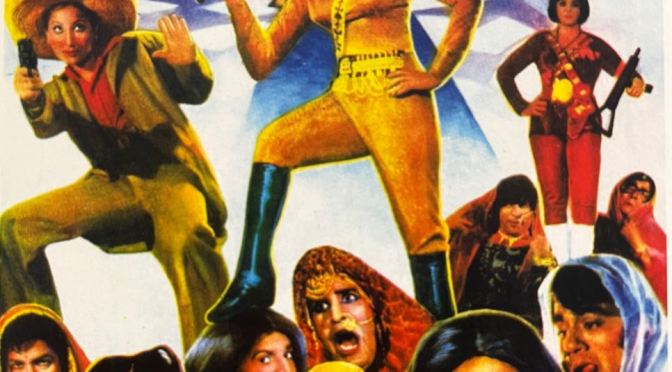
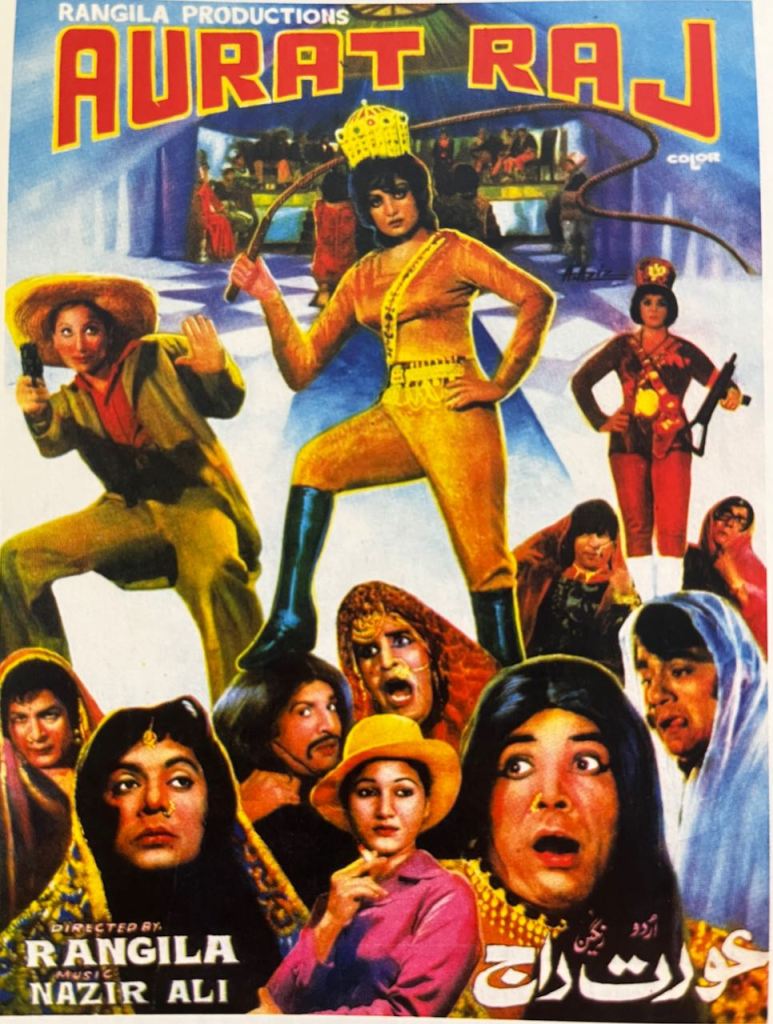
The pioneering concept behind Sultana’s Dream has inevitably inspired other writers and artists to take their cue from a world in which women have the power and men are the submissive other. Aurat Raj, a 1979 Pakistani film, which on the surface appears to be inspired by Rokeya’s work, is also a commentary on the military (and masculine) regime that had come into power, under General Zia. Aurat Raj, is a strange and kitsch interpretation, at whose heart is a social message, centred on exposing the oppression of women. But when the roles are reversed, the women behave in a similar fashion too, unlike Hossain’s short story.
Source: Cinema and Society edited by Ali Khan & Ali Nobil Ahmad (OUP, 2016)
The poster for the film Aurat Raj is equally intriguing as the film itself. It “depicts a woman dressed in a tight-fitting suit and long boots with a crown on her head and a whip in hand, all the more intriguing. She has a commanding, imperious expression on her face. To her right another woman in men’s clothes brandishes a gun. A third woman confidently smokes a cigarette. At the feet of the ‘Empress’ a series of men, including Sultan Rahi, are dressed in women’s clothes. Rahi demurely wears a dupatta on his head, his expression one of effeminate alarm. A subversive and experimental drag movie directed by Rangeela, who had appeared in scores of films in side-comic roles usually playing to the front benchers, Aurat Raj is perhaps Pakistan’s only satire to date and it lampoons not only the naked chauvinism that prevails in Pakistani society but also pokes fun at the way that this attitude pervades the industry. The film targets the machismo of Pakistani men and revels in inverting the gender and power roles, making the women literally wear the pants and leaving the men, including Sultan Rahi and Waheed Murad, wearing frilly frocks and helpless expressions.” Ali Khan, “Film Poster: Reflections of Change in the Pakistani Film Industry” in Cinema and Society: Film and Social Change in Pakistan, edited by Ali Khan & Ali Nobil Ahmad (OUP, 2016), P251.
Despite its well-known star cast of Waheed Murad, Rani, Rangeela and Sultan Rahi, the film was a commercial flop. However, it is certainly worth revisiting, if only as a reminder of the subversive message of the film, which dreams of a more equal society.
Dr. B.R. Ambedkar (born April 14, 1891, Mhow, India—died December 6, 1956, New Delhi), leader of the Dalits (Scheduled Castes; formerly untouchables), chairman of the drafting committee of the Constituent Assembly of India (1946-49) and law minister of the government of India (1947-51).
On his 131st birth anniversary, I share below an excerpt from a paper read by a 25-year-old Ambedkar titled Castes in India: Their Mechanism, Genesis, and Development, at Columbia University, New York, U.S.A. on 9 May 1916:
Subtler minds and abler pens than mine have been brought to the task of unravelling the mysteries of Caste ; but unfortunately it still remains in the domain of the “unexplained”, not to say of the “un-understood” I am quite alive to the complex intricacies of a hoary institution like Caste, but I am not so pessimistic as to relegate it to the region of the unknowable, for I believe it can be known. The caste problem is a vast one, both theoretically and practically. Practically, it is an institution that portends tremendous consequences. It is a local problem, but one capable of much wider mischief, for “as long as caste in India does exist, Hindus will hardly intermarry or have any social intercourse with outsiders; and if Hindus migrate to other regions on earth, Indian castes would become a world problem.”
And pasted below are a slice of the meagre UK newspaper reportage across the first three decades after Ambedkar’s death, when he was not the indispensable icon that he has become in the India since 1990-91:
“Dr Ambedkar”, ‘…had once thought of asking to be received as a Sikh’ – political rather than theological conversion to Buddhism, therefore – opinion is equally divided on whether Untouchability is dying out or whether the caste system is still rigid, though it may take rather new forms’ – ‘the Untouchables would be happier if, without exaggerating their separateness from the main body of Hindus, they can produce more leaders to carry on Ambedkar’s work’.
7 December 1956, The Manchester Guardian, p. 10
“India’s former Untouchables seek arrest” – ‘Harijans all over India have launched an agitation to press their demands…yesterday 500 demonstrators courted arrest…but the Harijans lack the political organisation or the strength within society to raise anything more than a matter of discontent, easily ignored…the Harijan agitation is being directed by the RPI, the descendent of the old SCF, which the late Dr Ambedkar made a political force in the years before independence but which has shrunk in influence [since]…the agitation was launched on Dr Ambedkar’s birthday yesterday in support of a charter of 10 demands placed before the PM two months ago (land, houses, fair distribution of food grains, enforcement of the laws against untouchability and “immediate cessation of harassment” of Harijans)…the Harijans are stirring…stiffening through desperation or anger [as evidenced] by clashes between caste Hindus and “neo-Buddhists” (Harijans who have converted to Buddhism) in Maharashtra’.
8 December 1964, The Times, p. 9
“The timeless untouchable Indian problem” – ‘not a small minority: 20% in UP, WB, Haryana, Punjab; 10% in Gujarat, Maharashtra, Kerala, and Assam… ‘what has happened to [them] in these past 30 years? Very little, according to Mr. Dilip Hiro, The Untouchables of India. [On] the Untouchability (Offences) Act, 1955, ‘if we took this law seriously, said one state police chief, half the population in the state would have to be arrested’. [Reservation] ‘has tended to break up or drain off any kind of movement fighting for untouchable rights…Dr Ambedkar, the first Untouchable leader, believed that their status would be ameliorated only when the caste system itself was ended in India and there are no signs at all of that. Among western anthropologists, this…may be seen as an effective and defensible ordering of society. Nor does it seem likely that Mrs. Gandhi’s new order, powered by the authority of Kashmiri Brahmins, is going to start at the bottom of the Indian social heap’.
23 February 1976, The Times, p. 6
“14 killed as caste violence strikes at Bihar village” – ‘the third serious outbreak of caste violence [against Harijans by middle-ranking caste Hindus] in northern India in just over one month’ – ‘during the Janata rule in Bihar, the middle-ranking so-called “backward” castes seized the advantage over the former upper castes’ – ‘atrocities had increased recently against Harijans and other economically weaker groups…because other communities had become jealous of their advance, according to Mrs. Savita Ambedkar, widow of Mr. B.R. Ambedkar, the prominent Harijan leader who helped to draft the Indian constitution’.
27 February 1980, The Times, p. 9
Postscript:
On 7 August 1990, Vishwanath Pratap Singh, the prime minister at the time, announced that Other Backward Classes (OBCs) would get 27 per cent reservation in jobs in central government services and public sector units. The announcement was made before both Houses of Parliament. The decision was based on a report submitted on 31 December 1980 that recommended reservations for OBCs not just in government jobs but also central education institutions. The recommendation was made by the Mandal Commission, which was set up in 1979 under the Morarji Desai government and chaired by B.P. Mandal (former chief minister of Bihar). 30 years since Mandal Commission recommendations — how it began and its impact today by Revathi Krishnan 7 August 2020, The Print.
Caption from The Times of India, April 5, 1983. “The new mayor of Bombay. Mr Manmohansingh Bedi, cheered by Bhangra dancers in a victory procession in the Fort are on Monday. Photo by Girish Dikshit.”
On 30 October 2014 Manmohan Singh Bedi, the first Sikh Mayor of Mumbai (then Bombay) died, weeks short of his 90th birthday. He was a restaurateur and the founder of Sher-e-Punjab Restaurant chain in Bombay in 1937, and the President of Hotel & Restaurant Association of Western India. But it was his Bombay mayoral victory in April 1983 that caught my eye. Below are three articles from The Times of India. They cover the victory of Bedi.
Bedi is city’s first Sikh mayor By A Staff Reporter, April 5, 1983.
R. Manmohansingh Harnamsingh Bedi of the Janata Party today became the first Sikh mayor of Bombay, amid unprecedented scenes of jubilation. Mr. Bedi polled 102 votes, the first time that a mayoral candidate crossed the 100-vote mark, against 32 of his lone opponent, Mr. Rameshkumer Mataprasad Dube of the Congress-I. No sooner was the 58-year-old Mr.Bedi declared elected by the outgoing mayor, Dr. P. S. Pai, than the house broke into thunderous cheers. Councillors and scores of supporters who had waited in the public gallery surged on to the dais with garlands end bouquets. A large number of Sikhs bad turned up to greet the new mayor, whose election was a foregone conclusion,
GARLANDS GALORE
Dr. Pai was the first to embrace and garland Mr. Bedi, followed by the municipal commissioner, Mr. D. M, Sukthankar, Mr. Dube, leaders of civic political groups, other councillors and the general public. Slogans hailing the Janata Party and the ruling Progressive Democratic Front (PDF) were raised to the accompaniment of the chant, “Bole So Nihe! Sat Sri Akal”. Security men, who had initially screened visitors to the corporation hall, relented in the face of popular enthusiasm and threw open the gate for streams of visitors carrying bouquets and garlands. As the crowds surged forward to greet him, Mr. Bedi was pushed back and the security men held on to the ornate mayoral chair to prevent it from toppling over the dais. Mr. P. H. Sehgal, a councillor, appealed to the crowd in Punjabi to disperse quickly. The new mayor was garlanded on behalf of a host of organisations, including the Guru Singh Sabha, the Punjab association, taxi-men’s unions and the association of automobile spare parts traders. The candidature of Mr. Bedi was submitted by the Janata Party last Thursday, after the party got the mandate from the PDF’s six-party constituents comprising 76 members in the house of 138. Of these, the Janata Party’s councillors total 40, followed by 20 of the BJP, 11 of the Congress-S, three of the Muslim League (Bukhari group) and one each from the CPM and the RPI. Mr. Bedi got the support of the Shiv Sena, a non-PDF group, with 20 members. The Sena decided support Mr. Bedi to prove its bonafides as “a truly anti-Congress-I organisation”.
“UNHAPPY FINANCES”
Two Muslim League councillors from the Banatwalla group, three from the CPI and an independent voted in favour of Mr. Bedi. The election was boycotted by three other independents-Mr. B. K. Boman-Behram, former mayor. Dr. (Mrs.) Bhaktawar Mahajan and Mr. G. B. Dutia—who said they resented the “bargaining” of the mayoralty and chairmanships of committees. Mr. Dube’s 32-strong Congress-I group stood firmly behind him. Delivering his first speech as mayor Mr. Bedi said the city of Bombay had honoured the Sikh community by electing him to the position. Hailing the old ties between Maharashtra and Punjab, he recalled the visit of Sant Namdeo to the Punjab region and the establishment of Sikh Centre at Nanded in Maharashtra by Guru Gobind Singh, the tenth guru. Mr. Bedi described the financial condition of the corporation as “not that happy” and said inflation was to blame. The corporation’s wage bill which was Rs. 39 crores in 1978-79. had risen to over Rs. 100 crores for 1983-84. The financial resources available to the corporation were limited and almost static. The new mayor called upon both the Central and state governments to assist in slum clearance. He said the state government was in arrears of Rs. 9.13 crores in the matter of slum improvement dues. He reminded the house that slum improvement formed part of the government’s 20-point programme. He also focused on water supply projects and said the government had yet 10 fulfil its commitment of Rs.23 crores for the first phase of the Bhatsai project which has been completed. Mr. Bedi pleaded for the implementation of the middle Vaitarna project for augmenting the water supply. He also called for the release of surplus lands under the Urban Land Ceiling Act to co-operative housing societies to ease the city’s housing problem.
Born on December 27, 1924 at Sargodha, now in Pakistan, Mr. Bedi’s family migrated to Bombay before the partition. Educated at Bharda New High School in Bombay, Mr. Bedi’s academic career was cut short by the “Quit India” movement. A councillor since 1957, Mr. Bedi represents the Bori Bander (VT) Constituency. He has served as the chairman of the markets and gardens committee (1961-62), of the works committee (1963-64), improvements committee (1967-68) and the BEST committee (1980-81). Now a treasurer of the state Janata Party, Mr. Bedi was a prominent Congressman in the past, holding the position of general secretary of the BPCC in 1968. A successful hotelier, owning a chain of restaurants, Mr. Bedi is a soft-spoken man, but a popular member of the house.
Moments after his maiden speech as mayor, which was delivered in English, Mr. Bedi garlanded the statues in the corporation hall, including those of Mahatma Gandhi, Shivaji, Sir Phirozshah Mehta and Dr. Babasaheb Ambedkar. He was taken in a procession to Hutatma Chowk where he paid a floral tribute at the Martyrs memorial. The procession included Bhangra dancers. Mr. Manohansingh Bedi is the third Janata Party mayor in the present house, after Mr. Raja Chimbuikar and Dr. A. U. Memon. Mr. Baburao Shete, who served as the first mayor in the present house was elected on the Congress-(S) ticket but later joined the Congress-(I). Dr.P. S. Pai whom Mr. Bedi succeeded, is a BJP councillor.
Vasantrao – was for unanimous election of mayor By S. T. Almeida, Bombay April 6, 1983
The chief minister, Mr Vasantrao Patil, was in favour of the Congress (I) candidate withdrawing from the race for the mayoralty as a gesture to enable Mr. Manmohansingh Bedi to become the first Sikh mayor of Bombay unopposed, it is reliably learnt. Mr. Patil had conveyed his feelings to the Congress (l) candidate, Mr. Rameshkumar Dube. saying that he was sure to lose and that gesture towards the Sikh candidate would be well-appreciated. Mr. Bedi had intimated to chief minister his wish that he be elected unopposed. But Congress (I) members in municipal corporation felt that mayoral election was too politicised an affair and that such a gesture would have been appropriate if Mr. Bedi was an independent candidate. They disapproved of Mr. Patil’s logic in supporting a candidate from minority community by recalling that when Congress (I) put up Mr. Zail Singh for presidency. Janata party went ahead in its support for Mr. Justice H. R. Khanna opposition candidate. Ironically, Mr. Bedi had lost the mayoral election to the Shiv Sena’s Mr. Wamanrao Mahadik in 1978. At that time. Mr. Bedi was a Congressman, but Mr. Vasantrao Patil, who was chief minister then, had instructed Congress (l) councillors to vote for Mr. Mahadik. Mr. Patil’s action had offended Mr. Bedi and other Congressmen, prompting them to leave the party.
Electing a mayor, by a Staff Reporter, April 11, 1983
Close on the heels of the election of the country’s first Sikh President, the city fathers voted Bombay’s first Sikh mayor and 54th in line, Mr Manmohansingh Bedi (59), at one of the noisiest mayoral polls in recent history. A huge gathering of the turbaned fraternity had ridden in their beflagged cars to the venue of the corporation meeting and rolled out three-metre-long chai crackers to announce the Sikh leader’s triumph. Not even the police could dampen their enthusiasm after warning them of the likely danger the crackers could cause to nearby cars and offices. The lane between the two MBC buildings and the main thoroughfares were choked with a major traffic snarl as vehicles continued to stream towards the civic building, reflecting the popular esteem in which Mr Bedi is held by a vast cross-section of the people. A troupe of bhangra dancers bedecked in their colourful regalia of bright yellow salwar-kameez topped by black tunics pirouetted to do a jig or two to celebrate the mayor-elect’s victory. The proceedings were redolent of the feisty nature of the Punjabis, extroverts to the core with their earthy style of living.
Epilogue
The dominant party in present-day Maharashtra, the Shiv Sena, was established in 1966 and in 1971 the party had its first victory under the mayoral candidature of Dr H. S. Gupte. Since 1985 the Shiv Sena has more or less dominated the mayoral seat of Bombay. In 1983 the BJP, the present ruling party in India had barely any presence, having only been established in 1980. This was also the year before Operation Blue Star in Amritsar, Punjab, when under PM Indira Gandhi the Indian security forces were sent into the Sikh’ssacred Harmandir Sahib to remove Jarnail Singh Bhindranwale in June 1984. This eventually culminated with the assassination of the prime minister, followed by the anti-Sikh pogroms in Delhi in November 1984.











 BAGICHA