Category Archives: Partition

Freedom and Fear: India and Pakistan at 70

IMG_1949
© 2014 Pippa Virdee

In the midst of the monsoon of August 1947, British India ceased to be and gave way to two independent nations. The logic of this Partition being religious and regional, the older and larger India was reinforced as a Hindu majoritarian society, while the newer and smaller Pakistan emerged as an Islamic country. No Partitions are total and absolute but this one was especially terrible and ambiguous and left a little less-or-more than 20% religious minority population on both sides. Moreover, it created two wings of Pakistan with a hostile Indian body-politic in the midst.

This event was not entirely of sub-continental making. The British Empire in Asia had begun to crack at the hands of the Japanese army during World War Two, most spectacularly with the fall of Singapore in February 1942, and crumbled in South Asia afterwards. Along with India and Pakistan, the-then Burma and Ceylon (both 1948) too emerged independent at this time. All this was to bring about many changes, both internally in India and internationally. Europe, the ravaged battlefield of the World Wars, ceased to be the centre of the Western world, with political and economic power shifting decisively to the former Soviet Union and the United States, representing two contrasting and conflicting ideological visions for the post-1945 world.

The end of the British rule in South Asia happened alongside the emergence of this conflict, christened the Cold War. The road to freedom and partition of India and creation of Pakistan was a long one and accompanied with fundamental social, economic and political changes. From the mutiny of 1857 from Calcutta to Delhi to the massacre of 1919 in Jallianwala Bagh, Amritsar, from the formation of the Indian National Congress in 1885 to the establishment of the All-India Muslim League in 1906, from fighting for King and country in two World Wars to seeking self-rule in the inter-war years, and, from the development of an elaborate civil and military bureaucratic and infrastructural apparatus and a space for provincial politics, all these were to completely transform Indian society.

Read the complete article via: http://magazine.thediplomat.com/#/issues/-Kq0QJtC_OQiU3Dy0tQ6 

No Man’s land: the Wagah-Attari Border

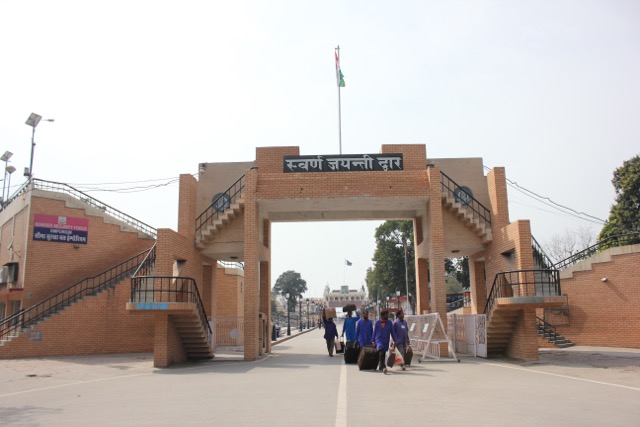
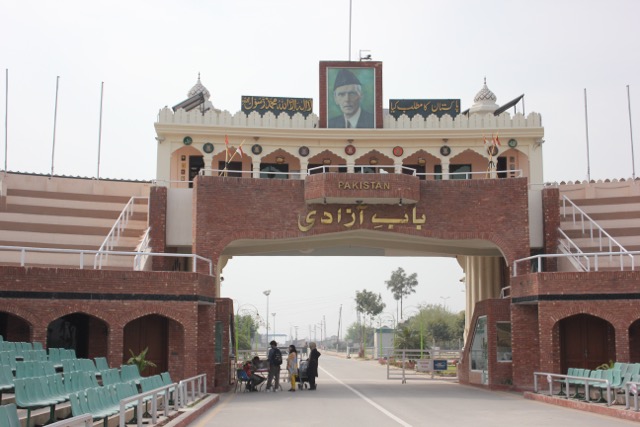
Located at a short distance of 24 kilometers from Lahore, Wagah is a small village in Pakistan and placed strategically on the Grand Trunk Road and serves as the main goods and railway station between India and Pakistan. The Indian counterpart is Attari and both serve as the only official land border crossing between India and Pakistan. The Radcliffe Line that divides them was the scene of both immense horror and gratitude for those fleeing to the “promised lands” in August 1947. Poignantly for writers such as Sadat Hasan Manto, many migrants were torn between the two spaces of no man’s land. This legacy continues today for those divided by this border.

The Wagah-Attari border is more accessible to foreigners who cross the border rather than the citizens of India and Pakistan. Having used this route numerous times, it brings up all sorts of surprises every time. There is always a sense of uncertainty about the political climate between the two countries, which can change at short notice. When relations are good between them, the border seems a little more open and less hostile, there is generally more traffic of people, especially people with green and blue passports. Otherwise, there are hardly that many people using the border only the diplomats, foreigners and the select few. I am one of the privileged few. The Pakistani’s always ask me if I’ve enjoyed my stay and have I faced any problems? I always reassure them that I’ve had a wonderful time. The Indians it has to be said are less talkative, though on occasions I have been “treated” to cups of chai.

There is usually plenty of dramatic material for the writers, artists, and peaceniks etc that want to spend time here for inspiration. There is sadness as people (de)part, despair as people fail to crossover due to lack of proper paperwork, there are covert (or not so covert) spies keeping an eye on passengers, and then there are security/customs people who are keen to show their power and within the ordinary, there are the money changers and inquisitive coolies working hard, often in the full sun. But there are always people wondering about the “other”.

When I first crossed this border, over fifteen years ago, the border was a basic set-up in old colonial bungalows. You could literally walk across from one side to the other. Today, both have made this border into an airport style, elaborate process with scanners and plenty of formalities and paperwork. Previously the coolies were employed to help carry people’s luggage to the international boundary that divides the two countries and they would also exchange goods that were permissible under trade agreements; the two carried on side by side. Now trade is exchanged more formally via the goods and transit terminal and the coolies make their livelihoods through the meagre travellers passing through. Most of the coolies belong to Wagah and Attari and come from a generation of families who have lived and worked in this border area. It is unlike any other place in India or Pakistan. They have seen many changes and have many tales to share, often from divided migrant families themselves.

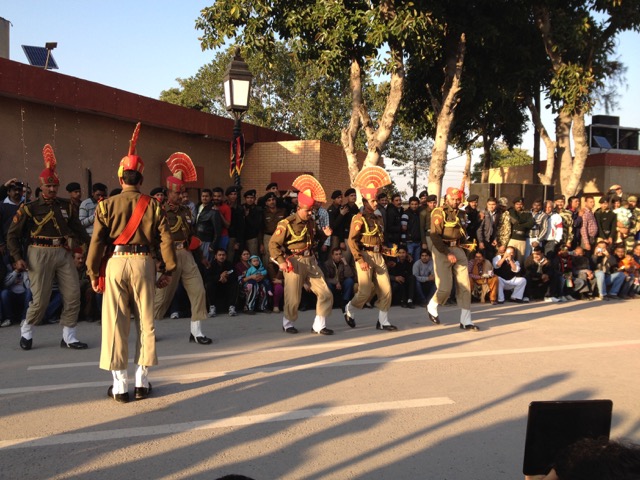
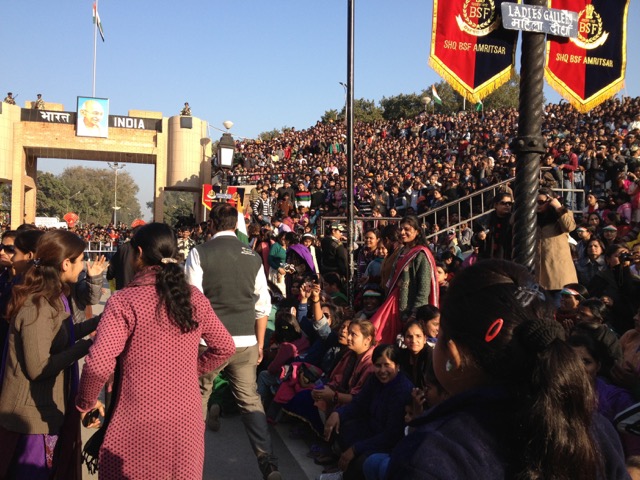
The Indian Border Security Force and the Pakistani Rangers have their daily ritual of lowering of the flag ceremony at the end of the day before sunset. Immaculately dressed, in Indian khaki and Pakistani Black, the soldiers walk and strut in their fast paced and intimidating style. Michael Palin, during his travels around the world, compared this to the Ministry of Silly Walks from the Monty Python sketches; this is not too far-fetched. Often referred to as the strut of the peacocks, this is a show of prowess, power, and pride of the most superficial nature. Hundreds of Indians and Pakistanis flock to see this spectacle of jingoistic and patriotic display. Few would wonder about how this well choreographed ceremony actually happens. It is in many ways an obscene drama that takes time to practice and perfect, and requires the two forces to work together. They do this away from the public gaze, so as to not taint the public image. This tradition started back in the 1950s has evolved now to only provoke the nationalist desire to fuel this antagonistic relationship between the two countries. It has continued to grow, attracting foreign as well as local tourists and the seating arrangements at the border are yet again being upgraded and expanded to accommodate the demand. Large crowds chant “Pakistan Zindabad!” or “Jai Hind!” to show their patriotism, waving their flags with unwavering allegiance to the idea of India and Pakistan. It is now nearly seventy years when the Radcliffe Line was drawn, and if anything, it seems this border has become even harder than previously.

Some useful links:

Peacock at Sunset by Frank Jacobs: https://opinionator.blogs.nytimes.com/2012/07/03/peacocks-at-sunset/

The Wagah border ceremony in India: https://adventuresofagoodman.com/wagha-india-pakistan-border-history/

The Partition Museum, Amritsar

This slideshow requires JavaScript.

The Partition Museum is an attempt to preserve the history and memories of 1947, that saw the creation of India and Pakistan and as a result the partition of Punjab and Bengal. Located in Amritsar the museum deals with mostly the effects of partition on Punjab rather Bengal. It is the initiative of Lady Kishwar Desai and The Arts and Cultural Heritage Trust, along with other organisations. The Partition Museum is in Amritsar’s Town Hall and located in the newly renovated area near Hall Bazaar. The renovation work is a delight in the hustle and bustle of the walled city of Amritsar. The surrounding area all carry remnants from the colonial period and ironically the museum itself is housed in the colonial Town Hall built in the 19th century.

The museum contains mainly pictures, a few artefacts and newspaper clippings from the independence period. It is spread across 3-4 rooms which use multimedia, visual and documentary sources to illustrate and memorialize the Partition. It is therefore a small exhibition and largely provides an overview of what happened.

I wish I could have connected better with the endeavours and intentions of the museum but it left me feeling empty and concerned with the lack of reflection. The museum unfortunately reflects the elite vision with which it was conceptualised. Having spent the last sixteen years working on the history of Partition, I realise that people still need to learn more about this period. But sadly, seventy years on we hardly have any empathy for the collective guilt that we all share in this legacy. The newspapers presented were from the Indian perspective, the horrors of violence were those perpetrated by Muslims against Hindus and Sikhs. Had we been on the other side of the Radcliffe Line, I imagine similar one-sided accounts would be shown of how Muslims were killed at the hands of Hindus and Sikhs. So, when do we move away from this communalized history of partition that still lingers on?

The pictures and voices shared were not of the ordinary people suffering but of prominent people and those who have come to “symbolise” partition history. This is certainly not a people’s history. Even the Tree of Hope presented me with little hope as it was covered in nationalistic and jingoistic slogans written by school children and visitors. Hardly giving secular India hope for the future. Instead the Tree of Hope just reinforces the new powerful and bullish India, unleashed by Modi’s vision.

My main concerns were with the well that has been installed in the museum. It is obviously designed to educate people but what sort of story is it trying to tell us? By simply stating that many women were forced to or rather martyred themselves by jumping into the wells is simplifying a very complex history. Women as the torch bearers of community honour were in some cases (we can hardly guess the numbers) forced to jump into wells by the patriarch of the family or community. Some went willingly but others were more reluctant; afraid of what was expected of them. We can most poignantly see this in the film Kamosh Pani. And so, to show this well in the middle of exhibition represents what exactly? If this was the original location, as in Jallianwala Bagh, it would make sense but to install it for effect is problematic. What kind of history and memory is being preserved by these acts to recreate history selectively? With little intellectual engagement with these selective symbolic fragments from our collective past we can only serve to re-enforce the communalised identities that led to 1947 in the first place.

Visit the website: http://www.partitionmuseum.org/

Dividing Punjab, 1947

Map of Punjab. Scale 1:16 Miles.

Muslim majority Tehsils and contiguous majority areas of Muslims.

Available in the National Documentation Wing, Islamabad.

By the summer of 1947, it was obvious that a one-state solution for British departure from India was not a possibility and so serious discussions were necessary regarding the division of British India. Above is one of the maps used by the Punjab Muslims League, Boundary Commission Office to make its case about how to divide the Punjab.

The 3 June Plan, or as it was more popularly known as the Mountbatten Plan, was accepted by the main leaders, Nehru, Jinnah and the Sikh leader Sardar Baldev Singh. According to the Plan, the areas of Bengal and the Punjab would be divided between Muslim and non-Muslim districts. The Commission consisted of four judges, Justice Din Muhammad and Justice Muhammad Munir (both Muslim) and Justice Mehr Chand Mahajan (Hindu) and Justice Teja Singh (Sikh). The Commission chairman was the British barrister, Sir Cyril Radcliffe. During the public sittings, all the parties were allowed to present their cases to the Commission.

The Muslim case largely rested on the basis that their population majority in contested areas should be considered a major consideration in demarcation of the boundary line. Amongst the numerous documents used by the Commission, the map above highlights the Muslim majority tehsils and contiguous majority areas of Muslims. The yellow area in the middle is around Amritsar in central Punjab. Punjab generally and more specifically this area was incredibly complex and mixed in terms of communal composition and so immediately it is obvious that the dividing up people and land would be no easy task. How would they undo hundreds of years of people living together, co-existing and now being forced into accepting a new nation state? In addition to looking at the distribution of different communities, the Boundary Commission also examined the existing boundary lines of the tehsils, the location of the railway lines, the Grand Trunk Road (which is the main artery of the Punjab and indeed North India, connecting Kabul right through to Calcutta), the rivers and canals, the irrigation system, natural boundaries etc and some of these are marked on the map. Of course each community further made a case before the judges to make recommendations about where the line should be. This is particularly pertinent in areas where we see the concentration or pockets of the “other” community. Justice Mehr Chand Mahajan in his report makes an interesting point about the city of Lahore, which historically and at the time of partition was claimed by all communities. The city has a rich history and was once the seat of power under Ranjit Singh. The Justice says:

“The town of Lahore in my view stands on a special footing. It has been metropolis of the Punjab for several hundred years. Both east and west have contributed to its prosperity. Its economic life has mainly been developed by the enterprise of the non-Muslims. In truth both the Muslims and non-Muslims can legitimately claim Lahore as their own town thought on different grounds…. If I could, I would have suggested that this town should be left in the joint management of both the communities as a free city, it freedom being guaranteed by the two Dominions with a suitable constitution in which one community may not dominate over the other.” (Kirpal Singh (ed), Select Documents on Partition of Punjab 1947 India and Pakistan (Delhi: National Book Shop, 1991, p333-4).

See some of the documents related to Indian independence at British Library: http://www.bl.uk/reshelp/findhelpregion/asia/india/indianindependence/indiapakistan/index.html

Read commentary and analysis by Lucy Chester, ‘The 1947 Partition: Drawing the Indo-Pakistani Boundary’. http://www.unc.edu/depts/diplomat/archives_roll/2002_01-03/chester_partition/chester_partition.html

Borders and Boundaries

As an academic my main pre-occupation has been centred around the partition of India and creation of Pakistan in 1947. I have been fortunate enough to have been able to spend time on both sides of the border, comparing the impact of this division on the people of Punjab; the area that has been severely affected by the decision taken in 1947. From being the bread basket of British India and the major recruiting ground for the colonial Indian army, East Punjab becomes the hostile border with Pakistan and West Punjab, while politically dominate, recedes culturally. The culturally, linguistically and economically rich land of Punjab is Balkanised after 1947 and now exists as a mere skeleton of its former self. The land has been reconfigured along religious identities which evaporate the pluralistic history; it tries to re-imagine itself for the new global order but lacks the former strength it had.

For the past 14 years I have crossed the official border crossing at Wagha/Attari between India and Pakistan numerous times; I’m lucky because I don’t have a green or blue passport, both of which immediately open you up tedious amounts of scrutiny. By virtue of being “foreign” and at the same time a “desi”, you get to experience this place in a different manner. Although I have Indian heritage, the Indians are on the whole sterner, matter of fact during the immigration and customs. Sometimes I will strike a conversation and there is rare chance to get their views. For example, during my last trip, the Indian official wanted me to recommend some history books to read, especially those that were impartial. On the Pakistan side, there are of course always questions, inquisitions about what, why, who…but there appears to be more “conversation”. There is always intrigue and sometimes joy that a “foreigner” would want to spend time in Pakistan. I have also been unlucky enough to be stuck on both sides of the border just as it is about to close for crossing. And both sides have blamed the other, “madam ji, we will let you go through but the Indians/Pakistanis will not accept you”. Both behave in this rather childish and tit for tat manner. It is a shame then that politics is also conducted in this manner. While Delhi and Islamabad exchange words of war, the ordinary people suffer, as they have suffered in the past 69 years.

The new global trend for hyper nationalism, as seen in the impact Trump is having in America, the growing influence, both emotionally and politically, of right wing politics can also be seen in the UK, France, Denmark, Sweden, and so socially progressive countries which are now retracting and adopting more defensive policies. While in India, the impact of Modi and his cosy relationship with RSS has unleashed and legitimatised a form of nationalism and patriotism which makes it difficult to question governments and their policies. In the name of showing loyalty to the state, Indianess/Hinduness and the armed forces, it has become unpatriotic to say anything which may offend. Have we become so insecure that we cannot even tolerate any scrutiny? Surely we need reflect on our past and how we face the challenges of an increasingly globalised society. We cannot live in isolation, putting up barriers, preventing the movement of people and creating homogenous spaces. India and Pakistan did this in 1947 and we live with the legacies of that today. Homogenous (religiously or ethnically) societies does not equate with security, peace and harmony. Look at the challenges Pakistan has faced since it was founded as a country for the Muslims of India. Working together for a solution is the only option. But amongst this raft of change has also been the enormous disconnect between the politicians and the people and this is a global challenge.

It is therefore staggering to think that as we approach 70 years of independence, little has been gained and little has been achieved in our relationship with our closest neighbour. We cannot deny that we were once attached together and there are many cultural, ethnic, linguistic commonalities that unite us, yet we are determined to focus on the differences and maintain the status quo of a sibling rivalry. Unfortunately, there is no parent who can step in try to patch up things, we have to be mature enough to do that ourselves. Otherwise, this rivalry will remain for the next 70 years. People away from border states like Punjab and especially Kashmir cannot comprehend the negative impact this rivalry has had on the mind-set and livelihoods of the people. They live in the shadows of this rivalry, even though there is much more which unites them than divides them. They also have a right to live in peace and aspire for prosperity, we should not be so selfish to deny them this.