Category Archives: India

Durga Mandir/Juma Masjid

This slideshow requires JavaScript.

In an unassuming side street of an old residential area in Sonipat is a hidden gem and remnant of the past. Durga Mandir of Mohalla Kalan in Sonipat is still popularly known as Badi Masjid (big/greater Mosque). The latter should give an insight into the former life of this Mandir, which once was a Masjid. Even today looking at the exterior of this mandir it could quite easily be confused for a masjid. It stands tall and looks grand in the red stone façade with a courtyard for Friday prayers which probably attracted many of the local Muslims in pre-partitioned Punjab. Apart from the obvious changes of installing flags and idols, the three main domes and minarets are easily identifiable with that of a small Juma masjid.

Like many other places of East Punjab, the Muslims of Sonipat migrated to Pakistan, leaving behind their homes and places of worship. These were quickly claimed by the incoming Hindus and Sikhs. Muslims were often the second largest group in these areas. For example, Muslims were significantly present in cities like Hissar (28%), Gurgaon (34%), Karnal (32%) and Ambala (32%) Rohtak (17%); all of these are part of present-day Haryana State. Most of the Muslims abandoned their homes in the ensuing violence of August 1947 and fled to Pakistan. Similarly, in Pakistan, many of the old abandoned religious (Gurdwaras and mandirs) buildings were converted/neglected by the incoming populations to be utilised for their own purposes. See link below for more about this.

In this case, the masjid has been converted into a Durga Mandir, a temple for worshiping Goddess Durga. It is now known as ‘Sri Sanatan Dharm Sabha Panji Durga Mandir.’ The Goddess Durga assumes the central position in the mandir and is surrounded by other deities; outside in the courtyard is an encased idol of Baba Sai. The dome interior has recently been filled to mask the obvious Islamic style architecture but the exterior remains as before. The link below provides further information on the Badi Masjid but more interesting are the photos. The short article was posted in October 2015, and the pictures shared are quite different from when I went to visit the site recently. The interior now has been changed to hide all signs of its former existence as a masjid. The pictures from 2015 show the perfect domes and remnants of frescoes and tiling from before. The fact that much of the interior has been transformed in the past two years is telling of the Hindutva agenda prevailing in the region.

Sonipat in August 1947 was a small city in united Punjab, then it became a city in East Punjab and eventually a part of Haryana after the reorganisation of East Punjab in 1966. There is little in the history books about the intervening years before it became part of Haryana, yet a lot has changed in this area. Looking at Sonipat today, it is difficult to tell that this historic city was once communally diverse with Punjabi Hindus, Sikhs, Muslims and Christians. Today it feels very much like a Hindu city. Perhaps the latter is more of a reflection of the current climate in India. But hidden away are these old structures that remind us of a different time and a different history.

Read further about Sonepat’s Badi Masjid and see pictures from 2013. http://www.gounesco.com/badi-masjid-sonipat/

Pakistan’s long forgotten Hindu temples and gurdwaras. http://blogs.tribune.com.pk/story/15785/pakistans-long-forgotten-hindu-temples-and-gurdwaras/

The Curious Case of Multani Mitti and the Taj Mahal

This slideshow requires JavaScript.

In 2001 Pakistan’s president General Pervez Musharraf came to Agra to hold a historic summit between India and Pakistan, with the aim of resolving some of the long-term fractious issues between the two nations. It has now been nearly 16 years since the two countries came close to finally resolving their enmity. As the talks collapsed it paved the way for the lost opportunities that both nations now lament at leisure. At the back of the Agra Summit, Musharraf also made a trip the Taj Mahal. In preparation for this trip the Taj Mahal got a face-lift, literally. Multani Mitti (mud from Multan, Pakistan where this lime-rich clay was originally found) was used to cleanse the Taj Mahal which was suffering from years of exposure to pollution and general wear and tear. Although it is less clear whether the Multani Mitti actually came from Multan. The Multani Mitti, which is effectively mud therapy and has been used for centuries as a beauty product, cleansed away the pollutants that gave the Taj Mahal more of a yellowish (dirty) appearance and now it gleams bright and white. In a recent visit to the Taj Mahal, the process of cleaning the historic site continues, slowly and painstakingly. Despite the hundreds of daily visitors looking for the perfect picture at the Taj Mahal, they have to suffice with the scaffolding.

For me a visit to Agra is incomplete without also paying homage to Fatehpur Sikri, the city founded in 1569 by the Mughal Emperor Akbar, which also served as the capital of the great empire from 1571-1585. Akbar choose the site to honour the Sufi Saint Salim Chishti (his shrine overlooks the capital city complex) and took great care in the vision and architecture of the capital, sadly once finished the complex was difficult to sustain due to the shortage of water into the city. One of the most architecturally rich pieces in the Diwan-i-Khas, hall of private audience, is the octagonal pillar, encompassing the secular, open and embracing vision that Akbar had for the new capital. The pillar brings together different architectural designs (see picture) highlighting his own interest in inter-faith dialogue. And it is here that Akbar apparently held his many theological discussions.

What was apparent in visiting the Taj Mahal and Fatehpur Sikri in the same day was the way both sites are treated, the Taj Mahal is by far the superior site. It attracts hundreds of visitors and foreigners (and Indians if they fail to bring ID with them) pay a generous entry fee and it is a site which is promoted by the UP government extensively. Where would ‘Incredible India’ be without the presence of the Mughal built Taj Mahal. Yet for me the deserted city of Akbar is equally, if not more, significant. It is more spread out and beams with the beautifully craved red stone architecture with geometric patterns, and the extraordinary Tomb of Sheikh Salim Chisti who was a descendant of Khwaja Moinuddin Chishti of Ajmer. The Sufi Saint foretold the birth of Akbar’s son, who is named after him, Prince Salim (later Emperor Jahangir).

What connects the Multani Mitti and Agra is the myopic and selective amnesia that ‘Incredible India’ has towards its Mughal/Muslim heritage. Fatehpur Sikri is visibly less attractive as a tourist destination and visibly more ‘Muslim’ as a lived city and the Taj Mahal in its glorious white marble beauty is entirely a commercial complex and less of a tomb to Emperor Shah Jahan’s favorite wife, Mumtaz Mahal. While the irony of using Multani Mitti on the Taj Mahal to sustain Indian tourism is not lost on many, there is at the same time a marginalisation of other sites. This is of course intrinsically linked to the wider politics of identity and more importantly in terms of how the Indian state is re-affirming and re-positioning its own identity which is increasingly ‘Hindutva’ in essence and less embracing, thus moving away from Akbar’s pillar of inter-faith and tolerance. With this the hopes that President Musharraf and the Indian Prime Minister Vajpayee once bought to the tables have all but disappeared; seventy years on and we are still unable to live amicably with each other but at least we are alright with using Multani Mitti to cleanse away the superficial dirt that accumulates around us.

Lata and the compact cassette

IMG_20170407_085346Imagine the nostalgia of jumping into a 4×4, on a rainy Friday morning in Islamabad, driven around by a German academic, only to discover several music cassettes by Indian singers tucked between the two seats. On close inspection, I discover the music of Lata Mangeshkar – the nightingale of Indian music. Sadly, there was no cassette player in the 4×4 but in that moment, I was transported to the 1980s, listening to popular Bollywood music on the small cassette players, an essential gadget in any household. The numerous compilations in the car were all of music belonging to the golden era of Bollywood music, Mukesh, Rafi and Lata.
Pakistan is not a place I immediately associate with music, you don’t often hear music in people’s houses, nor the streets or even the restaurants and cafés. When I do hear music it often registers in my mind, the sound of music to me is universal and without borders. The melodic sounds can reach out to anyone and everyone and so for me, music is like a breath of air. Growing up, we were always surrounded by music, whether this was religious music or popular music on the radio. Early childhood memories are filled with different genres of music but each one them is associated with a time and place, with the power to transport you back to that time and place.

I can’t exactly remember the last time I might have played something on the compact cassette. I know the earliest interviews I did were all recorded on cassettes, usually on the 60 minute tapes. This was as late 2002, only fifteen years ago. The cassette quickly disappeared after the micro discs and then eventually digital recordings which ended the reign of the cassettes. Digital recordings have been far more versatile, especially when traveling around and not knowing how long the interviews might last. But the cassette, despite its flaws and ability to get stuck in the cassette player, still has the power to evoke emotional memories associated with a bygone era.

Mela Phulkari: IV

This slideshow requires JavaScript.

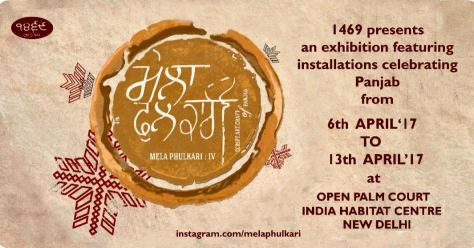
Mela Phulkari is the brainchild of Kirandeep Kaur and Harinder Singh, owners of Punjabi revival arts and crafts brand, 1469. Last year I was lucky enough to stumble upon the exhibition at the India Habitat Centre and managed to even spend time with Kirandeep, Harinder and the curator and art historian Dr Alka Pande.

The mela (festival) is an attempt to bring together the arts and crafts of Punjab to showcase the vast and impressive handicrafts of the region. Some of these crafts are dying out now due to lack of awareness, investment and changes in people’s tastes. Through their brand of 1469 and Mela Phulkari, Kirandeep and Harinder are trying to rejuvenate and inject new life into these arts and crafts of Punjab.

The Mela derives its name from phulkari which is essentially made up of two words phul = flower and kari = craft and is piece of embroidered cloth. The embroidered floral work was done with floss silk on cotton fabric and over time this type of work quintessentially became associated with Punjabi craftsmanship. Interestingly the phulkaris were traditionally woven by women especially for special occasions such as weddings. Remaining in the domestic space they were never intended for commercial sale as these were individual pieces put together for personal use only. The weaving of phulkari is therefore akin to weaving dreams and desires that they had rather than just a regular chunri (head scarf) or shawl. It brings together bright, jubilant colours to represent joyous occasions. Devoid of any religious subject, the phulkari is a simple design yet creative piece of design work. Motifs represented everyday life but the colours and style of embroidery varied across the region and depending on the occasion. The mela thus serves as a wonderful syncretic tradition of the Punjab.

Read more about Phulkari: http://indianheritage.biz/Phulkari.html

Apart from the phulkari, the mela brings together lots other artefacts from Punjab and installations. The mela is definitely worth a visit when you are in Delhi. Go exploring at the Mela Phulkari, Open Palm Court, IHC. Exhibition showing from 6th to 13th April 2017. http://www.indiahabitat.org/

Visit the 1469 shops or go online: http://www.1469workshop.com/

WhatsApp Image 2017-03-18 at 19.36.12

The Partition Museum, Amritsar

This slideshow requires JavaScript.

The Partition Museum is an attempt to preserve the history and memories of 1947, that saw the creation of India and Pakistan and as a result the partition of Punjab and Bengal. Located in Amritsar the museum deals with mostly the effects of partition on Punjab rather Bengal. It is the initiative of Lady Kishwar Desai and The Arts and Cultural Heritage Trust, along with other organisations. The Partition Museum is in Amritsar’s Town Hall and located in the newly renovated area near Hall Bazaar. The renovation work is a delight in the hustle and bustle of the walled city of Amritsar. The surrounding area all carry remnants from the colonial period and ironically the museum itself is housed in the colonial Town Hall built in the 19th century.

The museum contains mainly pictures, a few artefacts and newspaper clippings from the independence period. It is spread across 3-4 rooms which use multimedia, visual and documentary sources to illustrate and memorialize the Partition. It is therefore a small exhibition and largely provides an overview of what happened.

I wish I could have connected better with the endeavours and intentions of the museum but it left me feeling empty and concerned with the lack of reflection. The museum unfortunately reflects the elite vision with which it was conceptualised. Having spent the last sixteen years working on the history of Partition, I realise that people still need to learn more about this period. But sadly, seventy years on we hardly have any empathy for the collective guilt that we all share in this legacy. The newspapers presented were from the Indian perspective, the horrors of violence were those perpetrated by Muslims against Hindus and Sikhs. Had we been on the other side of the Radcliffe Line, I imagine similar one-sided accounts would be shown of how Muslims were killed at the hands of Hindus and Sikhs. So, when do we move away from this communalized history of partition that still lingers on?

The pictures and voices shared were not of the ordinary people suffering but of prominent people and those who have come to “symbolise” partition history. This is certainly not a people’s history. Even the Tree of Hope presented me with little hope as it was covered in nationalistic and jingoistic slogans written by school children and visitors. Hardly giving secular India hope for the future. Instead the Tree of Hope just reinforces the new powerful and bullish India, unleashed by Modi’s vision.

My main concerns were with the well that has been installed in the museum. It is obviously designed to educate people but what sort of story is it trying to tell us? By simply stating that many women were forced to or rather martyred themselves by jumping into the wells is simplifying a very complex history. Women as the torch bearers of community honour were in some cases (we can hardly guess the numbers) forced to jump into wells by the patriarch of the family or community. Some went willingly but others were more reluctant; afraid of what was expected of them. We can most poignantly see this in the film Kamosh Pani. And so, to show this well in the middle of exhibition represents what exactly? If this was the original location, as in Jallianwala Bagh, it would make sense but to install it for effect is problematic. What kind of history and memory is being preserved by these acts to recreate history selectively? With little intellectual engagement with these selective symbolic fragments from our collective past we can only serve to re-enforce the communalised identities that led to 1947 in the first place.

Visit the website: http://www.partitionmuseum.org/

Golgappas/Panipuri

Golgappas have to be one of the most popular street foods in India. For me it’s a ritual, when I go to Ludhiana, I have to have golgappas. It is a simple hollow, fired puri, made with flour or semolina. The flour ones are more crispy and more popular. A small hole is inserted and then filled with any combination of chickpeas, onions, potatoes and then filled with flavoured water. The water is what makes the golgappa; from simple tamarind based pani, the street vendor now has multiple flavours. Sweet, tangy, spicy to appeal to all taste buds. Affordable by all and enjoyed by all, this is the simple attraction that keeps bringing me back to India.