
Pakistan: A Very Short Introduction (Oxford University Press, 2021).
What is Pakistan? The name refers to a seventy-year-old post-colonial product of the bloodiest partition of territory and population that accompanied the end of British empire in South Asia. But the region of the Indus Valley has a four-thousand-year-old history, and was the site of one of the earliest and greatest riverine civilisations in the world. Although the modern nation of Pakistan as we know it was created as a homeland for the Muslims of British India, it is impossible to understand the complex tapestry of linguistic, ethnic, and cultural identities and tensions of the region without tracing its deep past.
This Very Short Introduction looks at Pakistan as one of the two nation-states of the Indian sub-continent that emerged in 1947. Pippa Virdee reaches into the ancient past to demonstrate the influence of trajectories of human settlement and civilisation on Pakistan’s contemporary political arena, and shows how the longer continuities between the land and its peoples are as important as the short-term changes in the political landscape. She considers Pakistan’s religion and society, the state and the military, everyday life, popular culture, languages and literature, as well as Pakistan’s relationship with the rest of the world. Virdee also looks to the challenges of the 21st century and the future of Pakistan.

From the Ashes of 1947: Reimagining Punjab (Cambridge University Press, 2018).
This book revisits the partition of the Punjab, its attendant violence and, as a consequence, the divided and dislocated Punjabi lives. Navigating nostalgia and trauma, dreams and laments, identity(s) and homeland(s), it explores the partition of the very idea of Punjabiyat.
It was Punjab (along with Bengal) that was divided to create the new nations of India and Pakistan and that inherited a communalised and fractured self. In subsequent years, religious and linguistic subdivisions followed – arguably, no other region of the subcontinent has had its linguistic and ethnic history submerged within respective national and religious identity(s) and none paid the price of partition like the pluralistic, pre-partition Punjab.
This book is about the dissonance, distortion and dilution which details the past of the region. It describes people’s history’ through diverse oral narratives, literary traditions and popular accounts. In terms of space, it documents the experience of partition in the two prosperous localities of Ludhiana and Lyal|pur (now Faisalabad), with a focus on migration; and in the Muslim princely state of Malerkotla, with a focus on its escape from the violence of 1947. In terms of groups, it especially attends to women and their experiences, beyond the symbolic prism of honour. Critically examining existing accounts, discussing the differential impact of partition, and partaking in the ever democratising discourse on it, this book attempts to illustrate the lack of closure associated with 1947.
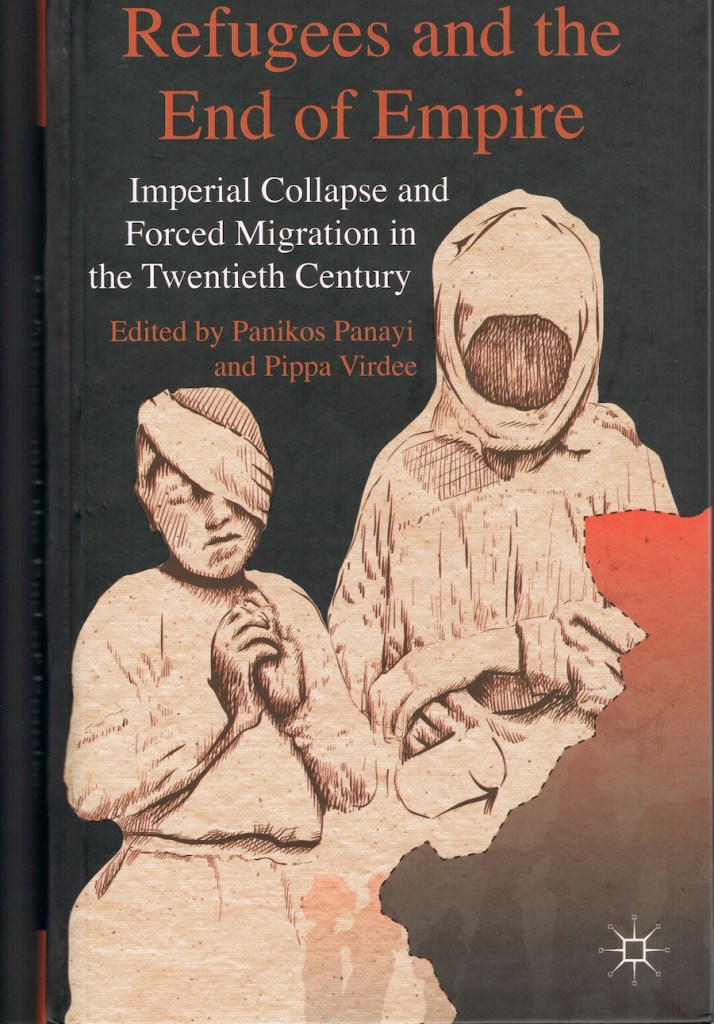
Panikos Panayi and Pippa Virdee (eds) Refugees and the End of Empire: Imperial Collapse and Forced Migration during the Twentieth Century (Palgrave Macmillan, 2011).
This volume examines the relationship between imperial collapse, the emergence of successor nationalism, the exclusion of ethnic groups with the wrong credentials, and the refugee experience. It brings together a coherent range of essays, written by established authorities and emerging scholars, which offer a highly original and comparative way of examining the refugee experience on a global scale. The book is structured into three distinct parts: the first contains three overview pieces introducing the key themes in the volume; the second focuses specifically upon the collapse of the Austro-Hungarian and Ottoman Empires at the end of the First World War, with individual essays on specific case studies: the third examines ‘The Consequences and Legacies of British Imperial Collapse’, with a particular focus upon the experiences of South Asians immediately after the partition of India and the specific case of Uganda.

Coming to Coventry: Stories from the South Asian Pioneers (Coventry: The Herbert, 2006).
Coming to Coventry reveals the hidden history of the South Asian migrants who arrived in the city from the 1940s to the 1960s. It is a fascinating story of individuals who uprooted themselves to improve their lives and those of their families. The pioneers who arrived in Coventry had little concept of what Britain was like, yet they gradually laid the foundations for an established South Asian community.
The book features personal accounts from many of the early migrants, and a wealth of photographs giving an intimate glimpse of their lives. Through an exploration of work, family, and social activities, it charts the challenges and successes as they settled into their new home.
 BAGICHA