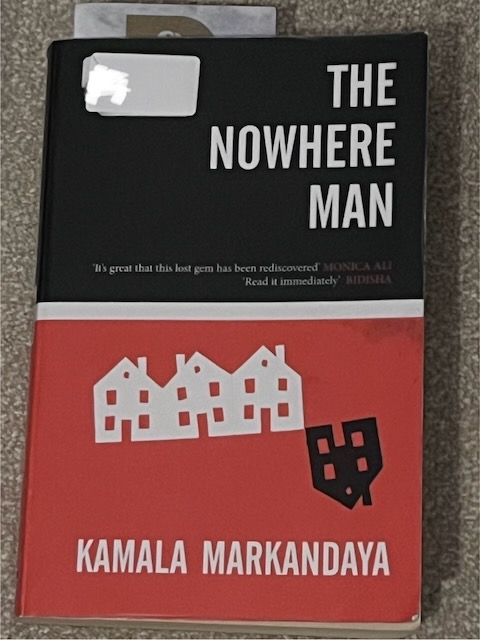
Kamala Markandaya (23 June 1924–16 May 2004), pseudonym of Kamala Purnaiya, married name Kamala Taylor, occupies a distinctive position in the landscape of South Asian literature. Born into a prominent Brahmin family in Mysore, India, she graduated from Madras University and established herself as a significant voice through short stories published in Indian newspapers. In 1948, shortly after independence, she uprooted herself and moved to London with literary ambitions, and thus straddled between two worlds – East and West – and also the transitional era from the colonial to the post-colonial.
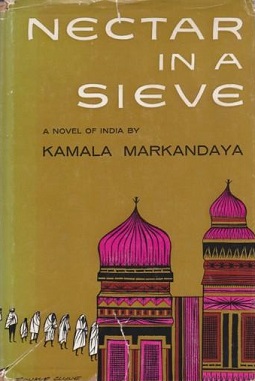
Her first novel, Nectar in a Sieve (1954), introduced readers to her unflinching examination of rural poverty and resilience and became a bestseller. The title of the novel is taken from the 1825 poem ‘Work Without Hope’, by Samuel Taylor Coleridge”
Work without hope draws nectar in a sieve,
And hope without an object cannot live.
This epigraph establishes a thematic preoccupation that would recur throughout Markandaya’s work: the question of what sustains individuals when hope seems futile, when effort appears wasted, and when displacement renders purpose elusive.
A Voice of the Indian Diaspora
According to Sunita Rani’s critical assessment, ‘Kamala Markandaya, a pioneer member of the Indian Diaspora occupies an outstanding place among the Indian women novelists writing in English… In a wider context, she comes under the umbrella of third world post-colonial writers.’ This positioning is crucial to understanding Markandaya’s unique contribution: she wrote from the margins, giving voice to experiences of displacement, cultural alienation, and the psychological toll of migration long before diaspora literature became a recognised genre.
Writing at a time when British literature was still predominantly white and male, and when post-colonial voices were only beginning to emerge, Markandaya carved out a space to explore the immigrant experience with psychological depth and nuance. Her attention to the internal lives of her characters, their negotiations between cultures, and their struggles for dignity in hostile environments marked her as a writer of considerable sophistication and empathy.
The Story of Srinivas

The Nowhere Man tells the story of Srinivas, who embodies the rootless existence its title suggests. After spending two-thirds of his life in England—during which he sacrificed a son to war—this Indian immigrant finds himself heckled by racist hoodlums and ultimately driven to his death. The tragedy of his situation is compounded by temporal irony: he has lived in England for thirty years, yet remains perpetually “foreign,” a restless, rootless individual stripped of both his Indian heritage and denied full acceptance into British society.
As Rani observes, ‘He is bewildered as to where he belongs: he has lived in England for thirty years and yet became a rootless, restless individual disposed of India and disowned by England. He represents millions of men who, for some reason or other leave their own roots and fail to strike roots in alien soil and die as rootless, restless individuals.’
Srinivas’s predicament speaks to the fundamental existential crisis of the immigrant: the loss of one identity without the gain of another, the perpetual state of being in-between. His thirty years in England count for nothing in the eyes of the racist youths who torment him; his decades of contribution, his sacrifice of a son to Britain’s war effort, cannot purchase him belonging. Markandaya captures with devastating clarity how racism reduces a lifetime of lived experience to nothing more than the colour of one’s skin.
Cultural Neglect and Critical Oversight
What makes the novel’s obscurity particularly striking is that it addresses themes that should have resonated powerfully in 1970s Britain. As Emma Garman writes in the introduction to the new reprinted edition, ‘writing ahead of one’s time risks cultural neglect, and The Nowhere Man was all but ignored on its publication.’ The novel confronted uncomfortable truths about race, belonging, and British society’s treatment of immigrants at a crucial historical moment – an era marked by increasing racial tension, the rise of far-right politics, and heated debates about immigration.
The 1970s saw the growth of the National Front, the implementation of increasingly restrictive immigration laws, and incidents of racial violence across Britain. The Nowhere Man spoke directly to these realities, yet British readers and critics seemed unwilling or unable to engage with its challenging portrait of their society. Perhaps the novel was too close to the bone, too unflattering in its depiction of British racism and xenophobia.
Garman picks up the inter-generational tension in Markandaya’s work, when newly-wed Laxman brings his wife Pat to stay at Srinivas’s home for a week, he feels embarrassed by his parents’ perceived lack of sophistication—their appearance, dress, and English. His father’s valiant attempts to fit into an awkward social environment reveal the painful immigrant experience that Markandaya captured so effectively. Garman notes how the ‘conflict and sense of separation that can arise between first and second immigrant generations would, thirty years later, be explored to great effect in Zadie Smith’s White Teeth and Jhumpa Lahiri’s The Namesake. But at the time Markandaya was writing, it was a subject few novelists had confronted.’ Yet her pioneering work went largely unrecognised, until perhaps its re-discovery through the new edition in 2019.
A Precursor to Contemporary Voices
Perhaps the most intriguing element of The Nowhere Man‘s neglect is how its outsider perspective—particularly its diagnosis of British society through the eyes of ‘a woman and a foreigner’—felt disconcerting to 1970s readers. Garman asks whether this dual marginalization could help explain the novel’s commercial and critical neglect?
Better known for her American success, Markandaya found her adopted home, Britain, a tougher market, yet she remained committed to exploring themes of cultural displacement. Garman shows how Markandaya ‘blamed the inevitable snobbishness towards an author from a former, and very recent, British colony.’ Again suggesting someone who was ahead of her time and working on the edges. And ‘perhaps discouraged by the reaction – or rather the lack of reaction – to her harrowing portrait of modern Britian, Markandaya returned to India for the setting of her subsequent four novels.’
Historically, Markandaya occupies a fascinating position: falling between the canonical generation of V.S. Naipaul (b.1932) and later Salman Rushdie (b.1947), and those who came before her such as R.K. Narayan (b.1906) and Mulk Raj Anand (b.1905). It was perhaps Ruth Praver Jhabvala (b.1927) that remained her most literary contemporary.
Her work on diaspora and displacement anticipated the themes that would define the later writers. Her work, particularly The Nowhere Man, deserves recognition as a precursor to contemporary diaspora literature—a pioneering exploration of identity, displacement, and the meaning of home that speaks with renewed urgency to our current moment.
And given the political rhetoric around nationalism in contemporary Britian, this makes for pertinent reading as a story which is set in 1968, the year of Enoch Powell’s ‘River of Blood’ speech, should resonate so much with our times today. Srinivas’s story remains tragically relevant, a reminder that the struggles for acceptance and dignity faced by immigrants are neither new nor resolved.
References and further reading:
Nasta S, Stein MU, eds. Disappointed Citizens: The Pains and Pleasures of Exile. In: The Cambridge History of Black and Asian British Writing. Cambridge University Press; 2020:193-310.
Nasta S. 1940s–1970s. In: Osborne D, ed. The Cambridge Companion to British Black and Asian Literature (1945–2010). Cambridge Companions to Literature. Cambridge University Press; 2016:23-39.
Rani, Sunita. “Probing Identities Amid Racial and Cultural Conflicts: Kamala Markandaya’s The Nowhere Man and Some Inner Fury.” Literature & Aesthetics 20, no. 1 (2010).
Harrex, S. C. (1971). A Sense of Identity: The Novels of Kamala Markandaya. The Journal of Commonwealth Literature, 6(1), 65-78. https://doi.org/10.1177/002198947100600108 (Original work published 1971)
Manoj Kumar Hemane and Mahindra Kumar H Fulzele. Endurance and Displacement: The Ethical Vision in Kamala Markandaya’s Novels. International Journal Research Engish. 2025;7(1):415-417. DOI: 10.33545/26648717.2025.v7.i1g.365
Discover more from BAGICHA
Subscribe to get the latest posts sent to your email.
 BAGICHA