I came across this article recently which immediately caught my eye because we rarely see these images kinds of images of women in the everyday, enjoying the public spaces the same way that men do.
Dipanjali Singh, ‘The Right to Rest: Women at Leisure’, The India Forum, 26 March 2021.
A woman at leisure is a rare sighting. Snatched at moments of rest between responsibilities, leisure marks the absence of prescribed duties and emerges as a space for expressing and curating subjecthoods beyond impositions and dictations.
Surabhi Yadav’s Instagram-based photo-project Basanti: Women at Leisure makes visible women’s leisure in all of its glorious heterogeneity. Surabhi writes about the “goddesses of small things” who find leisure beyond straitjacketed renderings of emancipation. In her work, women wash themselves off definitions which require them to act in this way or that, and are seen splayed out in the sun with a book-covered-face quieting the harsh rays, painting their toenails, posing meticulously for a candid picture, or simply letting down their hair while plonked up on a tree.
Harinder Bindu and Sonia Mann have become prominent faces at the ongoing farmers’ movement. Both Bindu and Mann’s fathers were gunned down by Khalistanis during the militancy in Punjab, in the early 1990s. “What does this society think of women? This society’s Manusmriti, its religious institutions, and its other institutions, they think that ‘Women have no wisdom. They should be kept under our shoes,’” Bindu said. “But we say ‘No.’ Women are equal to men and they too have the right to struggle. For a life of equality, for a good life, they should fight.” “They [the government] are the ones operating like terrorists,” Mann said. “They are the ones shooting cold water [from water canons] at us and our elders, throwing tear gas at them, and hurting them [elders].” Shahid Tantray reports. Camera by CK Vijayakumar and Tantray. #FarmersProtest
Shaker, Why don’t you sing? by Maya Angelou (Random House, 1983), p16-17
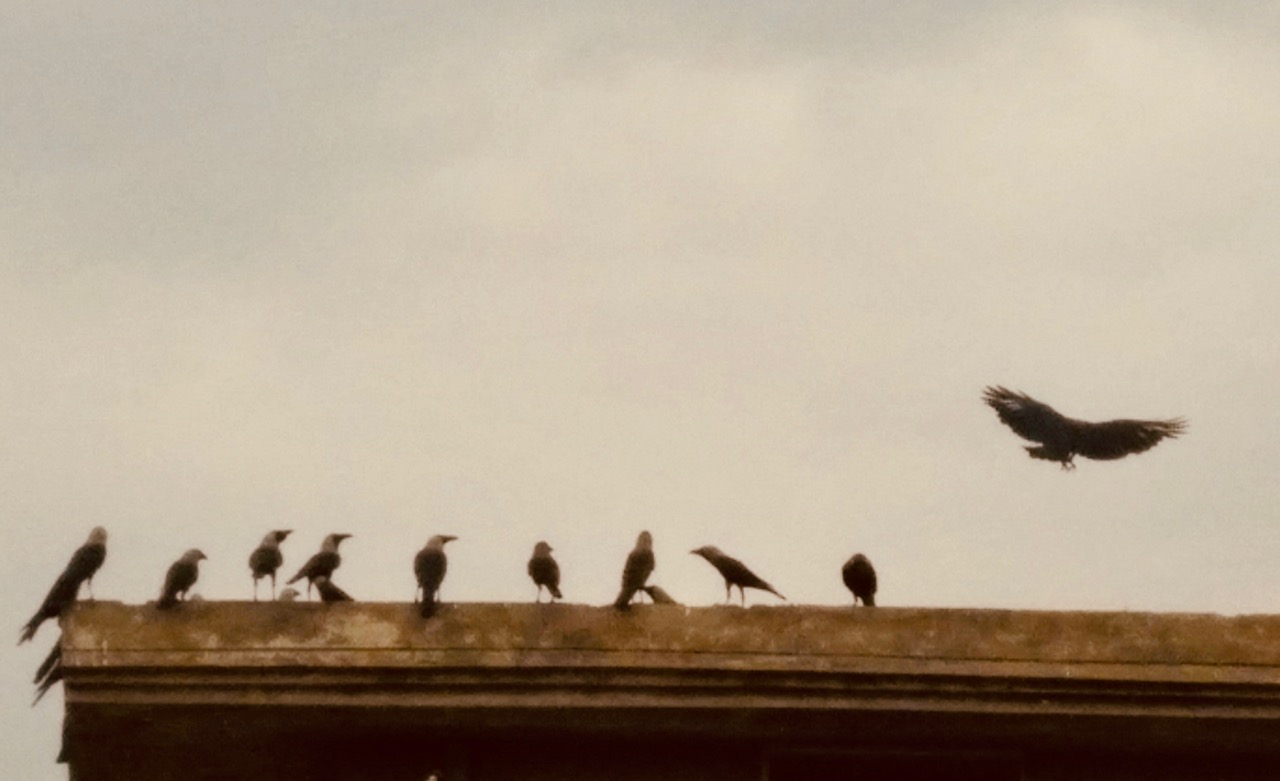
Caged Bird
The free bird leaps
on the back of the wind
and floats downstream
till the current ends
and dips his wings
in the orange sun rays
and dares to claim the sky.
But a bird that stalks
down his narrow cage
can seldom see through
his bars of rage
his wings are clipped and
his feet are tied
so he opens his throat to sing.
The caged bird sings
with a fearful trill
of things unknown
but longed for still
and his tune is heard
on the distant hill
for the caged bird
sings of freedom
The free bird thinks of another breeze
and the trade winds soft through the sighing trees
and the fat worms waiting on a dawn-bright lawn
and he names the sky his own.
But a caged bird stands on the grave of dreams
his shadow shouts on a nightmare scream
his wings are clipped and his feet are tied
so he opens his throat to sing
The caged bird sings
with a fearful trill
of things unknown
but longed for still
and his tune is heard
on the distant hill
for the caged bird
sings of freedom.
A fragment of my personal history in celebration of International Women’s Day and in memory of my own mother, who played such an important part in shaping my ideas. Visit the Indian Memory Project to read the full piece which I wrote in 2013.
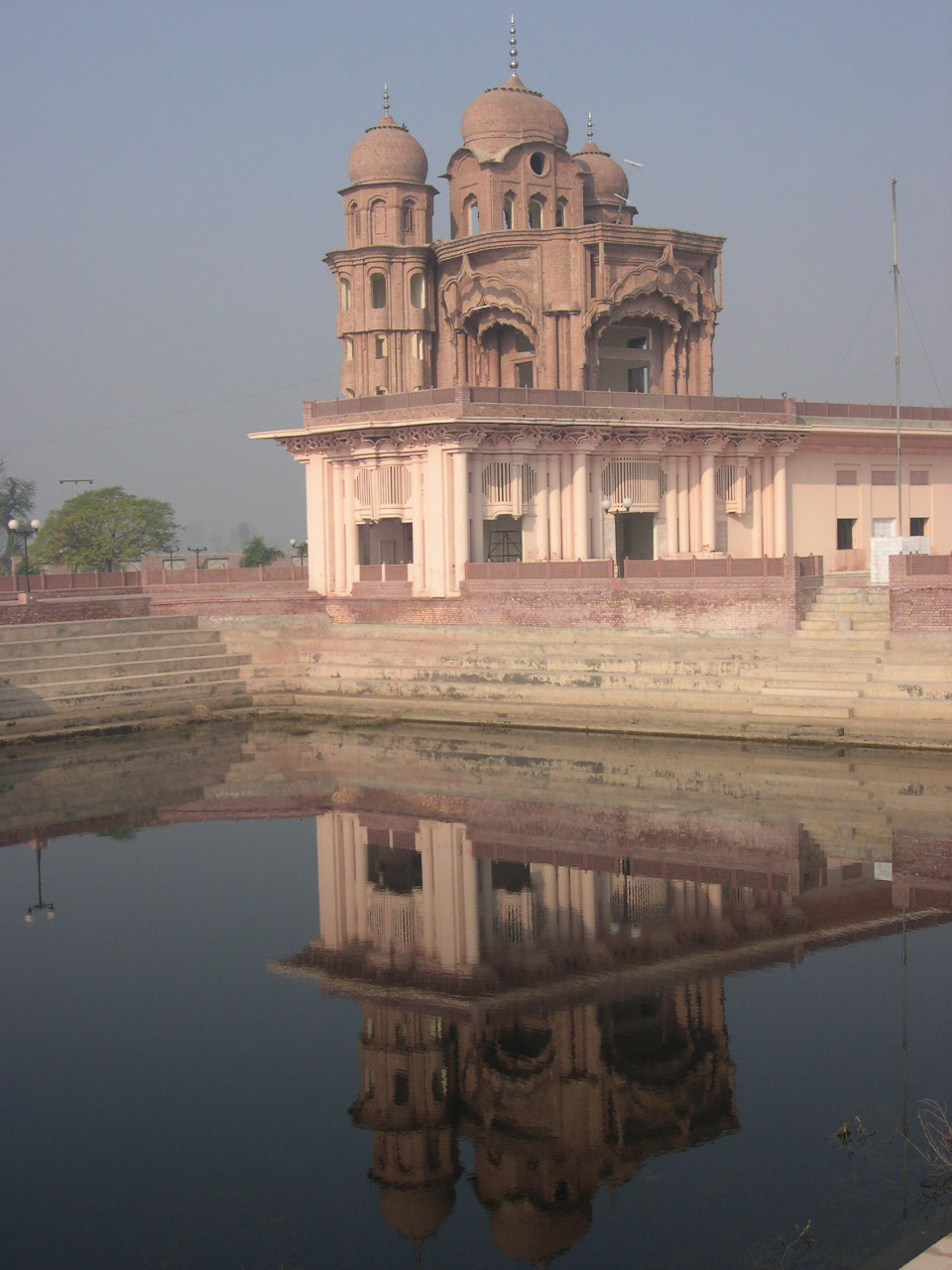
Gurdwara Sri Rori Sahib, Eminabad, Gujranwala (c) 2004 Pippa Virdee
A reflective essay on the lack of women in history writing and Punjab history. This was originally published in The Friday Times, 5 July 2019.
My first visit to Pakistan was in 2002. It was primarily to do research as a PhD student. At that time, I came with the religious baggage of belonging to a Sikh family and venturing into the known unknown. When I finally got my visa, I was very excited about travelling to the ‘near other’; unknown yet somehow familiar. After all, I rationalised, the cultural region of Punjab is, well, Punjab across both sides of the Radcliffe Line. And so, the journey into Pakistan’s history begun, a space in which the personal and the academic intermingled and boundaries became a metaphor for more than just the relationship between India and Pakistan.
The Sikhs in Pakistan are a small community; one of the smallest minorities in Pakistan. Exact numbers are difficult to estimate but they vary from around 6,000 to perhaps 20,000. They are largely concentrated around places like Peshawar, Nankana Sahib and Lahore. The interesting thing is that apart from the ethnic Punjabi Sikhs, many of the Sikhs that remained in Pakistan after 1947 were Pathan Sikhs. The latter were scattered in small numbers across Balochistan, Federally Administered Tribal Areas and Khyber Pakhtunkhwa. Most have been forced to relocate since, often seeking sanctuary in numbers. Though small, the Sikh community over the past few years has come to enjoy some state patronage. In an otherwise ‘Islamic’ milieu, Sikh men are easily identifiable by their turbans. Added to this are the old persistent colonial stereotypes of the Sikhs being a ‘martial’ race (even in Pakistan). And of course, the ‘Khalistani’ Sikhs have the sympathetic ears of the Pakistan establishment since the early 1980s. Thus, in Pakistan today, the medieval shadow of the Sikh-Muslim rivalry of Mughal India, as well as the pall of 1947 have receded to create a strange co-existence and a convenient acceptance of current realpolitik rather than a bitter dwelling in the past. However, this convenient relationship does not necessarily translate easily or well in the Sikh diaspora, especially here in the United Kingdom, where I am based.
While my main purpose for visiting Pakistan in 2002 was for my doctoral research, there was inevitably an interest to visit Sikh Gurdwaras and shrines; those remnants of pre-1947 which still existed. I have subsequently visited Pakistan more times than I can remember and have seen the changes in many of these shrines and their localities. Over the last 15 years, there has been a transformation of many of these shrines; from being small and poorly maintained to now being considered as one of the growing areas for pilgrim tourism in Pakistan. Every year, especially at the time of Vaisakhi and Guru Nanak’s birth anniversary, pilgrims come in their thousands from the UK, USA, Canada, which are home to significant Sikh diaspora communities. Depending on political temperatures, Indian Sikhs also make this pilgrim trip. For instance, this year, the Government of Pakistan issued 2,200 visas to Sikhs pilgrims in India for Vaisakhi. There is much trepidation amongst these of falling under the radar of intelligence agencies on both sides. Beyond the politics of two paranoid and securitised states though, growth in this tourism has benefitted local communities, as infrastructure around the ‘important’ shrines has improved to facilitate foreign tourists. These bring in the much-needed foreign exchange. They travel, stay, eat, drink, shop and thus spend their foreign currencies in Pakistan and, ultimately, some of this does make its way into the local economy. But this development is localised and centred around a handful of shrines, with the majority still largely neglected.
Social media and its ability to connect across borders, has spurred on a handful of people to seek adventure in Pakistan and document the ‘lost’ history of the Sikhs. Conversely, there has been more interest in these forgotten histories within Pakistan too. Combined with increased pilgrim tourism, there is almost a fascination and a sense of lost kinship that many Sikh Punjabis have with Pakistan and Pakistani Punjabis. These complex historicised feelings are under-girded by a common language, culture, biradari connections, and bhaichara. There is an old romantic connection that many have with reaching Lahore (formally Maharaja Ranjit Singh’s capital) captured in the phrase, Jis Lahore Nai Dekhya O Jamyai Nai/ Jine Lahore Nai Vekhya O Jamya Nai, meaning ‘One who has not seen Lahore has not been born’! This has been recited countless times and it helps to maintain the old pluralistic image of colonial Lahore. In this quest then, for the lost history of Sikhs in Pakistan, there has been a profusion of activity which has generated research in universities, fictional/non-fiction literature and pictorial books on Sikhs. These latter easily detract and divert from the difficult issues of politics, while sticking to the sites of nostalgia and neglect. Even the research at Pakistani universities (not exclusively though) is largely focused on the Ranjit Singh period (1801-39). When the bearded young man boasts of Ranjit Singh, of the contribution of the Punjabi (but usually Sikh) soldiers, of the great martial tradition, they rarely give women a thought.
These histories perpetuate and create a myth of the splendour associated with this lost history of the Sikhs. Even hard leftists have a soft spot for an otherwise unelected, unrepresentative, hereditary maharaja. While this greater interest and curiosity amongst scholars and students is welcome, it also serves to reinforce old stereotypes by avoiding the more difficult question of the broader issue of non-Islamic histories of Pakistan. Moreover, the study of history and its periodisation retains much of the colonial interpretations, hardly allowing us to interrogate these boundaries intellectually and dispassionately.
In the quest for academic “impact” and to connect with the general public, many academics in the west have been compelled to promote themselves. Social media again has been the route for this seemingly altruistic self-promotion. Articles, blogs and personal posts on social media, of travelling around Pakistan and bonding with the locals, for people’s immediate consumption and gratification. Moreover, the Punjabis express this in their usual flamboyant style of visiting their ‘lost’ Punjab, bonding with the local Punjabis and then sharing these ‘amazing’ bonding experiences. On closer inspection though, these all have something else in common. They are all invariably shared by men and are about their fraternal experiences. Statistically, we know that on average women are 26 percent less likely to own a mobile than men and 70 percent less likely to use mobile internet. Naturally, this means less women are visible and even when they are, they use it differently. Women largely use social networking to make connections and keep in touch with family or friends, in contrast men use social media to gather information they need to build influence. In South Asia, this discrepancy stems from the fact that men usually have better educational opportunities, have mobile phones, have greater levels of digital literacy, and this advantage over women fuels their privileged status.
Much of this social conditioning starts from the home, through to schools and universities. The social system perpetuates and emboldens men, making them entitled from a young age. As young women, we often have to fight our way to pursue our aspirations and dreams. Wanting to study politics and history at university for me was not easy because this was not considered an appropriate subject for a girl, even though it eventually reaped rewards. Universities themselves are supposed to be some of the most intellectually progressive spaces but actually they are not. They are just a reflection of society itself. They have the same prejudices and reflect the same class, caste, gender biases that society has. This is reflected in the largely male student body in South Asia, and although the number of girls is increasing and often, they perform better, many still see this as way of improving their choice of marriage partners. This is not a criticism of their desire to improve their lives, but rather a reflection of the limited value of education. The staff fraternity also tends to be male-dominated, especially the senior staff. Although this is no better than in the UK where the Royal Historical Society recently published a study on Race, Ethnicity and Equality (2018) and found that there was an over-whelming dominance of white male professors compared to females and the numbers are even smaller for those from Black and Ethnic minorities.
These centres of learning, therefore, do not reflect the voices of everyone because even here, the skewed societal power structures remain intact. Men control the institutions and therefore they control the narrative. They are the gatekeepers of knowledge and learning and without challenging these structures the narrative cannot be changed.
My experiences of being a (Sikh) woman living and working in Pakistan (largely Lahore and the Punjab) has been quite ordinary in many ways and extraordinary in other ways. I have never been given a free taxi ride; unlike the numerous accounts one reads of visiting Sikhs (i.e. Sikh men) who have struck a long-lost kinship with the taxi driver, who then from the kindness of his heart refuses to charge the client. In fact, I have struggled to speak with taxi drivers and men in public spaces in Punjabi because they consider this to be impolite. Unlike men, I am usually compelled to speak in the Urdu, which imposes a certain level of distance and formality to the conversation. While I cannot have my ‘bromances’ with most of those around me, I can, however, quietly enter the zenana spaces. And these, like the history pages that neglect them, are often hidden away.
I have learnt over the years that women, whether in South Asia or in the West, do not boast of their achievements. They work like ants, running around, keeping busy and building structures out of crumbs. The obstacles they encounter en route can be difficult and they are not always successful. More often than not they will encounter men who are in positions of authority and wield substantial power over the lives (and bodies) both in the home and the outside world. And the outside world is designed by men and for the needs of men. They would rarely acknowledge the privileged position they have in the home and the outside world and the freedom this gives them.
While I have spent many years working in Pakistan, on Punjab’s history, I have rarely felt the need to write about my “non-academic” experiences. The motivation has largely come from the fact that despite all these years, there is still not enough progress and even today there are few female historians coming forward. Even today we are judged on how we look, what we wear rather than what we think and write. Intellectually there is a stale and over-bearing concern for constantly writing about conflict, nationalism, religion, battles, and hero-worshipping; a reflection perhaps of an insecure male society that seeks glory from former victories to validate its present. The only way we can get diversity in the way we view and write about our history is to have that diversity in the people who write it. As a society we need to challenge these hyper-masculinised and hyper-nationalised histories that distort our past and shape our future. If we want to be part of the narrative, we have to take responsibility for writing it. As women we need to make ourselves visible in both the past and the present.
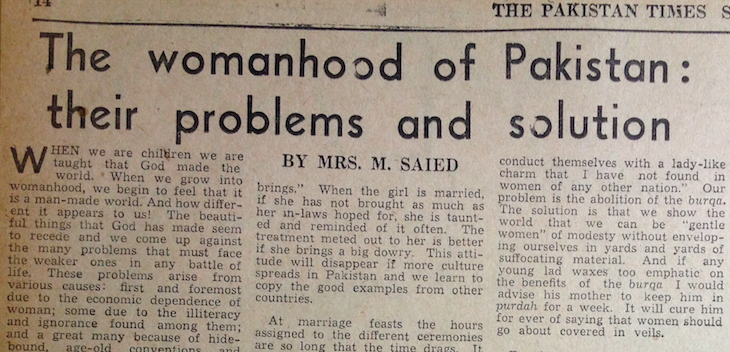
This is a small section from a discussion on the problems and solution regarding women in Pakistan. It is a full page piece written in The Pakistan Times Supplement, there is no information on the writer, other than her name, Mrs M. Saied. It offers a detailed discussion/opinion on women in relation to education, purdah, tradition, customs, marriage, economic dependency and more.
THE PURDAH
One of the greatest enemies of womanhood in Pakistan is the rigid religious code that tradition seems to demand. There is no code or rule or law, ancient or modern which has been passed for the whim or amusement of those in authority. Necessity of some kind or the other has demanded the code and it has been given out as a law to be obeyed. The only trouble in Pakistan is that traditions which are not now necessary are still being followed. Take purdah the biggest bone of contention between the bearded maulvis and the “Europeanised” young men and women. Which Muslim country is observing purdah with the rigidity with which people in Pakistan do? Yet we acknowledge they are Muslim countries. When their men and women come here, we embrace them and hail them as our Islamic brothers. Yet if a Pakistani woman is without a burqa what pious hands of Ya Allah Tauba! are lifted to heaven and the women are told that they are not Muslims but Kaffirs. Why? Is the purdah a hukum for only Pakistani women? I would request all pro-Purdah people to remember that if a Turk, Irani, Iraqi, Arabian or Egyptian woman without a burqa is a Muslim, so is the Pakistani woman who goes with no veil. Whether to be in purdah or to be out of it, worries many women. For the future of womanhood in this country, the girls should be allowed to lead their lives unburdened by the burqa. This will teach them to face the world untrammelled by the handicaps that a woman brought up in burqa suffers from. The other solution is that those already out of burqa should behave in a modest manner. I do not mean that they should sit or walk with hesitant steps and downcast eyes. No, but rather a quiet gentle manner of speech and behaviour. During 1944 in Calcutta, a British Colonel, talking of the W.А.С.ls said to me, “The Indian (pre-partition days, remember) girls never seem to lose their dignity.
Even the eighteen-year old girls conduct themselves with a lady-like charm that I have not found in women of any other nation.” Our problem is the abolition of the burqa. The solution is that we show the world that we can be “gentle women” of modesty without enveloping ourselves in yards and yards of suffocating material. And if any young lad waxes too emphatic on the benefits of the burqa I would advise his mother to keep him in purdah for a week. It will cure him for ever of saying that women should go about covered in veils. For those girls who have to attend schools or colleges and who do not go in buses but have to walk there in groups of three or four; for those who might take an outing with other women neighbours and friends; for those who make up a picnic party or who decide to go to a cinema show there is the loathsome problem of goondaism. It fills me with horror, I feel as if I am touching something putrid when I have to talk of this. This is nevertheless a very present and definite problem for women in Pakistan.
Three girls of school age used to pass along a certain road every day. And every day a certain young man would call out to them, telling them. The girls would go along their way in silence. The third day of this occurrence, when the same young man began to pass remarks, the tallest of the girls turned round, snatched the cane which the young fellow was carrying and gave him the beating he was itching for! The passers-by collected; cries of “Shabash! Zindabad! Changa! Changa!” rang out on all sides. The boy was taken to the Police Station. The three girls still pass on that road on their way to school.
If the women have courage, they will in time get rid of these goonda elements. Let there be no secrecy, no false shame about these occurrences. They must all be brought to right. When public opinion condemns a thing or a person, it has to go. Pressure from all sides must be put on the Government that they should deal very harshly, mercilessly and with absolute justice when a goonda is caught in any act of molestation. Women here are just getting used to the outside world. They must be given adequate protection to step out and be as free to move as they require. Instead of this they are jeered at, their personal appearance and their garments are discussed, they are deliberately pushed and shoved.
Heads of male institutions should arrange for lectures on etiquette. By the help of posters and other publicity, every Pakistani should be taught how to behave in the presence of women. It is very sad that in Pakistan there are many so-called educated men who are ill-mannered. They must be punished if seen doing or saying anything unbecoming before a woman.
One problem which does not arise for every woman and is yet of vital importance to the womanhood of Pakistan is that of divorce. There are so many rights which belong to women and which are very clearly given to them by the Prophet himself. When a woman does not observe purdah there are so many who twist and misquote the Holy Quran to prove their point. But when it comes to anything favourable to women and the women themselves quote it, they are told, Oh No, that is not the meaning at all.”
I hold no brief for divorce. It should be the last resort for ending an unhappy married life; but under circumstances which must be judged by an unbiased tribunal, a woman must be given the right to ask for and to apply for a divorce. No stigma or stain should be attached to a woman who is granted a divorce after the case has been judged by Muslim judges. The only way by which women can get these rights is by becoming active in the political sphere. The slogan of every woman here must be Educate, Educate, Educate!”
Problems are solved by everyone concerned doing their bit. And certainly it will be only by raising the standard of the women that Pakistan will find her rightful place in the modern world.
Going through some archival footage from The Pakistan Times I come across this gem from 28 April 1960 in Letters to the editor. Written in 1960 but some of the issues highlighted in the letter still exist even today, especially in the second paragraph. What is also fascinating is how many men were really marrying ‘foreign’ girls during this period? Was it really that prevalent, enough to prompt a letter to the editor? If anyone knows more or knows of such stories please do share these with me.
May I invite your attention to a grave social problem which is becoming more and more acute day by day.
It has been observed that large number of our young men who get an opportunity to go abroad for higher education, professional studies or training come back with foreign wives. This is very frustrating for our own eligible girls. It deprives them of intelligent marriage partners. On the other hand, those who marry these foreign ladies become status conscious and become eager to raise their standards of living. Their wives feel like fish out of water in our society. They cannot freely mix with us due to a great difference in cultural, social and religious background. Naturally, they try to divert their husbands from the country’s social stream. Thus these young men – our own kith and kin – virtually become foreigners in their own milieu. This is no fault of theirs. It is a natural process.
The question is why do these young men marry abroad? The answer is very simple, in our society they have no opportunity to come in contact with girls and hence no understanding can possibly develop between them. It does not need much imagination to foresee the serious consequences of this tendency, which is the product of our defective social pattern and of the ignorance of the parents. If they give their children even a limited opportunity to mix with one another and then chose their life companions our young men will not even dream of marrying aboard, this will make for social integration and give a chance to our girls to contract suitable marriages.


 BAGICHA