Tag Archives: India

Two villages, two nations: Ganda Singh Wala-Hussainiwala


This slideshow requires JavaScript.

The villages of Ganda Singh Wala and Hussainiwala are two villages divided by Cyril Radcliffe’s line. Rather counter-intuitively in these times of Hindu/Sikh India and Muslim Pakistan, Ganda Singh Wala is a village in Kasur District in Punjab, Pakistan, while Hussainiwala is its Indian counterpart, located 11 km away from Ferozepur city. Until the early 1970s, this was the primary border crossing between the two countries but it now only functions as a ceremonial border. Like Wagha-Attari, the now-primary border crossing between India and Pakistan, there is a daily Retreat Ceremony with the lowering of the national flag. There are, however, a few differences between the two ceremonies as Ganda Singh-Hussainiwala is generally not open to foreign tourists and is therefore more intimate with fewer attendees coming largely from the local area. The seating, especially on Ganda Singh side, is right next to the Pakistani Rangers and thus provides a spectacular viewing of this daily spectacle.

While restricted to mostly locals, there remains some jingoistic overtures around it; more palpable during tense times between the two countries. The ceremony lasting 40 minutes, is shorter than the Wagha-Attari version and has less of a fanfare and build-up. People loiter around, catching the opportunity to be close to Indian/Pakistani people and take photos of the Rangers and Indian BSF. According to Ferozepur district’s webpage (http://ferozepur.nic.in/html/indopakborder.html), there was no joint parade and retreat ceremony here until 1970. It was apparently, “Inspector General BSF, Ashwani Kumar Sharma, called upon both authorities to have joint retreat ceremony and since than it has become a tradition”. In 2005, there were discussions about opening this border crossing, to no avail. Today it is easy to forget that this was once a thriving check-point. In 1970, Paul Mason, while travelling the sub-continent, excitedly crossed the border from Ganda Singh to Hussainiwala. He recalls this experience in his travelogue, Via Rishikesh: an account of hitchhiking to India in 1970 (2005):

“In the morning we have little difficulty in locating the Ministry of the Interior and are supplied the necessary chits which give permission for us to travel along the restricted road to the border. For the sum of two rupees apiece we obtain bus seats and are soon headed off down the dusty track, but the trip is much longer than I expect and it is mid-afternoon before we arrive at the Pakistani customs of Ganda Singh Wala.

At the customs post on the Indian side of the border, a worryingly intelligent young woman who reminds me much of my elder sister Margaret deals me with. I do my best to conceal my anxiety about the concealed roll of banknotes. She eyes me carefully and exchanges a few words with me before turning to the next in line without first acquainting herself with the contents of my underpants.

We have made it to India! We are here in India! At last! Amazing, amazing, amazing!

I take a look at stamp in my passport; it states simply; ‘ENTRY 16-10-70 Hussainiwala Distt, Ferozepore’ – not even a mention of India! Oh well, we’re here, and that’s all that counts!

We follow the flow of other new arrivals along a path beside a wide still river [Sutlej]. There is also a disused railway track, which presumably used to connect the two countries.”

[See full account: http://www.paulmason.info/viarishikesh/viarishikeshch16.htm]

We see from Mason’s account of the simplicity through which he crossed the border with only a slight mention of Ganda Singh and Hussainiwala printed in his passport (pictures of the entry stamps are available on his website above). Today when crossing via the land route, there is a clear stamp with Attari (India) and Wagha (Lahore) in the passport. Mason also mentions the hundreds of cars left abandoned at the border because it was too costly to take them across. But, this was at least possible to do then; impossible today. Equally, the disused railway track lies there abandoned but remains as a reminder of the two broken halves.

Ferozepur, India is the land of martyrs and Hussainiwala is the site of the National Martyrs Memorial, where Bhagat Singh, Sukhdev and Rajguru were cremated on 23 March 1931. This is also the cremation place of Batukeshwar Dutt, who was also involved in bombing the Central Legislative Assembly with Singh. Bhagat Singh’s mother, Vidyawati, was also cremated here according to her last wishes. Interestingly, the spot of the memorial, which is only 1 km away from Hussainiwala and on the banks of the Sutlej river and built in 1968, was originally part of Pakistan. On 17 January 1961, it was returned to India in exchange for 12 villages near Sulemanki Headworks.

Read ‘Making of a Memorial’ by K. S. Bains, http://www.tribuneindia.com/2007/20070923/spectrum/main2.htm

-, ‘Shaheedon ki dharti’ in The Tribune: http://www.tribuneindia.com/1999/99jul03/saturday/regional.htm#3

See a short clip of the ceremony at Ganda Singh Wala: https://www.youtube.com/watch?v=vZR-eLVYo6s

From before and beyond the international border that divides them, there is a story that connects these villages. Majid Sheikh writes about the ‘Spiritual connect of two villages’ in Dawn and brings out their historic connections. To commemorate a highly decorated soldier, Risaldar Major Ganda Singh Dutt, the British had named this village after him, while the village Hussainiwala derived its name during colonial days from Pir Ghulam Husseini, whose tomb is now in the BSF headquarters. Today they exist as two halves of the same story.

Read ‘Spiritual connect of two villages on both sides of the divide’ by Majid Sheikh: https://www.dawn.com/news/1379906

Ludhiana’s Clock Tower (Ghanta Ghar)

Ghanta Ghar is one of the most iconic landmarks of Ludhiana city. It stands tall amongst the hap-hazard development of the industrial city. Previously it was the pride and the centre piece of the historic area of Chaura Bazaar, which was the hub of economic and political activity in the city. Located at the entrance of the commercial centre, the Clock Tower was and still remains a landmark in the city’s landscape. The railway station is conveniently located a short (walking) distance away from the Clock Tower, allowing for trade activity to flourish easily in the area. Apart from commercial activity Ghanta Ghar also attracts political activities, as it is a convenient location to hold political party protests and dharanas. Today the Clock Tower has receded into the background as a flyover dominates the urban landscape. Although, Ludhiana as a city has grown manifold since the Ghanta Ghar was built, and much of the commercial activity has moved to The Mall Road or Ferozepur Road, Chaura Bazaar still remains popular amongst old and new inhabitants. There is the old charm of the traditional sub-continental bazaar with its nooks and crannies. The narrow lanes, tucked away behind the wide and partial Chaura Bazaar, remain hidden gems for jewellery – gold, silver or artificial. And then there are the scrumptious aloo tikkis, gol guppas and chaats to satisfy the hungry shopper. It is a shame that the Ludhiana Municipal Corporation has not invested more in the city’s historic sites and made more of these places. But, this is part of a wider problem with preservation of heritage and history in the sub-continent.

The history of the Clock Tower, of course, evokes the British colonial heritage: Ghanta Ghar/Clock Tower was designed by the then-Municipal Chief Engineer of Amritsar, John Gordon. The design reflects the traditional European Gothic style and uses an interesting red brick, which is striking even amongst the colourful and vibrant Chaura Bazaar. Although the construction began in 1862, it was not officially inaugurated until 1906 by Sir Charles Montgomery, who was the Lieutenant Governor of Punjab, along with Diwan Tek Chand, Deputy Commissioner of Ludhiana.

Ludhiana actually came under British rule in 1835, when Rajah Sangat Singh died. The Gazetteer of Ludhiana District (Punjab Government, 1888) notes that it was under Sir Claude Wade (1823-38) and his successors that the town increased in its size and importance. Trade expanded, and Ludhiana became a centre for trade in grain, sugar, cloth. The small presence of Kashmiri weavers (approximately 8-10 families) expanded after the famine in 1833 to around 1,500-2,000 Kashmiris, who settled in the town. Following the Sutlej campaign (1845-1847), Ludhiana district was formed, and the civil offices were removed to the cantonment side of the city. In 1854-55, the Grand Trunk Road was metalled and realigned to its present position.

The opening of the Railway from Delhi to Lahore in 1870 undoubtedly gave a great stimulus to trade and commercial activity in Ludhiana. In addition, the number of shops and sarais along the Grand Trunk Road, facing the station were also growing. According to the Gazetteer, the new town to the south of Chaura Bazaar had all the hallmarks of being modern. The streets were wide and straight, and the houses and shops were uniformly designed, giving them a modern appearance. ‘The principal streets, the Chaura Bazaar and the Hazuri Sarak, were designed by Sir Claude Wade himself; and, one of his projects, the Iqbal Ganj, is a standing proof that he was rather too sanguine about the speedy development of the two for which he did so much’ (p. 216).

The population of town was modest compared to the 1.6 million people living in the city today. In 1868 Ludhiana had 39,983 (Males 21,701 and Females 18,282) and in 1881 this rose to, 44,163 (Males 24,685 and Females 19,478)

CENSUS REPORT 1881

Total Population – 44,168

Hindus – 12,969; Sikhs – 1,077; Jains – 752; Muslims – 29,045; and Others – 320

The population of Ludhiana started to grow, most likely with opening of the railway and consequently the establishment of the town a collecting centre for the grain traffic. But in 1878, there was a huge loss of life due to malaria fever following the monsoon season. It was estimated that around 6-7 per cent of the population died especially, ‘half-starved Kashmiris and others of the lower classes not having sufficient stamina’ (p. 217). According to the 1881 census, the town was overwhelming Muslim and indeed even in 1947, Ludhiana was a Muslim majority town. The city today is dominated by the Sikhs but there are still some remnants of a former history scattered around the city, like the Ghanta Ghar and Chaura Bazaar.

From the archives: 2 letters – Patel to Nehru

Nehru & Patel

62 (II), Patel to Nehru, 7 November 1950:

My Dear Jawaharlal, [in hand-writing]

I am most grateful to you for your affectionate greetings and good wishes on my birthday and for the very kind terms in which you have conveyed your message to the public meeting at Ahmedabad. It is my earnest and heartfelt prayer that I continue to serve my country up to the very end and that I live long enough to see it emerge happily out of the critical period through which it is passing. Whether God will answer my prayer is in the lap of future, but your affection and leadership sustain my faith in it and your appreciation gives me strength and support for which I am deeply obliged.

With love,

Yours Vallabhbhai Patel [in hand-writing]


63 (II), Patel to Nehru, 14 November 1950: 

[Entirely handwritten]

My Dear Jawaharlal,

My affectionate greetings on your birthday. Relations between us transcend formalities and I need hardly say anything more than this: it is my fervent and heartfelt prayer that you may live long and well to lead the country through all difficulties and establish in it an era of peace, happiness and prosperity. I so much wanted to come to your place since this morning but I have been feeling out of sorts since yesterday and I could not do so.

Yours Vallabhbhai

From Ambedkar to Mayawati

This slideshow requires JavaScript.

Patangbaazi greets one at the magnificent Parivartan Sthal (Ambedkar Memorial Park) complex constructed by the orders of Chief Minister Mayawati and completed by 2009-10. It is a park today and has from khomche to ice-cream, from couples to families, from beggars to bourgeoisie and all castes in the midst. Stretching along the river-front, a tourist-spot complete with statues and footpaths, in marbles and sandstones, it has a marvellous sense of space. An extraordinary, larger-than-life and gargantuan assertion of identity, dignity and deities – Ambedkar and wife, Kanshiram and Mayawati on opposite sides – this is not merely a reclaiming, recovery of history. It is not even an attempt to re-write history. This set-up, so reminiscent of the Lincoln and Luther King Memorials in Washington, is a grabbing of past and present by its throat and laying down a marker for future. 

The geometrically precise, expansive space – rational and theistic with its human-Gods – has a jarring note struck by the VIP Lounge on one side of the entrance with the other side being for reserved for others. One long path takes tourist-pilgrims to a stupa-hill, rock-cut alignment with huge mural depictions of Ambedkarite Buddhism from deeksha to nirvana. Hues of blue lighting enhanced the sandstone, soil-coloured backdrop amidst which stood exceptionally well-done, real-life-likeness statues. Ambedkar is sitting majestically in the Lincoln pose in the sanctum-sanctorum. On the circular walls, on one side, Ambedkar is ‘giving’ the gift of Constitution to Babu Rajendra Prasad, the upper-caste Chairman of the Indian Constituent Assembly and on the other, Ambedkar is shown receiving the gift of deeksha from a Baudh-Bhikshu. 

Guest Post.

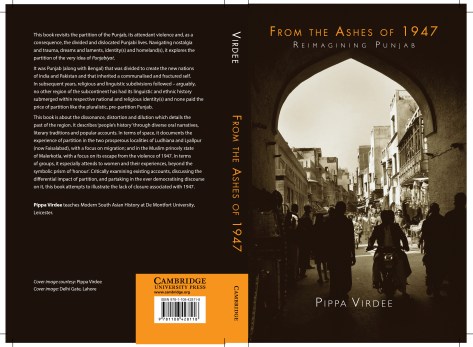
From the Ashes of 1947: Reimagining Punjab

From the Ashes_Full Cover

Full details: From the Ashes of 1947

Watch the panel discussion with Pippa Virdee (De Montfort University, UK), Afzal Saahir (Poet and Radio Host) and Sajid Awan (Quaid-e-Azam University) of my book From the Ashes of 1947 at the Afkar-e-taza, January 2018 Panel Discussion

Living in Coventry: from Thatcher to May

Screen Shot 2017-12-11 at 15.18.21This week Coventry successfully won the bid to be the city of culture in 2021. Subsequently, there have been numerous articles about Coventry in the media, reflecting both the history and lived experiences of the city. The response has also been mixed in the sense that some people have continued to dwell on the lack of culture and “beauty” in the city, and in part this is true. The more optimistic see this as an opportunity to revive the glorious past with renewed energy.

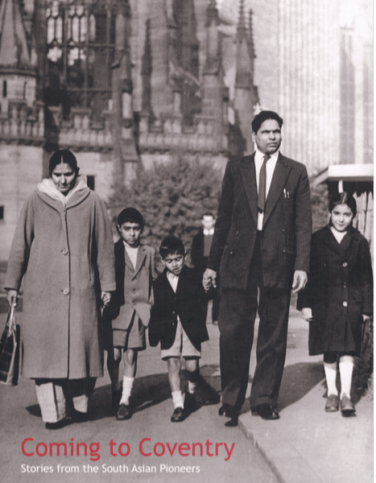
As I reflect on the city’s bid to become the city of culture, I remember an oral history project, which I did in 2005-6, Coming to Coventry. It was funded by the HLF and supported by The Herbert and documented the migration of South Asians to Coventry from the 1940-60s. We collected over fifty oral accounts of people, who migrated here and, through these testimonies and the beautiful pictures that people shared with us, we documented their journeys to Coventry in search of a better life. Many of the early migrants had intended to go back home but gradually, some of them made Coventry their home. They contributed to the growth and development of the city in the heyday of the post-war years. The 1970s were, of course, to bring about change and the consequent downturn was not kind to Coventry.
The time through the duration of the project gave me an insight into the city, which I did not fully comprehend before. It made me reflect on my own experiences of migrating to it. Coventry is a city that I came to, not out of choice but as a child accompanying my mother. At the time, I had no preconceptions of the city and my response was only that of a child, who could not quite understand the upheaval of migration and dislocation to a “foreign” land. It could have been anywhere and I suspect the response would have been the same. Nonetheless, Coventry became my home while growing up in 1980s Britain: a challenge in itself. In the backdrop were Thatcher’s Britain, the Falkland’s war, the vibrant music of the 80s, racism and the declining car industry in Coventry. Gradually the former car plants gave way for housing and retail parks. The city changed and adapted, as did I. But the years of the Thatcher administration left its mark on me, especially when I was beginning to see and understand the society around me, even though the Prime Minister would have us believe that there was no such thing as society. Studying politics, sociology and art seemed to me a perfect combination in response to the excesses of Thatcherism.
The pursuit of knowledge led me to University and I had two choices, University of Warwick or the newly created Coventry University. Despite having a place at the former, due to personal circumstances, I chose the latter. I had felt out of place at a visit to the former and besides, something caught my eye on the courses offered at Coventry University, namely, the opportunity to study the history of India and Pakistan – from where I and my parents originally came from. As that has become my life’s calling, I have stayed in Coventry, despite subsequent other opportunities. There is something quite strong and resilient in the city, which has kept me here, in my adopted home of over three decades. It is, as many have pointed out not the most attractive city and lacks many amenities, yet, there is a subaltern robustness and romance to Coventry. The city, for all its drawbacks, is standing, attempting to reinvent and reimagine itself. For me, it provides my base, which is provincial, on-the-margins and of the under-dog; these feed the spirit and space to keep hoping and doing.

Lucknow: the Awadhi ‘heartland’.

This slideshow requires JavaScript.

Lucknow is the capital of the Indian subcontinent’s Awadhi ‘heartland’, in historian Gyanesh Kudaisya’s evocative words. Less evocatively, it is the capital of the Indian State of Uttar Pradesh (UP) and its largest city with a population of three million people, of which 26 per cent are Muslim. It is the centre of Shia Islam in India, historically the capital of Awadh, it was one of the major centres during the rebellion in 1857, the cultural capital of north India and home to the famous Chikankari embroidery work, thought to be popularised by Nur Jahan. The Nawabs of Lucknow were known for their refined tastes as much as their extravagant lifestyles, and the city has most beautifully been captured and bought to life in the 1977 film, Shatranj ke Khiladi that was based on the Hindi short-story of the same name by Munshi Premchand  and the 1981 film, Umrao Jaan that was based on the Urdu novel Umrao Jaan Ada by Mirza Hadi Ruswa. Set in mid-nineteenth century Lucknow, they show the decadence of the Lucknavi high society through the life of Nawabs and courtesans, the moral decay/hypocrisy around their lives in the backdrop of political intrigue and rebellion. Shift to the present-day Lucknow/UP and the state is better known for returning a thumping win in the state election of 2017 for an ascending Hindu ‘nation’ led by Narendra Modi and, in return, finding itself being ruled by a Yogi. A milieu previously famous for its adab-tehzeeb is now the habitus of Adityanath and his terrific to many, terrifying to some, presence.

A recent visit their began at the annexe of the Charbagh station, past the pillars of the fly-overs of the-then on-going metro constructions and a rather tasteful red-and-white façade of the Charbagh metro-station with its Jali décor; apropos which my auto-wallah remarked, ‘Akhilesh ne kaam to bahut kiya par chacha ne harwa diya’. In no time, we were in old Lucknow; the narrow, congested streets of Aminabad, where the first thing noticeable was that while many shops had named the lane we were on as Latouche Road, others had it as G.B. Road, for, Gautam Buddha. The incongruity of being in a space that marked its time from both the British Lt-Governor Sir James Latouche (AD 1901-06) and the Shakyamuni Siddhartha (563-483 BC) did not end there. It was also reflected in much of the arms, air guns et al, and ammunitions market on one side being stared at by hundreds of chickens from their kens in many of the poultry-khanas on the other. While the arms stores dated back to 1933, 1940s-50s, prominent among these being Gupta Brothers, Hashim Manzil, with their colonial, hanging, dilapidated balconies, small windows, tapering and peeling pillars, darkening, decaying visage, plants growing out of lime plastered walls, the poultry-khanas seemed without pedigree. Amidst this sea of noisy chatter around the selling of guns and the stoically silent birds, there was also a serene and strikingly yellow-coloured masjid/madrasa and its school of calligraphy. It plainly stood apart and alone in its intent and purpose.


“The real meaning of life”: the tomb of Khwaja Khizr

The city of Sonepat, in present day Haryana State, hardly has anything of note for the wandering and curious tourist but surprisingly there are a few gems hidden away. Tucked away in the semi-urban landscape is the tomb of Khwaja Khizr, surrounded by a lush green garden, buffaloes and residential housing. Standing tall and elevated on a mound is the tomb, overlooking the city of Sonepat. Local residents and the accidental tourists looking for scenic open spaces come here and congregate around the garden. Relaxing in the open air, families surround the tomb, passing time or having picnics; children play games and make merry. And the occasional visitor ventures inside the tomb to pay their respects or simply out of curiosity.

This stunning tomb was built over the remains of Khwaja Khizr. According to a Persian inscription on the site, Khwaja Khizr was the son of Darya Khan Sarwani. Darya Khan himself was an influential noble in the court of Sikandar Lodhi. Work commenced on the tomb in 1522 and was completed by 1524 by Ibrahim Lodhi.

Latif writing in 1889 notes:

Sikandar Lodi died in 1517 in Agra, his son Ibrahim Lodi ascended the throne. Dissatisfied with the court of Delhi, Doulat Khan Lodi (Sikandar’s uncle and viceroy of the Panjab) sent his agents to Kabul to urge Baber, the Moghal prince, a son of a great-grandson of Tymur, to attempt the subjugation of the empire of Hindostan, in imitation of his ancestor’s conquests. Baber, accordingly invaded India in 1526, and a battle was fought between the Moghals and Indians on the plains of Panipat, a battle-field on which the fate of India has so often been decided. This memorable battle, which was fought on the April 21, 1526, resulted in the victory of Baber. Ibrahim Lodi, the last of the dynasty, was slain on the field, and by his death a new dynasty under the Moghals was established. The reign of Ibrahim Lodi had lasted twenty years and the dynasty to which he belonged seventy-six in three successions, from 1450 to 1526. (Syed Muhammad Latif, History of the Panjab, 1889)

Locally Khwaja Khizr was revered as saint; he apparently renounced his courtly lifestyle in favour of pursuing a simple life inspired by the Sufi tradition. Like many before him, he was in search of the real meaning of life. Carefully leaving their shoes/slippers outside, the occasional devotees go inside the tomb to pay homage, lighting an incense stick, leaving offerings and tying treads for manants. The syncretic tradition associated with this historic land still finds places to hide-away and co-exist. For the curious visitor, the tomb itself is a rare example of being built with kankar (variety of limestone) blocks and red sandstone. The wide staircase leads to the two-arched gateway. The Indo-Islamic style of architecture sympathetically reflects the fusion and syncretic tradition. While reading around to find out more about the shrine, there was an article which suggests that ‘the tomb was once decorated with blue tiles – now missing – and that it was repaired in 1921-22 at a cost of Rs 130 although the sanctioned amount was Rs 167!’ (http://portofcall1.blogspot.in/2010/12/sonepat-beyond-toughs.html) Although the tomb could certainly do with some more care and attention, it is still worth a visit for the accidental or the intentional tourist who happens to pass by Sonepat. Neglect, whether this is willfully done or not, means that places like these fall into disrepair and with them they erase centuries old histories.

Tomb of Khwaja Khizr (Khijar Makbara and Park) – Sonepat, India https://www.youtube.com/watch?v=sZLZNr9bFdo