Produced by the Films Division, Ministry of Information & Broadcasting, these short news reviews by the Government of India give us a glimpse of old India. Produced one-year after Partition/Independence, the review shows Pandit Nehru in Karachi, messages of inter-communal harmony, tolerance and equality at the Urs of Ajmer Sharif Dargah, elephant diplomacy in the US, dance, theatre and hockey matches.
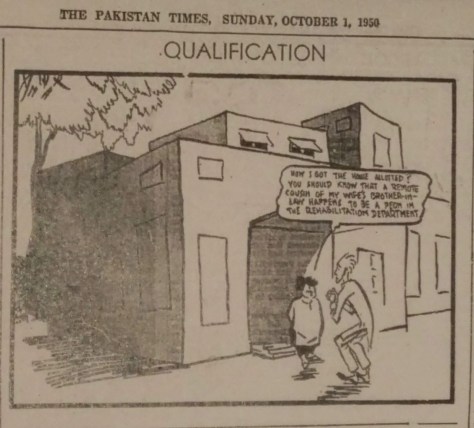
The Pakistan Times, 1 October, 1950. Qualification. “How I got the house allotted? You should know that a remote cousin of my wife’s brother-in-law happens to be a peon in the Rehabilitation Department.”
Located in the heart of the Punjab civil secretariat, Lahore, the octagonal shaped building is a legacy of Emperor Jehangir. The grandeur of the Mughal-era building and the tomb inside is a marvel. After numerous incarnations, the tomb today is home to the Punjab Archives and is more popularly known as simply Anarkali. Taking the name from the celebrated relationship between Prince Saleem (Jahangir) and Anarkali (Sharif un-Nissa aka Nadira Begum), a courtesan in the court of Emperor Akbar. There are many different accounts of this relationship and the death of Anarkali, with little history authenticity. Whether she died naturally or under more mysterious circumstances or whether Akbar ordered her to be buried alive in a wall. We may never know the truth, but the legend and the myth of the passionate affair between Saleem and Anarkali has inspired many.
‘The tomb of Anarkali is one of the most significant buildings of the Mughal period. It is an ingeniously planned octagonal building. Circular in shape and roofed by a lofty dome, the tomb once surrounded a garden, called Anarkali Garden, but during the last couple of hundred years it has been put to several uses. Under the Sikhs, the mausoleum was occupied by Kharak Singh. Later it served as the residence of General Ventura, the Italian General of Ranjit Singh’s army. Under the British, the tomb was converted into Church (a protestant Church) in 1851 right after 2 years of British Control on Lahore. Few years later, it was converted to St. James’ Church in 1857 till 1891. Since then, it has been used as Punjab Archives Museum with an amazing treasure for those interested in the history of British Punjab.’ Story of Anarkali and her Tomb at Lahore.
An extract on the Tomb Anarkali from R.E.M Wheeler, Five Thousand Years of Pakistan: An Archaeological outline. With a Preface by Fazlur Rahman. Royal Book Company, first published in 1950. Page 84.
Anarkali or “Pomegranate Blossom” was the nickname of an attractive girl who was brought up in Abkar’s harem and was suspected by the emperor of carrying on an intrigue with prince Salim, afterwards the emperor Jahangir. The story is variously told, but it would appear that the girl was barbarously executed in the year A.D. 1599. When Salim came to the throne, he strove to make some amends for the tragedy by building a large tomb over her grave. This tomb stands in the ground of the Punjab Secretariat to the south of the old city, and has passed through vicissitudes which have concealed all its original decoration. It is hexagonal on plan, with a domed octagonal tower at each corner, and is crowned by a central dome on a tall cylindrical drum. After 1851 it was used as a Christian church, and for this purpose the arched openings in the eight sides were wholly or partially walled in, a gallery (now removed) was constructed in the interior with an external staircase, and the whole structure was whitewashed internally and externally. The large monolithic marble gravestone had already been moved out of the building in the Sikh period, when the tomb was turned into a residence, amongst the occupants being General Ventura, the famous Italian officer of the Sikh Government. The stone was subsequently replaced by the British within the tomb, but in one of the side bays, not in its original central position. It has been stated that the actual grave was also moved to the present site of the gravestone, but digging in 1940 in the middle of the building revealed the former still intact five feet below the present floor, in its proper place. From accounts of the discovery, the grave would appear to be of plastered brickwork. The building is now used as the Punjab Record Office.
The gravestone bears well-cut inscriptions which include the date of the death of Anarkali with the words “In Lahore” and the date of the construction of the tomb (A.D. 1615). It also bears the ninety-nine attributes of God, and a poignant couplet,
obviously composed by Jahangir himself, which may be translated thus:
“Ah, could I behold the face of my beloved once more,
I would give thanks unto my God until the day of resurrection.”
Elsewhere on the marble are the words: ” The profoundly enamoured Salim, son of Akbar.”
It is for these inscriptions, and for the vast size of the building which reinforces their
sincerity, that the tomb is noteworthy, rather than for any special architectural quality.
Today the documents belong to the people of Punjab at the Punjab Archives are being digitised for posterity, and will hopefully allow historians to view untapped accounts and records. This is a mammoth task but at least the process itself has started. See the project website: http://dap.itu.edu.pk/
Three kilometres from the Indian border, in the tranquil green plains of the Narowal district of Punjab in Pakistan is an unassuming sacred shrine: Gurdwara Kartarpur Sahib. It’s the final resting place of Guru Nanak (1469-1539), founder of the Sikh faith.
On the other side of the river Ravi, about a kilometre inside the border in the Gurdaspur district of Punjab in India, is the bustling holy town of Dera Baba Nanak. Here stands Gurdwara Shri Darbar Sahib, associated with the life and family of the same first Sikh guru.
On a clear day, both are visible to each other. But the Radcliffe Line, drawn in August 1947 between Pakistan and India, ensures that travel for the average Indian or Pakistani is impossible across this international border. India’s Sikh community is roughly around 20m people – under 2% of India’s population of over a billion. More than half of them live in the Punjab, India and are cut off from the most significant shrines associated with the founder of their faith, all located in Punjab, Pakistan.
There had been many times in Pakistan’s history when stupid decisions were taken by the government. Nationalization in Bhutto’s era was one of those decisions. 22 Families lost everything that they had worked for all their lives. BECO (Batala Engineering Company) is one such example.
Late Chaudhry Mohammad Latif was the founder and chairman of the Batala Engineering Company (BECO). After attending a meeting of leading Muslims in Batala, who wanted to establish Muslim industries in the face of Hindu dominance of retail, that he struck upon the idea of forming BECO.The company was established in 1932. , He sold its first 10 shares to a lime merchant for Rs 10. In the early years, he worked almost single-handedly to build up the company from its first workshop in two rooms and a veranda. Over the course of the next forty years, and in spite of losing much of his business…
Located in Bilaspur, Himachal Pradesh, Bhakra Dam is one of the largest dams in India. Construction of the dam started soon after independence in 1948 and it was opened in 1963. Agreement for the project had been signed before independence in 1944 by the Punjab Revenue Minister, Sir Chhotu Ram and the Raja of Bilaspur. However, the idea behind the project was suggested around 1910 by the British. My father worked on the dam during its construction and lived in Nangal for ten years. The dam is unequivocally the dream of modern India that Jawaharlal Nehru had imagined.
This 20 minute documentary is made by Films Division which was a production house for the Ministry of Information and Broadcasting, Government of India. Established in 1948, it regularly made documentary films.
The Nizam of Hyderabad receiving Sardar Patel after Operation PoloExtract from the Sunderlal Report
Operation Polo is the code name of Hyderabad “police action” in September 1948. On Day 5 of this operation, 17 September 1948, the Nizam announced a ceasefire which ended the armed action. The operation led to massive communal violence and violations by the police. This prompted Jawaharlal Nehru to appoint a commission, led by Pandit Sunderlal, to investigate the situation. The findings of the report remained buried until 2013 when it was finally released and was accessible from Nehru Memorial Museum and Library (New Delhi).
Subject File No. 2. Sunderlal Papers, NMML.
We were asked by the Government of India to proceed to Hyderabad state on a goodwill mission and beg to submit our report. The delegation consisting of Pandit Sunderlal, Qazi Abdul Ghaffar and Maulana Abdulla Misri arrived in Hyderabad on 19th November and left for Delhi on 21st December 1948. During this period, we toured through 9 out of the 16 districts of the state, visiting 7 district headquarters, 21 towns and 23 important villages. In addition, we met over 500 people from 109 villages which we had not visited. Further, 31 public meetings and 27 private gatherings…were addressed by the members of the Mission.
At all these meetings, the main problem discussed was that of the creation and maintenance of cordial relations between the communities. Appeals were made to the people to forget the past and to work unremittingly for the establishment of peace and harmony amongst themselves….special emphasis was laid on the objective which was the established of a secular government…Ours was not a commission of investigation or enquiry into events proceeding of following the police action…All the same we feel it our duty to bring to your notice what we saw and gathered in our two weeks.
Killing and Looting
Hyderabad State has 16 districts comprising nearly 22,000 villages. Out of them only three districts remained practically free of communal trouble which affected the state during first the activities the Razakars and then during the reprisals that followed the collapse of that organisation. In another four districts the trouble had been more serious but nothing like the havoc that overtook the remaining eight. Out of these again the worst sufferers have been the districts of Osmanabad, Gulbarga, Bidar, and Nanded, in which four the number of people killed during and after the police action was not less than 18,000. In the other four districts viz Aurangabad, Bir, Nalgonda and Medak, those who lost their lives numbered at least 5,000. We can say at a very conservative estimate that in the whole state at least 27,000 to 40,000 people lost their lives during and after the police action. It is a significant fact that the four worst affected districts had been the main strongholds of Razakars and the people of these districts had been the worst sufferers at the hands of the Razakars. In the town of Latur, the home of Qasim Razvi, which had been a big business centre, with rich Kuchchi Muslim merchants, the killing continued for over 20 days. Out of a population of about 10,000 Muslims there, we found barely 3,000 still in the town.
Other Crimes
Almost everywhere, communal frenzy did not exhaust itself in murder, in which at some places even women and children were not spared. Rape, abduction, loot, arson, desecration of mosques, forcible conversions, seizure of houses and land, followed or accompanied the killing. The sufferers were Muslims who formed a hopeless minority in rural areas. The perpetrators of these atrocities were not limited to those who had suffered at the hands of Razakars, not to the non-Muslims of Hyderabad State. These latter were aided and abetted by individuals and bands of people, with and without arms, from across the borders, who had infiltrated through in the wake of the Indian army. We found definite indications that a numbers armed and trained men belonging to a well-known Hindu communal organisation from Sholapur and other Indian towns as also some local and outside communists participated in these riots and in some areas actually led the rioters.
The Army and the Police
Duty also compels us to add that we had absolutely unimpeachable and independent evidence to the effect that there were instances in which men belonging to the Indian army and also the local police took part in looting and even other crimes. During our tour we gathered, at not a few places, that soldiers encouraged, persuaded and in a few cases even compelled the Hindu mob to loot Muslim shops and houses. At one district town, the present Hindu head of the administration told us that there was a general loot of Muslim shops by the military…Complaints of molestation and abduction of girls, against Sikh soldiers particularly, were by no means rare…unfortunately there was a certain element in the army that was not free from communal feelings probably because some of them could not forget the atrocities committed elsewhere on their kith and kin. Before concluding this summary of atrocities committed we would like to affirm that we have not made any of the above statements lightly or without realising to the full our responsibility in making them…we are prepared to place before you all the relevant material collected.
The Razakar organisation, had in the Muslim mind stood as an effective barrier against the establishment of a Hindu Raj, the latter being synonymous to the average Hyderabadi Muslim with the demand by state Congress of a responsible government as it would in effect be based on the will of the Hindu majority. Barring a microscopic minority, the Muslim masses generally were unable to realise that their sufferings were the inevitable reprisals of the Hindu masses to the atrocities committed on the latter only a few weeks before by the Razakars, who had the active sympathy if not the actual support of practically every single Muslim in Hyderabad from the Nizam downwards. There were some exception of course, but it is doubtful if they number more than a few dozen. Such of them as dared to publicly oppose the Razakars’ activities paid heavily for their temerity. Even those Muslims who traced their happenings to their original cause, the Razakars, considered the police action as their immediate cause for which they held the Indian government responsible. Like the Razakars, the perpetrators of these crimes against the Muslim actively encouraged and nurtured the belief that they had the backing of the administration of the day.
Colour was lent to this belief by some actions and omissions of such people in authority as had been unable to purge their minds of the communal virus. The doubts and suspicions as regards the good faith and the absolute impartiality of the Indian government as between the Hindus and the Muslims, however baseless, were thus not the unnatural outcome of the indiscriminate sufferings of hundreds of thousands of Muslims in which tens of thousands lost their lives…in this campaign of retaliation at least a hundred were made to suffer for the sins of each guilty individual. Unfortunately, the conduct of some of the congressmen added to the distrust of the Muslim population…it was reported to us during our tour that at some places, persons claiming to be congressmen took the law in their own hands and adopted various devices of extracting money from panicky Muslims…such persons were going about approaching Muslims who had not left their homes or those who had returned extracting money from them against promises of so-called protection…Congressmen had auctioned cultivatable land left behind by Muslims on condition that half the crops were to be handed over to the Congress.
Doubts and suspicions in the minds of the literate Muslims were aggravated by yet another factor, namely the complaints of those who had been in state service before the police action and had lost their jobs. We have received a long list of names of persons dismissed, degraded, suspended or otherwise penalised in various departments…we are quite prepared to believe that some of these were men who could not be allowed to continue in the best interest of the administration but we have reasons to believe that a large number have suffered and are suffering for no fault of theirs. There may be cases of mere suspicion or false accusation. In fact, we have incontrovertible evidence of the innocence of some of these men. We are sure these men can be depended upon for their loyalty to the new regime. The fact also remains that these readjustments have landed a large number of Muslims families in considerable difficulties…the fact is that bitter experience has brought home to the Hyderabadi Muslims the dire consequences of communalism. Naturally they now want to live and let live. We believe that they would be perfectly happy and contented if they can be taken out of the present atmosphere of distrust and frustration.
Going through some archival footage from The Pakistan Times I come across this gem from 28 April 1960 in Letters to the editor. Written in 1960 but some of the issues highlighted in the letter still exist even today, especially in the second paragraph. What is also fascinating is how many men were really marrying ‘foreign’ girls during this period? Was it really that prevalent, enough to prompt a letter to the editor? If anyone knows more or knows of such stories please do share these with me.
May I invite your attention to a grave social problem which is becoming more and more acute day by day.
It has been observed that large number of our young men who get an opportunity to go abroad for higher education, professional studies or training come back with foreign wives. This is very frustrating for our own eligible girls. It deprives them of intelligent marriage partners. On the other hand, those who marry these foreign ladies become status conscious and become eager to raise their standards of living. Their wives feel like fish out of water in our society. They cannot freely mix with us due to a great difference in cultural, social and religious background. Naturally, they try to divert their husbands from the country’s social stream. Thus these young men – our own kith and kin – virtually become foreigners in their own milieu. This is no fault of theirs. It is a natural process.
The question is why do these young men marry abroad? The answer is very simple, in our society they have no opportunity to come in contact with girls and hence no understanding can possibly develop between them. It does not need much imagination to foresee the serious consequences of this tendency, which is the product of our defective social pattern and of the ignorance of the parents. If they give their children even a limited opportunity to mix with one another and then chose their life companions our young men will not even dream of marrying aboard, this will make for social integration and give a chance to our girls to contract suitable marriages.




 BAGICHA